Fractals
-
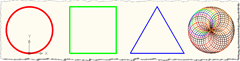
This topic started in this recent post, where I introduced a simple turtle graphics engine for AutoCAD implemented in C#. My eventual aim is still to implement a subset of the Logo programming language in F#, calling through to this C# engine, but for now I've been side-tracked: I'm simply having too much fun with the engine itself and exploring the possibilities of turtle graphics inside AutoCAD - especially around the use of recursive algorithms to generate fractals. This post and the next (and maybe more, depending on how much fun I continue to have) will be devoted to recursive…
-
Like many thirty-something Brits (and possible non-Brits, for all I know) my earliest introduction to the world of graphics programming was via a language called Logo running on the BBC Microcomputer. This machine and its educational software were commonplace in UK schools in the 1980s, and I have clear memories of staying late at primary school (which I suppose means I was somewhere between 8 and 10) to fool around with BBC BASIC. With a friend I used to try to write text-based adventures ("you are in a cave, there are exits North, South, East and West" - you know…
-
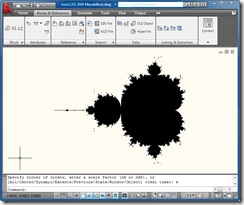
Some of you may remember my interest in fractals from these two previous posts. Well, while researching a problem in F# (related to the conversion of the last post's code to F#), I stumbled across this post from Luke Hoban, which contains some neat, recursive F# code to generate the Mandelbrot set, sending the result to the console as ASCII text. I couldn't resist modifying the code to generate Solids (filled shapes with 3 or 4 sides, as opposed to Solid3d objects) inside AutoCAD. Here's the F# code: #light module Mandelbrot #I @"C:\Program Files\Autodesk\AutoCAD 2009" #r "acdbmgd.dll" #r "acmgd.dll" #nowarn…
-
This post was almost called "Generating Koch fractals in AutoCAD using .NET - Part 3", following on from Parts 1 & 2 of the series. But by the time I'd completed the code, I realised it to be of more general appeal and decided to provide it with a more representative title. I started off by adding a progress meter and an escape key handler to the code in the last post. Then, while refactoring the code, I decided to encapsulate the functionality in a standalone class that could be dropped into pretty much any AutoCAD .NET project (although I've…
-
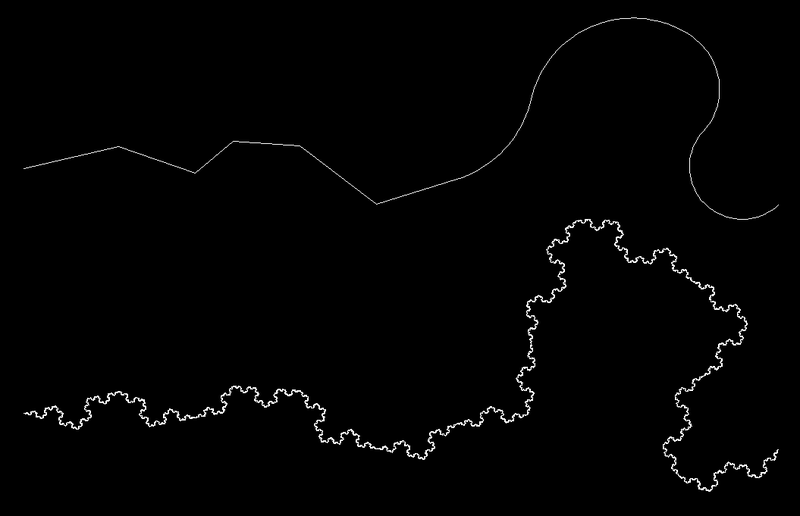
This post continues on from the last one, which introduced some code that creates "Koch curves" inside AutoCAD. Not in itself something you'll want to do to your drawings, but the techniques shown may well prove helpful for your applications. Last time we implemented support for Lines and Arcs - in this post we extend that to Polylines. These are a different animal, as rather than replacing the original entities with 4 times as many for each "level", in this case we add 3 new segments to each original segment. So we don't then mark the entities for erasure, either.…
-
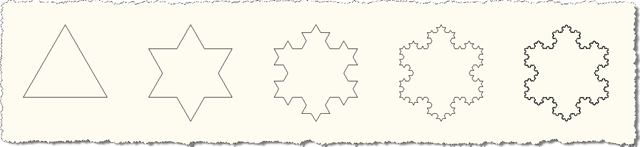
I'm currently waiting to get my RealDWG license through, so I'll interrupt the previous series on side databases to focus on something a little different. I'll get back to it, in due course, I promise. 🙂 A long time ago, back during my first few years at Autodesk (which logically must have been some time in the mid- to late-90s, but I forget now), I developed an ObjectARX application to create fractals from linear geometry. I first got interested in the subject when I stumbled across something called the Koch curve: a very basic fractal - in fact one of…