MX3D
-
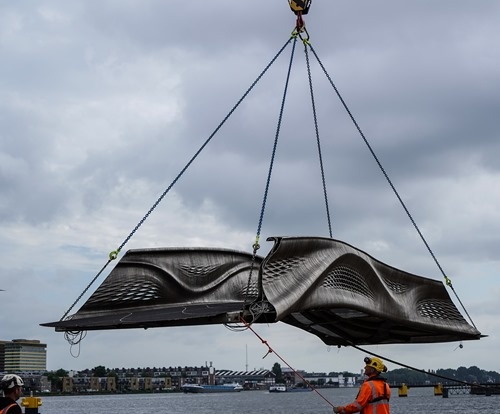
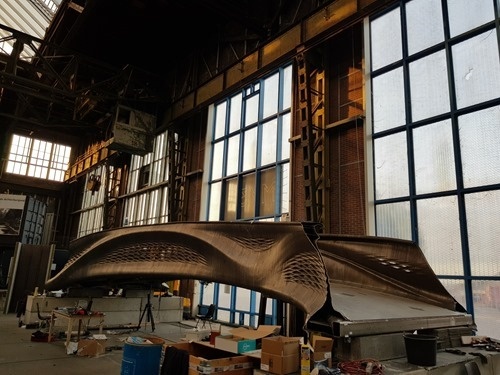
After having talked about its opening, and its data, it's time to wrap up this week's triptych of posts about the MX3D bridge by taking a moment to appreciate its beauty. The bridge has been printed from stainless steel and has not received any surface treatment – other than sandblasting and the manual removal of any jaggedness that might cause injury… the point is that there isn't a layer of paint or lacquer covering it. It's amazing to me (again, a software guy, so take this with a pinch of salt) that the bridge has this golden sheen. The reflectiveness…
-
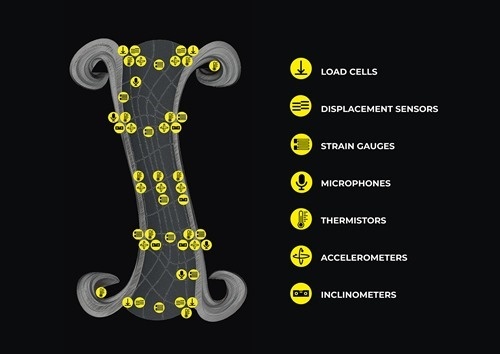
The MX3D team first showed the smart bridge to the public back in October 2018 at Dutch Design Week in Eindhoven. I was there with the team to finish and test features such as realtime display of skeletons detected using computer vision. Here's a reminder of how that went: An interesting aspect of the public's response to the bridge at DDW2018 was that it had broad appeal to people but that people appreciated different aspects of the project: The majority view: "wow, what a cool-looking bridge!" Those who dug a little deeper: "it was 3D-printed by robots? Interesting…
-
On Wednesday afternoon I headed back across to Zurich airport for my second trip to Amsterdam in as many weeks. This time I was flying with Swiss rather than KLM, and ended up checking in and boarding through an area of the airport I didn't recognise at all. Whether this was because it had been so long since I'd been there or due to some deep refurbishment being completed during the pandemic remains to be seen. By the time I arrived in Amsterdam, things had progressed significantly with the MX3D bridge. Here's a fun staged photo by Thijs Wolzak showing…
-
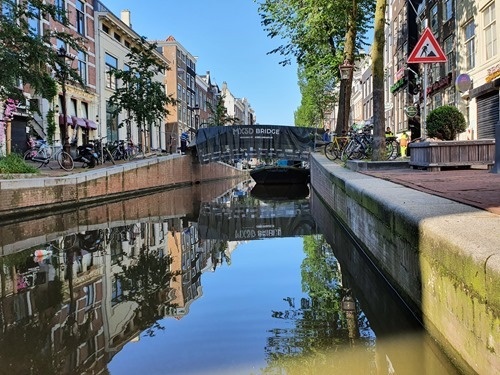
Now that the weekend has passed and the football is over for another year or so (for me, anyway, as I only pay attention to major tournaments), I thought I'd share some of the work that was done last week on the MX3D bridge, and what's planned for this coming week. The major work done on Friday was to raise the bridge (allowing access to the current foundations) and to start the job of lowering it. Sometimes you have to go up to go down. I was impressed by the fact the bridge could be raised – one end at…
-
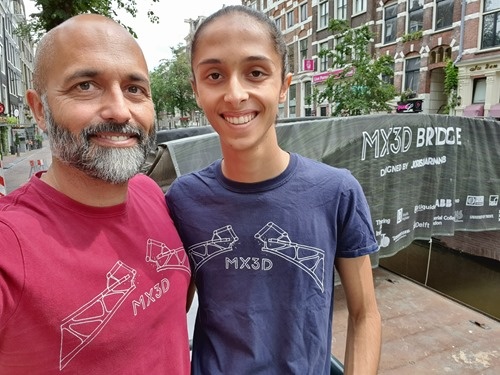
It's now Thursday night, and tomorrow morning we'll be heading home from Amsterdam. As with any project, some things haven't gone quite as smoothly as they might, but more on that in a bit. My son and I proudly donned our MX3D T-shirts for this morning's pic: Here's another shot from the bridge itself, looking down the canal. Now for some information about the main issue currently impacting the project. Here's a video I took while on the bridge, that shows a quick walkover and the canal views. As you can see, there's an issue with the clearance between the…
-
This weekend I had a very strange task to perform: I had to book travel for work. Remembering how our corporate travel system worked was just one hurdle to cross – beyond that I had to deal with getting the appropriate management and travel department approvals, along with the fact I've booked a separate ticket for my 16-year old son to come along, and wanted to be 100% sure that we're on the same flight. Was life really this complicated pre-pandemic? I'm sure I'll get used to it all again, before long. The reason I'm travelling is pretty exciting, at…
-
Over the next few posts – in this series, anyway – we're going to take a look at the shading of objects (actually meshes) using the Forge viewer's Data Visualization Extension (Project Hyperion). This is something we've done in Dasher for some time, and I was excited that using Hyperion would once again allow us not only to rip out some of our old code but also to go in new directions and explore interesting new capabilities. Let's first explain how this type of shading differs from what we've seen in previous posts, namely volumetric room and planar shading: simply…
-
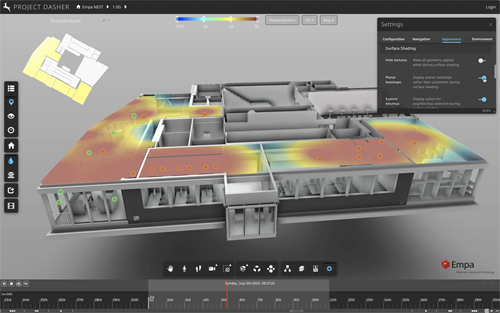
Having spent time recently looking at integrating sprites and volumetric room heatmaps into Dasher, today we move on to a capability that we didn't have previously but has been enabled by Project Hyperion (i.e. the new Data Visualization Extension for the Forge viewer): planar heatmaps. Planar heatmaps do just what you'd expect: they display a heatmap for 3D geometry in a plane. This means you can display a heatmap on the floor or ceiling of rooms, or place them on tables or work surfaces. They might – for instance – be used to indicate usage of an area, such as where…
-
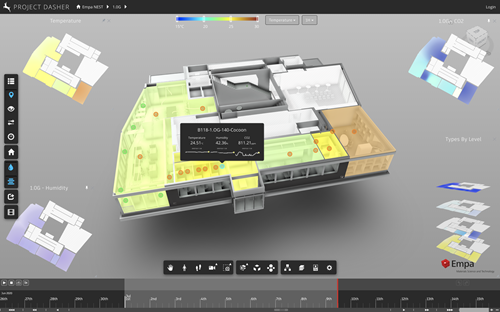
Today's post is a follow-on from the first part where we looked at integrating Hyperion sprites into Dasher. (The posts are independent, though, so you don't have to read the first one if you're only interested in integrating heatmaps.) I was supposed to publish this at the beginning of the week, but I ended up getting bogged down by a couple of urgent projects – both of which I'm happy to say have led to me making some interesting enhancements to Dasher, which is, at least, something. Anyway, the topic I wanted to share is the approach for integrating Hyperion's…
-
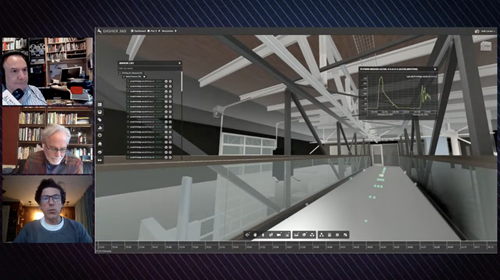
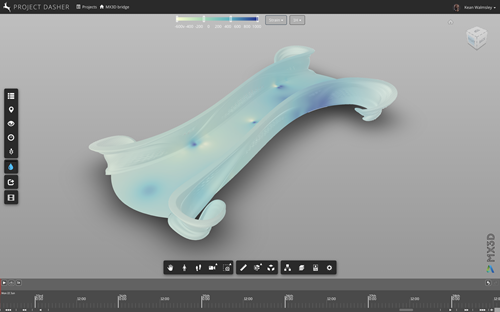
My friend and incredibly inspiring former colleague, Mickey McManus, has been co-hosting a regular (I want to say weekly) live-streamed event under the name of Quarantime. They've just posted the 51st episode (which means they must be doing this more than once per week) which featured another friend and current colleague, Alec Shuldiner. Alec has been the real workhorse driving forward the MX3D Smart Bridge project and Autodesk's involvement in it. He joined Quarantime to talk about the project in the context of our cities' future digital infrastructure. Here's a snapshot with Project Dasher as a backdrop: It's really a…