Happy New Year! I've just come back online after a wonderful (and much-needed) 2-week break. I hope those of you who were lucky enough to get time off at this time of year made the most of it and managed to spend some quality time with your loved ones. (I will admit that since the beginning of this year I've been spending a little time working on a really fun side project, so I can't say I've disconnected completely… but more on this later. 🙂
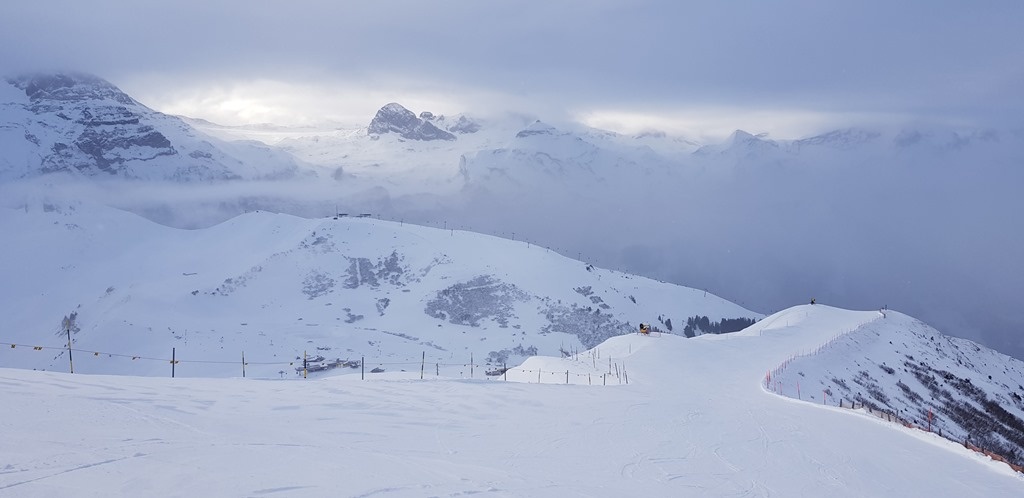
As I don't really have an image to accompany this post, here's a quick scenic shot I took on Saturday morning.
At this time of year people tend to reflect on the past 12 months – and sometimes make predictions for the coming 12 – so I'm going to indulge in a little of each, myself, in this post.
On a personal level, I have to say that 2018 wasn't great. Coming back from a wonderful 6-month trip with my family in the back stretch of 2017, I found myself saying goodbye to nearly 200 friends and colleagues during the course of the first 8 months of 2018 with the closure of our Neuchatel office. (For various reasons – whether to give people additional time or for business continuity – this was a long, drawn-out process, but the office doors finally closed at the end of August.)
On the other hand, professionally speaking I felt that 2018 was actually pretty amazing. I started the year by getting heavily involved in the Van Wijnen project, which exposed me to the core of our technology infrastructure for implementing Generative Design workflows for AEC (i.e. Dynamo + Refinery). This has led to some really interesting discussions with many Autodesk customers, and really leaves me excited about the future. My other hat – where I work on Dasher 360 – led for me to become involved in the MX3D smart bridge project, which is beyond cool. And the future where IoT meets Generative Design is one that I find immensely inspiring… I can't help but feel I'm exactly where I want to be, technologically speaking.
So, despite various headwinds (both personal and political), I do find reasons to be cheerful going into this new year. I'm personally going to think of 2019 as "the year of Generative Design", mainly because I think this is the year we're going to see the technology break through and get serious adoption across multiple industries. And I'm not the only one. By the way – as you read the title of this post, please do say the individual digits – "two-oh-one-nine" – as it makes for a much better rhyme. 😉
I genuinely believe this to be a once-in-a-generation, sea-change event. The vision Jeff Kowalski talked about at AU 2014 – where computers participate in the design process, rather than just being used to help document it – is really coming to pass. And the opportunity for people with the knowledge and skills to help make this happen is enormous. The tools themselves aren't complicated to start using: you need a visual programming environment (such as Dynamo) alongside an optimization framework (such as Refinery) – both of which are easy to get started with – and the demand for people with these skills is going to be off the charts. If you spend time learning one thing in 2019, I suggest making it Dynamo + Refinery (OK, well two things).
Anyway, that's it for my first post of 2-0-1-9. In the coming posts I'm going to talk a little about my project to connect Refinery with WebXR, with the eventual goal of being able to send candidate designs from Refinery to a set of consuming devices, whether Google Cardboard or higher-definition VR, phone-based AR or MR headsets such as HoloLens – in much the same way as we explored with Vrok-It – to allow stakeholders to better evaluate the geometry (and eventually the various metric scores) generated by the process. This is going to be a lot of fun.


Leave a Reply to Kean Walmsley Cancel reply