Generative design
-

This year has been strange at so many levels that it seems a bit petty to highlight one particular area. But preparing material for Autodesk University 2020 has certainly been one such area, and it's very fresh in the mind of AU speakers around the world. With this year's event being all digital, it's clear that the AU team had to find a way to get classes delivered remotely: one option would have been to live-stream them all, but at some point the decision was made to get everything pre-recorded for on-demand delivery. (On-demand classes are not the only way…
-
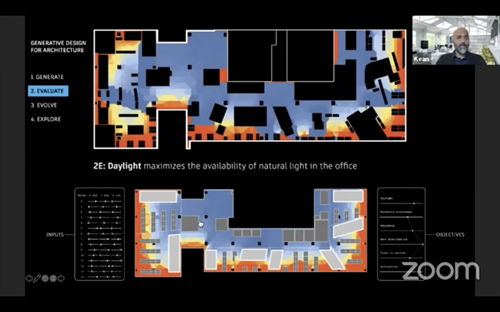
From one online conference to another. Here's the recording published by the Swiss Data Science Center for last week's SDSC-Connect event. I've set it to start at the beginning of my session – which in 30 minutes takes a whirlwind look at four generative design projects run by Autodesk Research – but the other sessions are also likely to be of interest to people, so feel free to scrub backwards! Next week I'll be busy recording my AU 2020 session and finishing up the handout. Here's a teaser for this year's all-digital event: I'm supposed to be on holiday, this…
-

Earlier this year, the Swiss Data Science Center kindly invited me to deliver a session on generative design at their October 1st SDSC-Connect event, entitled "Enhancing discovery and creativity with AI". A perfect umbrella topic for a session on GD! The event was originally going to be held in-person in Zurich, but with recent developments it became clear that it would have to be held online. This is bad and good, of course: it's bad because I won't get to meet attendees in person – and they sound like a really interesting group of people – and it's good because…
-
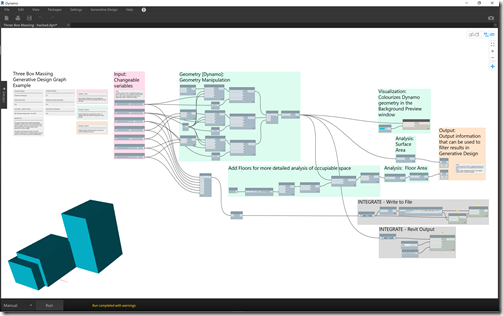
In the last post we saw how the Data.Gate node can be used to send geometry to Revit 2021 when the "Create Revit Elements" button gets pressed from the Explore Outcomes UI for a Generative Design study. Phew. In this post we're going to dig into how this node can also be used to have other "side effects" such as storing the various input parameters to a text file. For the purpose of this workflow I've chosen to hack the standard Three Box Massing.dyn graph (which ships with Revit 2021 as a sample for the Generative Design feature). The general…
-

I was inspired to write this post by a chat I had with Zachary Kron, earlier in the week. I'd been noodling on how best to support a workflow where users of the Generative Design feature in Revit 2021 can select specific solutions in a study and do something with them. The specific use-case was around some functionality I'd prototyped back during the days of Project Refinery, where while exploring the results created during a generative study you could double-click individual designs – whether in the scatterplot or the design grid – which would add them to a graphical dashboard…
-

I have the sense that I'm seeing my face too much at the moment (admittedly I'm very attached to it… haha). All I can say, in my defence, is that over the last few weeks I've started to receive more requests to participate in virtual activities. And I've mostly said yes, as it's a reasonable alternative to travelling to meet people, given the current circumstances we're all in. In case you haven't seen these various pieces of virtual content – and you're actually interested – here's a quick round-up of some current and future ones. Getting Simple When my friend…
-
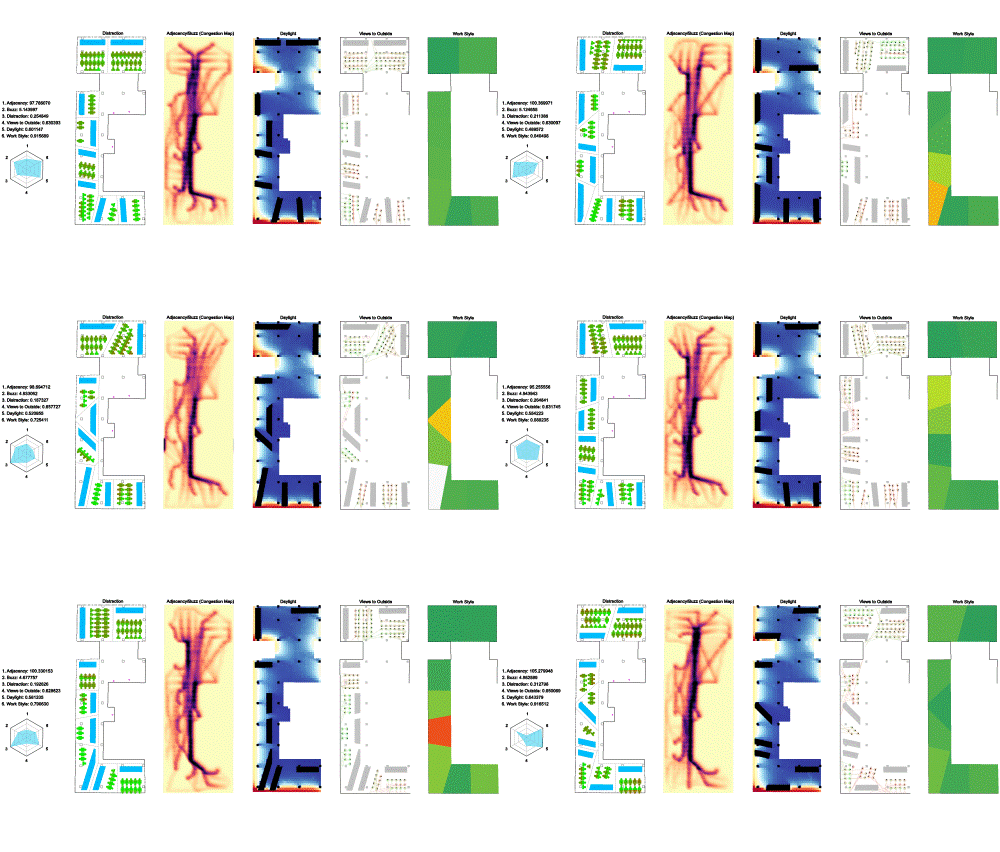
For the last few weeks I've once again been heads-down on Generative Design-related tasks after several months working almost exclusively on Dasher. I like switching context like this but it can certainly be a little disorientating, at first. Anyway, it's been really interesting working once again with my friends in the AEC Industry Futures team (the rockstars formerly known as The Living), and with Rhys Goldstein – the designer of the algorithms driving the Space Analysis package – on imagining a tool to help with post-COVID office layouts. Something I speculated about a little while ago, although that was before…
-

As a follow-up to the last post which talked about SimAUD and it's going online, today I wanted to mention some other online resources that might also be of interest to people during these times. The Institute of Technology in Architecture (ITA) at ETH Zurich is one of many institutions that have moved their public lectures online and have made them available for anyone to watch. So far I've watched a couple of them live, the second one being by my friend and former colleague, Matt Jezyk, who is now spearheading Tesla's efforts to streamline gigafactory design using techniques such…
-

Next week is the annual Symposium on Simulation for Architecture and Urban Design (SimAUD, pronounced Sim-Odd). This conference was started a decade ago by my former manager Azam Khan, along with Gabriel Wainer and Ramtin Attar. I've only had the pleasure of attending one SimAUD event – the 2018 edition was held in the Netherlands at TUDelft – but I was hoping/planning to attend this year's in Vienna: a paper submitted by Rhys Goldstein – with Simon Breslav , myself and Azam as co-presenters – was accepted for the conference. Here's a quick photo from a dinner we had in…
-
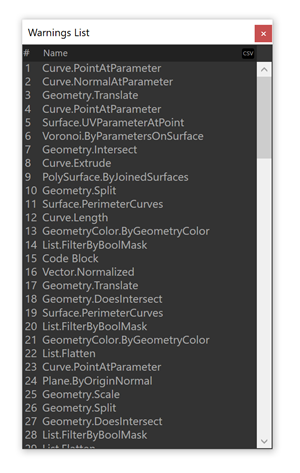
I've made some minor tweaks to a couple of my Dynamo packages, this week. One was to make sure Capturefinery – a tool that generates screenshots and animated GIFs for Refinery optimisation runs – works with the shipping release of Generative Design for Revit 2021 (it now does, but needed to look in a new directory structure). This is available from Capturefinery 0.9.11. The other was to add a feature to Warnamo – a tool that lists the warnings and errors in your Dynamo graph – to let you export the error list to Excel. This is available from Warnamo…