TEDx Portand talk on generative design and human augmentation

Following up from last week's post, which included a brief video showing where we're headed with generative design, today's post highlights a speech by my colleague in Autodesk's Office of the CTO (OCTO), Maurice Conti. I've mentioned Maurice before: he has an Applied Research team working on Pier 9 that is currently hiring a Machine Learning + Robotics researcher.
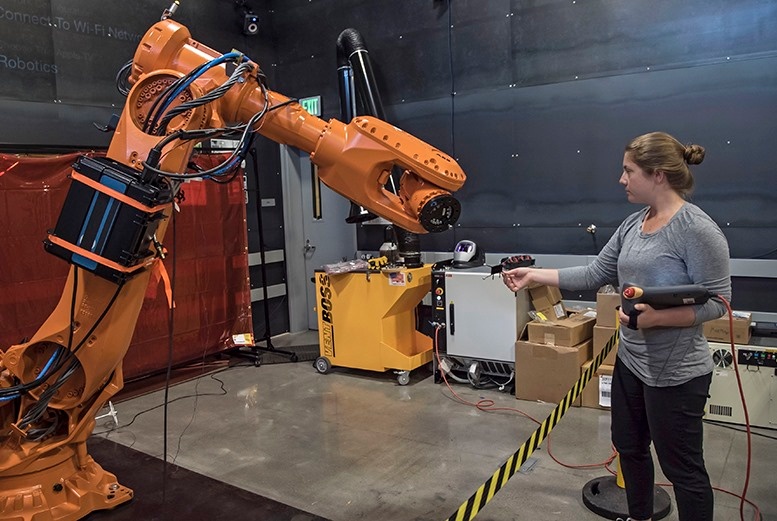
Taming robots

Maurice gave a speech at TEDx Portland entitled "The Future of Human Augmentation". It looks at how we're being augmented, not only by computational systems (helping us think) but by robotic systems (helping us make) and by a digital nervous system that connects us together.

He makes the case that change is accelerating by looking at the various eras that have defined human civilization:

  • The hunter-gatherer age lasted several million years
  • The agricultural age lasted several thousand years
  • The industrial age lasted a couple of centuries
  • The information age lasted a few decades
  • The augmented age is next

Presumably the age after is going to hit before the end of the decade and will last about 6 weeks. ๐Ÿ˜‰ In all seriousness, it's this rate of accelerating change that many believe will lead to The Singularity, which many more believe to be no joking matter. Interesting times are certainly ahead. At some point we'll even be able to start nesting new levels of simulated reality, rather than being a leaf on the tree that Elon Musk acknowledges almost certainly exists. But I digress.

Aside from mentioning โ€“ on the "design" side โ€“ Dreamcatcher and some projects using it, Maurice also talks โ€“ on the "make" side โ€“ about human-robot collaborations such as  and The Hive from AU 2015 and โ€“ on the "use" side โ€“ the ability for IoT to have bring significant benefits for designers and manufacturers: rather than spending all that energy making people want our stuff, we'll be able to spend it making stuff people actually want.

Here's the video:


I like Maurice's techno-optimist view of the world: despite having a penchant for post-apocalyptic science fiction, I'm also mostly optimistic about the role technology has to play in our future. I do believe advances in digitial fabrication (sometimes mentioned under the umbrella of Industry 4.0) are going to bring about significant change for many parts of society, one of the reasons I was disappointed by yesterday's overwhelming rejection of the universal basis income by the Swiss people. But the fact the vote happened at all is significant, so we'll see where things go.

What do you think? Is this where things are headed? Are you concerned that things are going to change for the worse? Let rip in the comments!

12 responses to “TEDx Portand talk on generative design and human augmentation”

  1. James Maeding Avatar

    Don't mind if I do ๐Ÿ™‚ I would say the next age is the interface age. NOT the cloud age. Also, the Civil BIM age (which has not happened yet). Mouse and keyboard are such a roadblock, as well as monitors at a desk. We need a decent verbal/body motion input system, and wearable monitors like google glass so we can make more use of the software available. The Civil BIM age seems like something I would say, since that is my industry, but really its is key to Autodesk's goals. They got BIM for architects by buying Revit, but they need to get the other half which is Civil. They need to redo their C3D pipeline objects, which would turn into many BIM objects like walls, channels, power lines, any utility or linear thing. They also need to get the data schemas published, and contained outside drawings. It may not even be profitable to redo that, but the muddying of the waters it is causing is hampering so many things, especially the efforts to get us to trust cloud and even automatic updates. You could do pipeline generative design if the pipeline objects were correct, I could walk you through it. So part of the next age needs to be longer term focused relationships with experienced industry people, at least on the civil side. Bentley has not got it right yet either. They get dynamicness, but not the "alignment based" objects thing. Whoever gets that right first will take over civil eventually, its so fundamental to our design process.

  2. Edward Mulder Avatar

    I definitely think this is where things are headed. Things could go either way, but we have unprecedented opportunity to make sure things go in a good direction. I'm like you Kean: I love post-apocalyptic science fiction, but am very much a techno-optimist. I believe that we will also need to apply things like blockchain technology (Ethereum for example) towards new economic and governance models for things to go right. This technology can be applied to universal basic income as well as other ideas out there. Perhaps the Swiss initiative was just a tad premature.

    I love the concept of the digital nervous system. Taking this even further and applying genetic design and machine learning, I can envision a world where software and hardware "operationally improve" themselves (for hardware this brings in the "make" side). Instead of depreciating, products and services could actually improve over time leading to the obsolescence of obsolescence (or closer to it anyway). Our creations will learn and grow along with us.

    I also see AI as the new meta interface via augmented/mixed reality, natural language, etc.I do not see the future as AI vs. human. I see augmentation and collaboration if we do this right. Human beings can actually stop being robots (not sure why people don't want this to happen) and return to being creative human beings with the fantastic twist of augmentation.

    I'm really glad to see you and people at Autodesk like Maurice and Jeff Kowalski helping to create this future!

    This was also a good video with Jeff Kowalski:

    youtube.com/wat...

    1. Kean Walmsley Avatar

      Thanks, Edward - I hadn't seen that link. I'll definitely give it a watch tomorrow.

      And I really appreciate your input, and not just because we're so clearly in alignment. ๐Ÿ™‚

      Kean

      1. Edward Mulder Avatar

        Thanks Kean! Following all of this very closely. Amazing possibilities ahead!

  3. James Maeding Avatar

    I started the video, but stopped a bit in as it was late. Him saying the computer did this "all by itself" is kind of the opposite of true. Good design automation is not the computer inventing anything. Some one had to tell it how to try multiple struts instead of one big one and so on. Sure, it tries the options we told it were allowed, but it seems computer power is being emphasized when really its a well designed automation system that deserves the credit. You gotta have the right object model before you tell the computer to try a million things.

    1. Kean Walmsley Avatar

      I don't think it's undervaluing the software, it's just that it's more that the advances in the computing platform have enabled the software to even be considered.

      Or it's because we're a software company and Maurice is being modest. ๐Ÿ™‚

      Kean

      1. James Maeding Avatar

        I think that is in the mechanical area mainly, where the speed is allowing the software to do new things. In other areas, its just that the software makers have not invested the time to make models that try things as they didn't need to business-wise. Certainly civil is that way.

    2. Edward Mulder Avatar

      Yes you tell the computer different options, but once you do it knows. Then you add more. I think the goal would be that over time it learns what works and when in different contexts via input from designers (curators) and digital nervous systems. Not unlike a child might learn music over time by continually adding techniques (tools/options) and hearing new genres. Eventually the child could begin to compose original material on their own. They begin to create and try new options by combining options they were taught. This is where I think generative design and machine learning will come together.

      1. James Maeding Avatar

        So how does a computer compose anything original? Think through that and you will be explaining how we told it what to do. I think the real terms here should be "computer bias development" and "better parametric model development". Don't let the marketing groups flatter the technical people when its not appropriate.

        1. Kean Walmsley Avatar

          The process is clearly guided by humans (although Machine Learning can also be used to evaluate aesthetics, although that's a whole nother discussion). The system's job is to explore the design space in a way the human wouldn't be able to. The human prunes the tree, as appropriate.

          Kean

  4. "The information age lasted a few decades"

    I would beg to differ with Maurice on that point. The information age is still in its infancy. The amount of information that exists in digital form today is minuscule compared to how much data is not yet digitized, and we are only just beginning to learn how to leverage it.

    1. Kean Walmsley Avatar

      I don't see one ending when the next begins (necessarily). Information is absolutely going to power augmentation (etc.).

      Kean

Leave a Reply to Edward Mulder Cancel reply

Your email address will not be published. Required fields are marked *