Dynamo
-

Rhys Goldstein, an Autodesk Research colleague with whom I've had the great pleasure of collaborating on various projects, over the years, has written an excellent explainer article that has just been published in Towards Data Science. This is intended as a companion to our paper published in the Journal of Artificial Intelligence Research, something I talked about in this recent post. Firstly, though, a quick shout-out to Zach Kron, who kindly allowed an image of one of his watercolours to be used in the article; one he created with the help of Dynamo and the Space Analysis package, which implements…
-
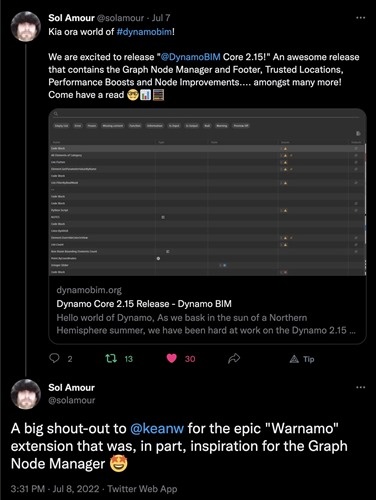
Dynamo 2.15 was released into the wild, last Thursday (at least via Dynamo Core, if not yet Dynamo for Revit), and as Sol Amour says in his blog post, it is "an absolutely epic release". I'd seen it flash by, but only sat up to take proper notice when Sol pinged me on Twitter to mention that includes capabilities inspired by Warnamo, a package I wrote to help keep track of warnings and errors in Dynamo. So I decided to dig into some of the new features – a great resource for this being the habitually comprehensive Dynamo release notes.…
-
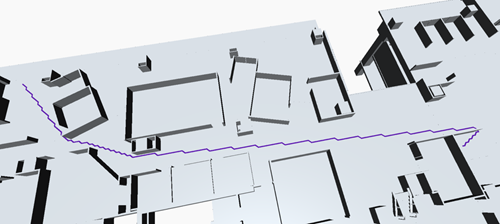
I'm very happy to share the news that a paper authored by current and former members of Autodesk Research has been published in the open access Journal of Artificial Intelligence Research (JAIR). The paper is entitled "Path Counting for Grid-Based Navigation" and talks in depth about the algorithm developed to power the Space Analysis package for Dynamo. Here's the paper's abstract, to tickle your fancy: Counting the number of shortest paths on a grid is a simple procedure with close ties to Pascal's triangle. We show how path counting can be used to select relatively direct grid paths for AI-related…
-

The Autodesk Construction Cloud team kindly shared a post on LinkedIn, last week, about a project I participated in. There's a new book from Springer on "Innovation in Construction" for which I contributed a chapter called "Cutting-Edge Practical Research on Generative Design, IoT and Digital Twins". This chapter weighs in at 29 pages – of an overall 454 for the book – and here's its abstract: This chapter explores two areas of research undertaken by Autodesk over the last decade and how they both have the potential to impact the construction industry. The first area relates to the Internet of…
-
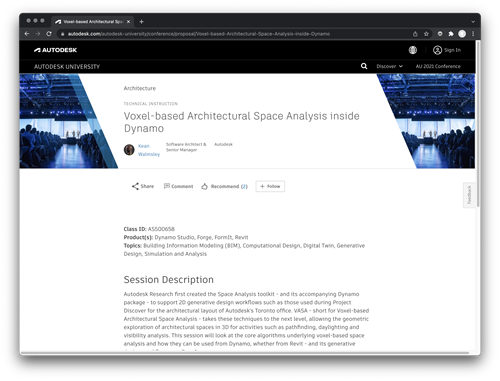
I've gone ahead and submitted two class proposals for Autodesk University 2022. If you think they should be part of this year's event, I'd certainly appreciate you voting for them: Voxel-based Architectural Space Analysis inside Dynamo Autodesk Research first created the Space Analysis toolkit - and its accompanying Dynamo package - to support 2D generative design workflows such as those used during Project Discover for the architectural layout of Autodesk's Toronto office. VASA - short for Voxel-based Architectural Space Analysis - takes these techniques to the next level, allowing the geometric exploration of architectural spaces in 3D for activities such…
-
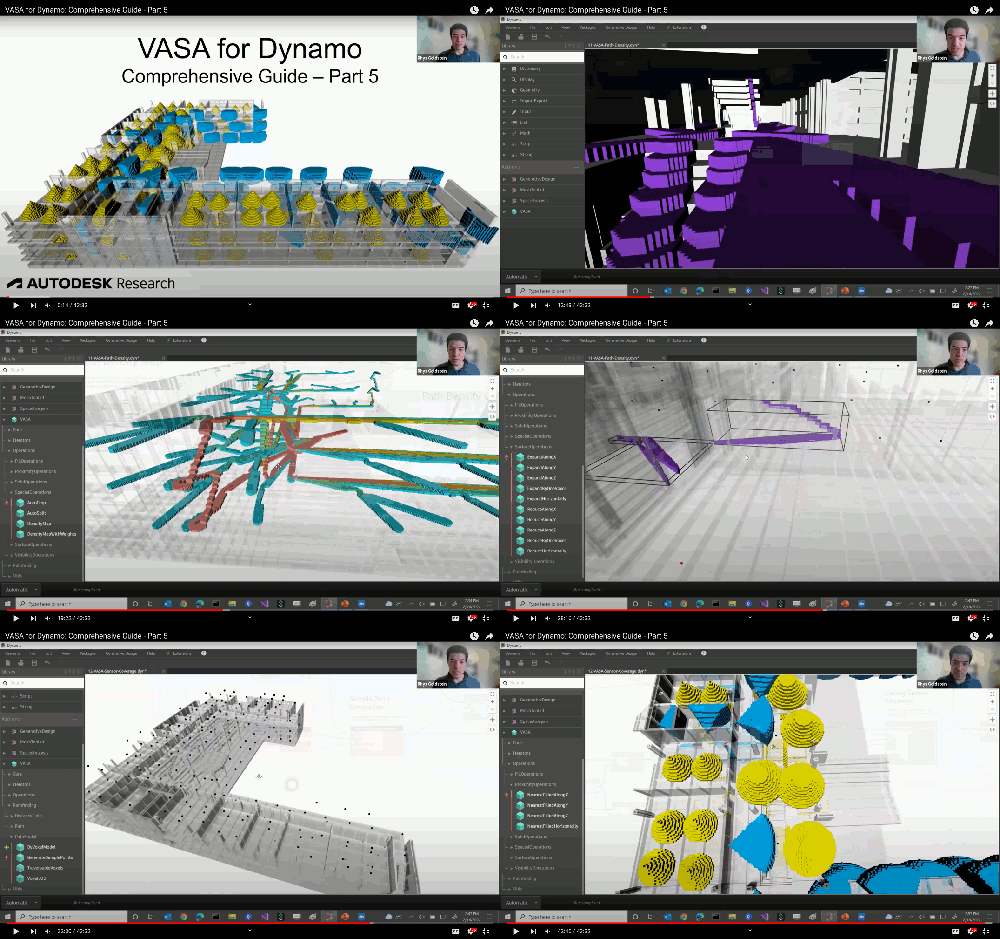
Rhys Goldstein has now published Part 5 in his video series on using VASA. In it, Rhys walks through the latest two samples that come with VASA 0.2.0, one of which I talked a bit about in a recent post. Both samples make use of sample points – one in the context of aggregating path information, while the other uses them (as we've seen) for sensor placement. Both workflows have significant potential for use in the context of generative design – something I hope to dig into at some point in another post. Hopefully you'll find this video…
-
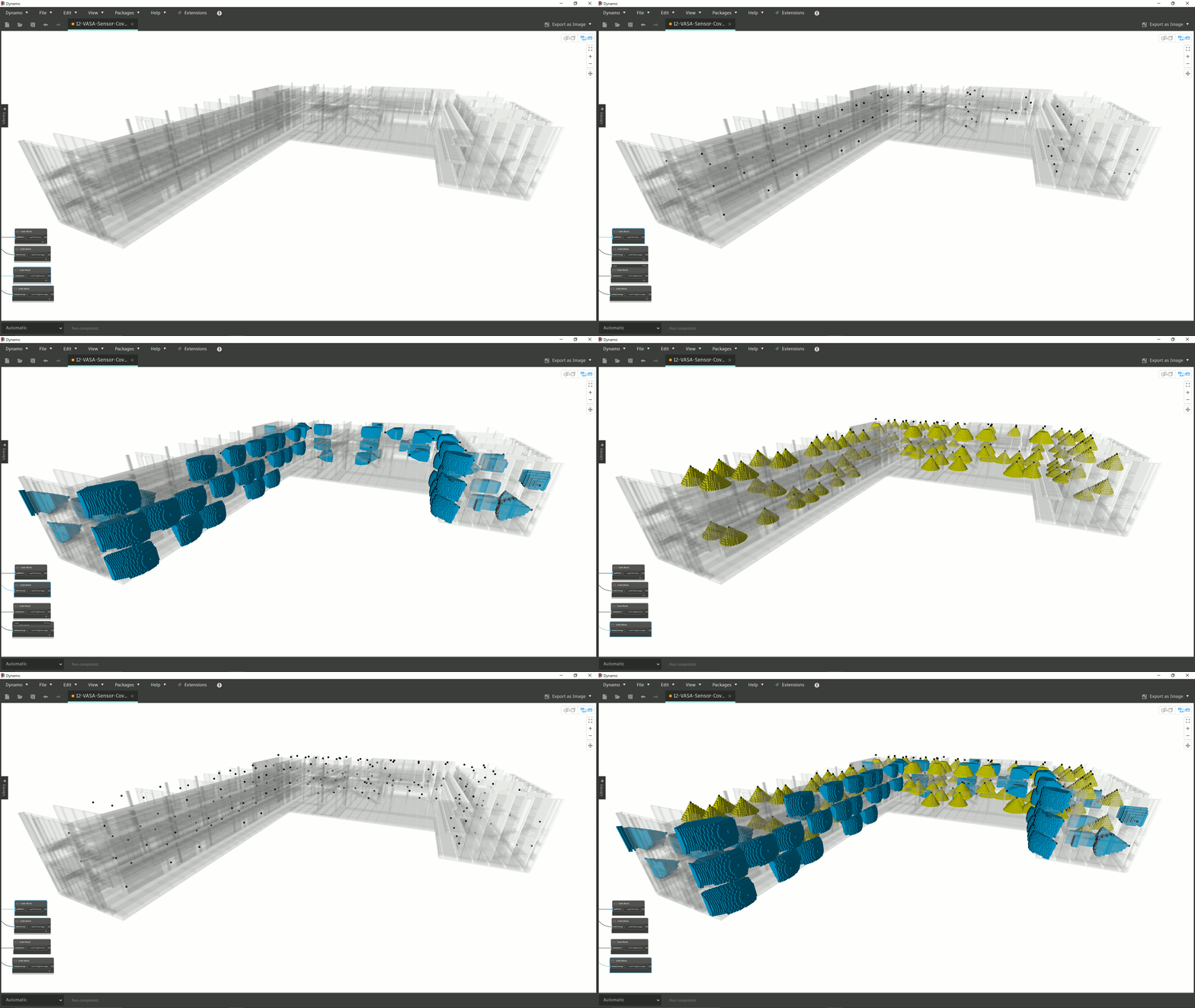
Last week I mentioned the release of VASA 0.2.0, which includes some new nodes and samples that raise some really interesting possibilities. I couldn't help but come back to the "sensor coverage" sample (named 12-VASA-Sensor-Coverage.dyn), in particular, as I can see so many possibilities for its use. Here's the description Rhys Goldstein included in the sample: A demonstration of how to combine sample point generation and proximity operations to select locations on walls and ceilings using the Voxel-based Architectural Space Analysis (VASA) package. In this example, the locations are used to place sensors and approximate their coverage. First, sample points…
-
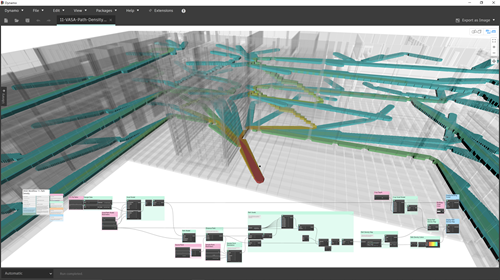
Rhys Goldstein has been busy implementing some new features in the Voxel-based Architectural Space Analysis (VASA) package. I've just published a new version to the Dynamo Package Manager containing the following enhancements: Added "PathModel.GenerateSamplePoints" and "DistanceField.GenerateSamplePoints", which generate sample points according to an approximate spacing parameter. Added proximity operations ("NearestFilledAlongX", "NearestFilledAlongY", "NearestFilledAlongZ", and "NearestFilledHorizontally"), which find the filled voxel nearest to a point. Added special operations ("AutoCrop", "AutoSplit", "DensityMap", "DensityMapWithWeights"), which automatically crop, split, and create density maps from voxel models. Added new examples ("11-VASA-Path-Density.dyn" and "12-VASA-Sensor-Coverage.dyn"), which demonstrate the new features. Fixed a bug in the fill from point…
-
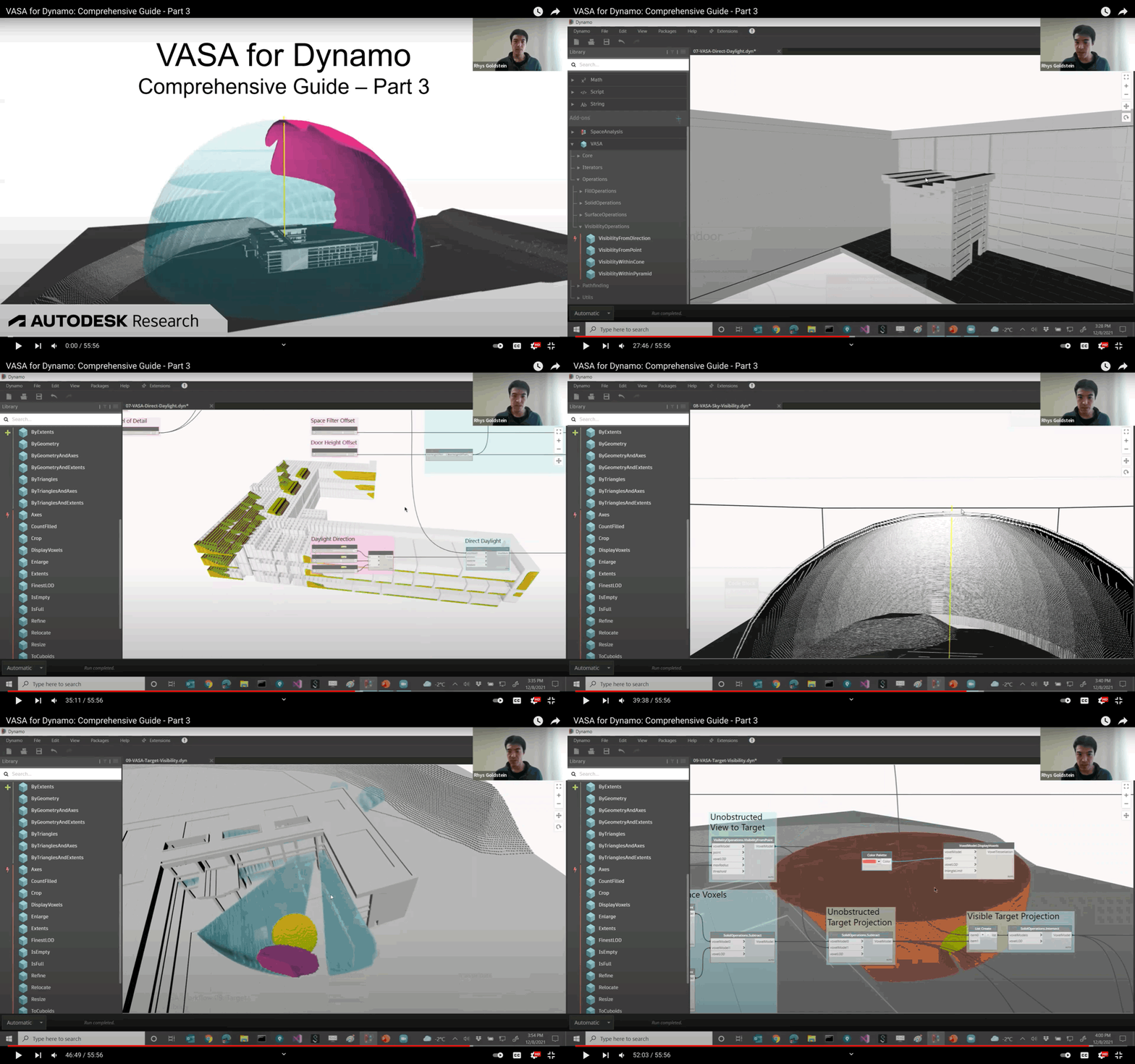
Rhys Goldstein has published the third part of his video series introducing capabilities of the VASA (Voxel-based Architectural Space Analysis) package for Dynamo. This part focuses on how VASA can perform visibility and daylighting analyses. Here's an animation showing some of topics covered: And here's the video itself: We're taking a break from this series now until the New Year, when Rhys will be sharing a walkthrough of the remaining VASA samples.
-
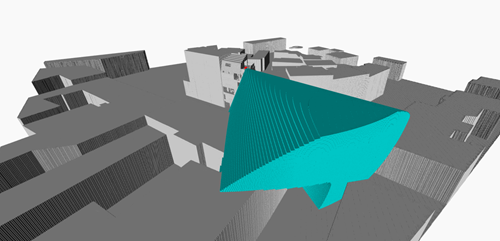
The first version of VASA we posted to the Dynamo package manager was numbered 0.1.0. Yesterday we posted a new version with some interesting new features, not least of which is the lack of an error when you install it (this one was very much my fault: I'd neglected to mark a couple of DLLs as not being node libraries when I posted it). Here's a breakdown of the new features in 0.1.2, courtesy of the package's author, Rhys Goldstein: Added VoxelModel.ToSolid, which converts a voxel model into a Dynamo solid that can be processed using standard Dynamo operations or…