Visual Studio
-
I don't normally talk about product offers, but then it occurred to me that some readers would find this promotion of interest. Microsoft is making Visual Studio 2008 available to first-time purchasers at the upgrade price, as long as they are using another development tool, including free tools such as Visual Studio Express Editions. It should go without saying that users of previous versions of Visual Studio are also eligible for this price (as long as they are not Visual Studio volume licensees). This means that - as long as you have downloaded and installed an Express version of Visual…
-
This comment came in from a developer on a previous post: We still do all our stuff w/C++/STL/COM/MFC; lots of custom entities and object behavior - for Civil 3D/Land Desktop/Map -- hence, I'm not Dot Netted. The predominate explanation I've heard to move from C++ to .Net is that UI is maybe easier to write...but we've had all that nicely standardized for years (although I could still strangle someone at MS at least once a week/month.) We tend to minimize external API use, whether ObjectArx/Win32/MFC, and try to have portable code. Granted, it's mostly Win32 dependent and perhaps lacks the…
-
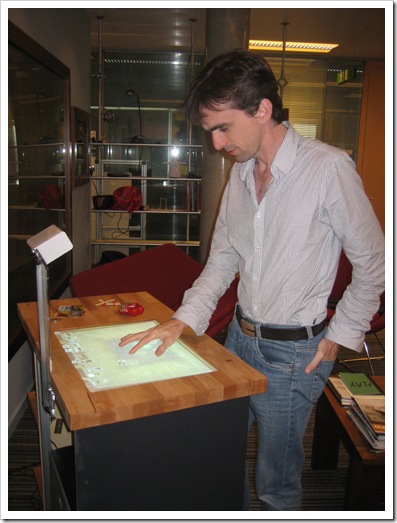
As mentioned in this previous post, I had the great pleasure of spending a day up at Microsoft Research in Cambridge last week. My host, Don Syme, took great care of me and was very generous with his time and knowledge. Some background on why I decided to request a meeting with Don: Don is the person behind F#, a new programming language that has, over the last year or so, transitioned from being a research project to a fully-fledged .NET language with full support in Microsoft's development tools. Expect to see the capability to create F# projects (just as…
-
This just may be the catalyst I needed to get around to installing Visual Studio 2008: the availability of the F# September 2008 Community Technology Preview. This takes F# an important step closer to being a full .NET citizen, with the first release delivered by Microsoft's Developer Division (the previous releases having been delivered by Microsoft Research). It's not required to use VS 2008 with this release of F#, but that's the version that's been targeted for the IDE integration, naturally enough. I've been holding off from installing VS 2008 for some time - mainly as ObjectARX applications still require…
-
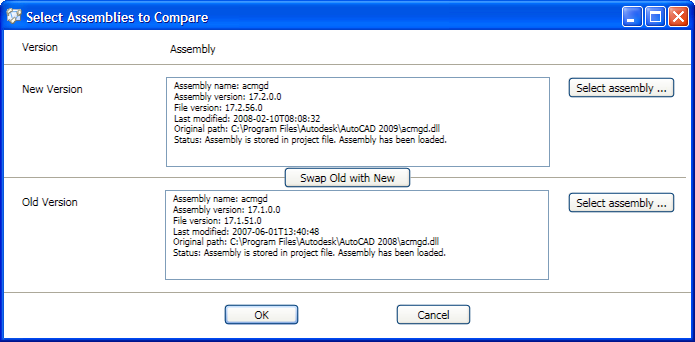
A member of our AutoCAD Engineering team pointed me at this very cool tool - the Framework Design Studio. The wiki doesn't really do it justice, so here's a post describing what the tool does. I also found it a little trick to get to the download, so here's the latest version at the time of posting. So what's so cool about this tool, as a developer working with AutoCAD? It seems as though the tool was primarily intended to allow platform developers to identify when their changes impact API compatibility, but it's also useful for developers working on a…
-
I've mentioned before how much I appreciate the content on MSDN's Channel 9. For those of you who are familiar with C# 1.0, but haven't yet taken the time to dive into the language features introduced since then, I strongly recommend the "whirlwind" series posted on Channel 9. Here's a quick description of what these whirlwinds are all about: Whirlwinds are bite-sized webcasts, each is shorter than 15 minutes. You can start anywhere in the series to learn about the parts you're most interested in. Here are links to the individual whirlwinds: What's new in C# 2 Whirlwind 1 -…
-
I've talked about Lutz Roeder's Reflector tool a couple of times and it's proven to be very useful to me, once again. I mentioned in my last post about some problems I was having with tail recursion, and my choice to replace certain recursive functions with iterative versions. Today we're going to use Reflector to take a look under the hood of some compiled assemblies, to determine which recursive functions have been optimised correctly and which have not. Let's start by taking a look at the two recursive functions I mentioned last time, starting with the most simple: // A…
-
A quick post, for now, just to point you to this blog: http://blogs.msdn.com/sburke/archive/2008/01/16/configuring-visual-studio-to-debug-net-framework-source-code.aspx This will only work with Visual Studio 2008, it seems, so I haven't yet tested this out myself (I tend to be a laggard when it comes to Visual Studio, for some reason). A quick note on what I've been up to in my spare time: I'm currently diving deeply into F#, to prepare for some internal presentations I'll be giving in February. As part of the exercise I went up to the attic and dusted off the 3.5" floppies containing my old final year project from…
-
Jeremy Tammik, from our DevTech EMEA team, pointed me to this useful and interesting site: http://www.yoda.arachsys.com/csharp/benchmark.html It introduces a very easy way to benchmark functions in your application by simply tagging them with a [Benchmark] attribute (you also need to have included the C# file posted on the above site in your project, of course). Jeremy also highlighted a very pertinent paragraph in the above site: Use local variables where possible. The CLR can do a more optimisations on code which doesn't (for the most part) "escape" from just local variables. For instance, it doesn't need to worry about other…
-
In parts 1 & 2 of this series we looked at metaprogramming with AutoCAD using AutoLISP and VB(A), and then using VB.NET and C#. In this post we're going to look at what's possible from F#, through the lens of my relative inexperience with the language, of course. The quotations mechanism in F# appears to be the way to represent, analyse and execute program structure. This article describes the concepts, although it's quite deep and doesn't address the case that's most immediately interesting to AutoCAD develeopers: the ability to evaluate and execute code represented as a string. In fact, this…