Visual Studio
-
My apologies to those expecting more on IP protection in .NET - I ended up deciding to make this interim post regarding a longstanding issue. I'll get right back to the IP question next (I hope :-). Back in a much earlier post we looked at getting the ObjectARX & Managed Wizards working with the Express editions of Visual Studio. While it was successful enough with C++ Express, VB and C# Express proved to be trickier animals - as was clear from the long thread that followed the post. Anyway, Cyrille Fauvel, the principle author of various Visual Studio Wizards…
-
Thanks to Fernando Malard for suggesting part of this topic in response to an issue he submitted through ADN support. Windows applications that make use of the .NET Framework can be configured via a ".config" XML file found in their executable's main directory (for more specifics, please see this MSDN article). In AutoCAD's case, this file is called acad.exe.config, and is found in c:\Program Files\AutoCAD 2007 (for instance). The default contents of this file for AutoCAD 2007 are: <configuration> <startup> <!--We always use the latest version of the framework installed on the computer. If you are having problems then…
-
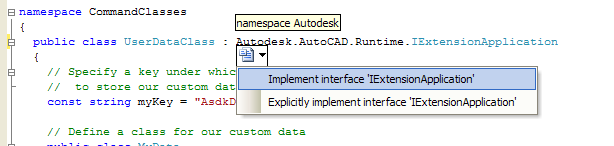
A colleague of mine in one of our Engineering teams just shared this tip that I'm in turn sharing with you... I was implementing an override of the abstract class Autodesk.AutoCAD.DatabaseServices.DwgFiler, which has about 40 abstract functions that have to be overridden. Since there are no header files in C#, I couldn't just cut and paste all the signatures as a template, like I would in C++. As I was manually typing in each signature, I noticed that Intellisense was keeping track of which signatures I had already accounted for. I thought… if it can do that, why can't it…
-

I had a nice surprise this weekend. Jorge Lopez, an old friend and colleague, had been reading this blog entry and decided to create a Visual Studio AddIn that allows you to see resbufs content expanding automatically while debugging. Jorge and I go back a long way - he used to work in DevTech (before it was called that) in our Americas team, back when I was based in Europe the first time. He later went on to join AutoCAD Engineering, and was one of the key contributors to AutoCAD's COM Automation API (although back then it was called either…
-
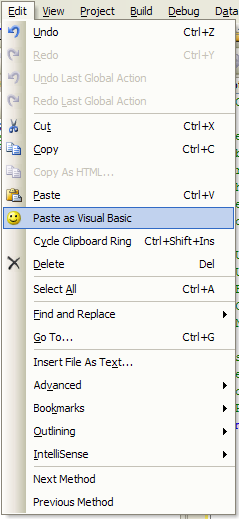
I won't tell you just how bored I've been getting while "post-processing" the HTML created when I copy/paste code from Visual Studio into this blog's editing interface. My aim is simply to maintain a certain amount of the formatting provided in Visual Studio (font, syntax colouring and indentation would be great, but I end up settling for the last two, and only then after a lot of HTML editing). So I decided to take a look at what tools might be out there on the web to help with this. The first tool I found wasn't what I wanted, but…
-
While debugging it's sometimes very frustrating to find yourself repeatedly stepping into an irrelevant function. For instance, complex statements pretty commonly include object constructors etc. that you know function perfectly well, but the debugger routinely takes you into them. The Visual Studio IDE has an undocumented (and unsupported) mechanism to help with this. During the VC 6.0 timeframe it was implemented via our old friend the autoexp.dat file (see my previous post on this), in a special section called [ExecutionControl]. Since VC 7.0 this has been moved to the Registry. For VC 7.0 and 7.1, it was in the HKCU…
-

I've been using Visual C++ (and afterwards Visual Studio) since it was 16-bit, back in version 1.52. OK, maybe that's not so long ago, relatively (11 short years), but the point is that in spite of having followed the Visual Studio technology over this period, I've so far been completely unaware of the autoexp.dat file. This feature of the Visual Studio was brought to my attention by Ahsan Ali, a programmer in the Inventor Engineering team who was based over in Bangalore at the same time I was (we had both previously worked in the US - he had come…
-

Most of our desktop products support a "plug-in" model of development: you create a DLL (which may or may not be renamed with a number of extensions, such as DBX or ARX) which gets loaded into the calling executable's memory space. This allows the process to share memory with the loaded modules, improving performance over the more archaic IPC (inter-process communication)-based architectures. [Here begins retracted information...] While Visual C++ Express Edition supports debugging DLL projects using an external executable, Visual C# Express and Visual VB.NET Express Editions do not. When developing with our products it is extremely common to launch…
-
This topic was suggested by one of our ADN members - Paul Richardson, from CAD System Engineering - and answered by Cyrille Fauvel, from DevTech EMEA. So all I really had to do was copy/paste and some minor editing... now that's my kind of blogging. 🙂 The ObjectARX Wizard's installer targets the Microsoft Visual Studio 2005 platform rather than the Microsoft Visual C++/C#/VB.NET Express Editions. The main reasons for this are the limitations of the Express Editions' IDE - particularly due to its lack of support for AddIns. The ObjectARX Wizard is actually made up of a number of components:…