APS (Forge)
-
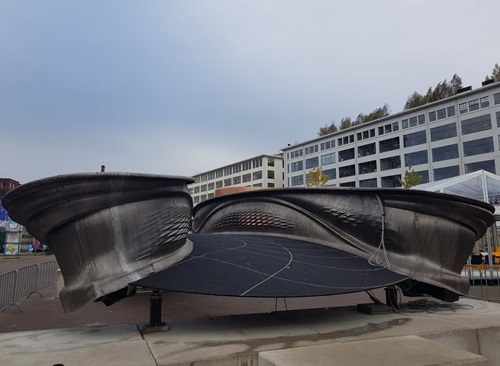
On Sunday I flex across to Amsterdam, once again, this time to take the train down to Eindhoven for Dutch Design Week. Alex Tessier and Michael Lee – colleagues who had barely recovered from the last trip across before coming back to help the project with one last big push – had arrived a few days before me. When we got to the bridge – on oversized cycles borrowed from the hotel but clearly intended for giants – the sky was still a little overcast. Alex and Mike got cracking on fixing some stray sensors and connectors. Our "home" for…
-
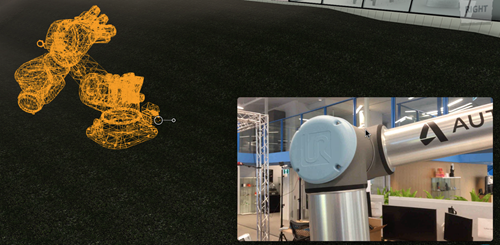
This week I spent quite a bit of time talking to people about digital twins that include skeletons and robots. For skeletons I've been working off real data from static JSON files – not yet time-series database-resident – but for robots I've just been relying on simulated movements. Until today, that is. Josh Cameron, an Autodesk Research colleague in Toronto, sent through a video he took of a robot while streaming its data to our time-series back-end. This helped me interpret the data (reasonably) correctly, at least for a first pass. You'll notice the virtal robot is a different model…
-
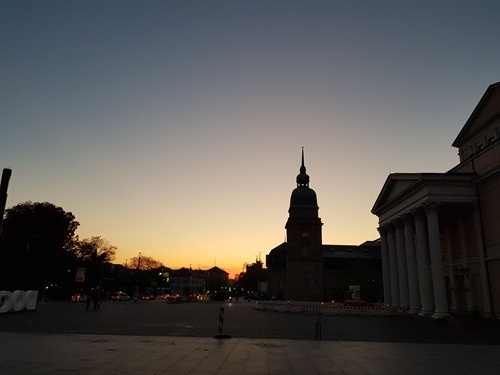
It's been a whirlwind few days. The trip up to Darmstadt on Monday went relatively smoothly: I had to take four trains to get there, and only missed one connection (the one in Frankfurt, but thankfully I could hop on another train and arrive just 10 minutes later than planned). Still, the nearly 6 hours of train passed reasonably smoothly. After arriving in Darmstadt I met with Sander Lijbers and Tony Thuy, who'd organised to host some customers from the Netherlands. We went for dinner at a nice restaurant serving local food. When in Germany, eat schnitzel! It was a…
-
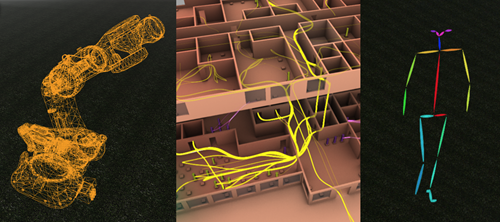
Well, this just happened: after having had three generative design-related classes accepted for AU 2018 (well, really two were accepted and one ended up getting a repeat slot at the Connect & Construct pre-conference), I wasn't due to talk about anything I've been doing lately with the Forge viewer. Which frankly was a shame, because between robots, skeletons and streamlines, as feel as though I've got lots of fun stuff to share, at the moment. That was until yesterday, when I got pinged by Stephen Preston (for the US DevCon) and Cyrille Fauvel (for the European one), to ask if…
-
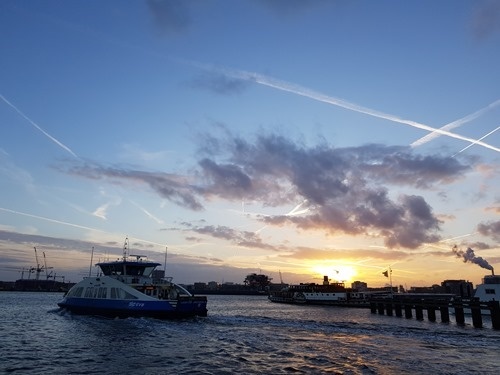
I've spent most of this week in Amsterdam with colleagues from the Toronto office. Our group descended on the MX3D offices in the funky NDSM wharf area of the city, to make a big push and help get the world's first robotically 3D-printed steel bridge – and its supporting systems – ready for Dutch Design Week. Most of the team stayed in a hotel right next to MX3D, but we did get the chance to take the ferry across to "the mainland" (it isn't really: everything is connected, it just seems that way) from time to time. It was really…
-
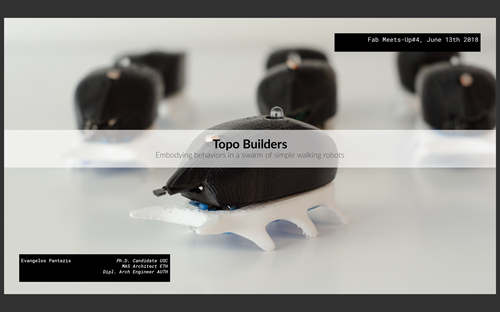
My world seems to be filled with robots, these days, whether seeing how they can be used in architecture and construction, animating them inside Forge, or seeing them 3D print steel bridges (I'm at MX3D again, this week). It makes me think I should probably dust off my HoloLens app for making robots dance in mixed reality: once we're using data inside the Forge viewer-powered Dasher 360 to show the position of a robot at a particular moment in time, it's hardly a huge leap to show that in XR. Anyway, I should get to the point… Given this current…
-

The inspiration for this post has come from a variety of sources. (Feel free to skip this preamble where I talk about the history of the project: as much as anything it's so I remember myself how things happened when I come back to this post at some point in the future. 😉 My colleague, Simon Breslav, worked on an initial implementation in Dasher 360 that animated robots – and even mapped stress information to their surfaces – for a demo shown at AU 2017, back when I was travelling around the world with my family. One of the issues…
-
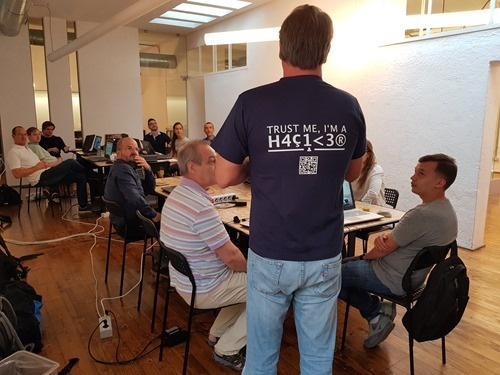
It's been a great few days in Rome, at the Forge team's first ever Roman accelerator. Things kicked off on Monday morning, as we occupied the conference room at Rimond's office in Rome's Trastevere district. As is usual at these events, there are a number of companies doing really interesting things: several of them have specifically mentioned Dasher 360 as their inspiration for visualizing additional (even IoT) data in the Forge viewer. Very cool. Yesterday I joined Peter Schlipf to visit Roma Tre University, where we spent some time with Stefano Converso from the Architectural Design department, as well as…
-

We're just a few weeks away from the 2nd European edition of the Forge DevCon. It's being held in Darmstadt on October 16th, the day before this year's AU Germany. This is a free, English-language* event where you can learn all about the capabilities that are currently (and will soon be) available through the Forge platform. (* I've seen a number of emails asking whether the event will be in German or English, presumably due to its proximity with a German-language event. I can confirm that the entire program will be in English.) Here are some "reasons to attend", provided…
-
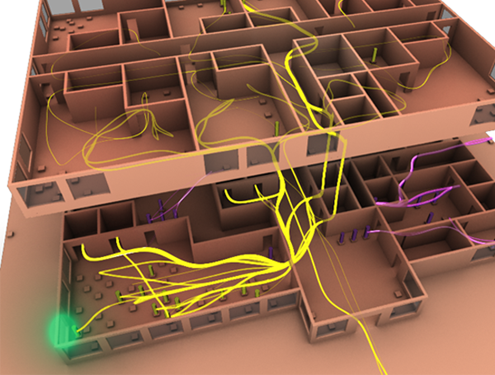
The integration of the MeshLine library into the Forge viewer – which we're using for the display of skeleton data, as we saw last time – has opened the door to displaying all kinds of other cool stuff. Back in 2014 colleagues in Autodesk Research published a SimAUD paper entitled "Towards Visualization of Simulated Occupants and their Interactions with Buildings at Multiple Time Scales". It explored the use of various visualization techniques to display how a building's simulated occupants interact with it. One of these techniques was called Speedlines (we also use the term Streamline): The original visualizations were created…