Autodesk
-
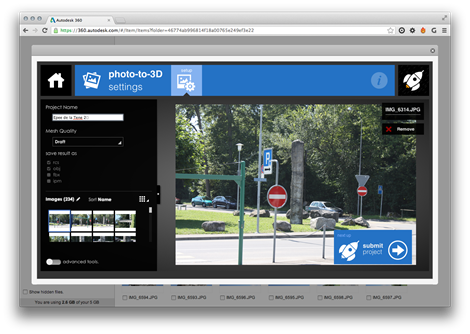
You're hopefully by now familiar with 123D Catch – a technology I've talked about before, a consumer-focused tool for reconstructing 3D models from photos – but Autodesk is also providing a professional-grade version of the system on Autodesk 360 called Autodesk ReCap Photo. To get access to the trial version of this tool, simply log in to Autodesk 360 and upload some photos of the scene you'd like to capture. You can then multi-select the photos, right-click and select "Create 3D model". You'll be presented with the "photo-to-3D settings" window that allows you to enter the name for the project…
-

I arrived yesterday morning in Singapore, coming in on a Singapore Airlines A380 from Zurich. It was a great flight, as far as long-hauls in economy go: comfortable seats with a great choice of films to watch (my favourite on this leg being "The Cloud Atlas", an excellent adaptation of a brilliant novel lent to me by Jeremy Tammik a couple of years ago). I even managed to catch an hour or two of sleep, which is surprising for a daytime flight, even if it landed at 6am local time in Singapore. I rested for a few hours at the…
-
For those of you who may have missed it, I really like the Morgan Motor Company, and in particular the latest incarnation of their iconic Morgan 3 Wheeler. Which is why I was very happy to see it featured during Autodesk's recent 2014 launch event: What's fascinating to me is the use of a high-tech design process to create something – which is then built by hand, with a wooden chassis – that has such a low-tech, no frills driving experience: I'm also a big reader of science fiction, so the idea of donning steampunk aviator goggles and leather helmet…
-

I'm excited to announce some revolutionary new technology our "reality capture" team is working on at Autodesk. By now many people will be familiar with the Rip-Mod-Fab workflow (the 3D equivalent of Rip-Mix-Burn for music). The problem with this is that there's something fundamental missing from the equation: that most aromatic of dimensions, the world of odours. How many of you have used 123D Catch to copy a real-world object, printing it using with MakerBot, only to find something missing? That once you've got over the utter coolness of being able to print something in three dimensions, you're somehow left…
-
In this previous post, we looked at using PointCloud Browser to visualize an AR scene containing a mesh generated by 123D Creature, a new iPad app from Autodesk. In this post, we head on over to Autodesk Labs to take Project Pinocchio for a spin. Project Pinocchio is an online character generator that helps you "create, customize, and download your very own rigged 3D characters from a catalog of over 100 body types, outfits, hairstyles, and physical attributes in a few simple steps." Once you've signed in, it's a simple process to create a character. You start by choosing your…
-

A few weeks ago, we looked at using PointCloud Browser to visualize simple spherical primitives brought down from a web-service, as well as creating a simple AR game to obliterate them. Visualizing (and popping) spheres is all well and good, but clearly it'd ultimately be much more interesting to visualize more complex objects in an AR scene. The good news is that PointCloud Browser supports loading models from .OBJ files, a format generated by a number of Autodesk products – particularly those used in the Media & Entertainment space. I'm not a big user of 3ds Max or Maya, and…
-

As I had to meet someone at Geneva airport, this morning, I decided to kill two birds with one stone and spend a few hours visiting the 83rd International Motor Show. The show opened its doors to the public, today, and includes such stunning vehicles as the $4.6 million Lamborghini Veneno: Yes, that wasn't a typo. This car would set you back the best part of $5 million. Ouch. I went quickly past most of the stands, though, and spent most of my time at Morgan Motor Company's. As I've mentioned before, MMC is a big user of Autodesk software.…
-
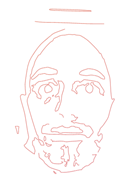
I clicked on through to the Chrome Web Lab from the Google home-page, yesterday. It contains some cool "experiments" that showcase the capabilities of modern web-browsers (and presumably Google Chrome, in particular). The one that especially caught my interest was number 3, the Sketchbots experiment: The experiment starts with an uploaded photo or – and this is what I did, in my case – a snapshot taken from your system's webcam. Some image processing and computer vision techniques then get applied to it – essentially to perform edge detection and convert those edges to vectors – and the resultant sketch…
-
This one did the rounds over the holiday and so I expect many of you will have missed it (unless you also happen to read Jeremy's blog). I'm still finishing up some work that I'll hopefully be able to unveil during the coming weeks, and I thought I'd post this in the meantime. Autodesk Research has published a pretty amazing visualization of Autodesk's organizational evolution over a period of four years, from May 2007 to June 2011. Like many nodes in the tree who remained static during that particular period, it can come as a bit of a surprise to…
-
Congratulations to fellow Autodesker, Jeremy Sawicki, on claiming first prize in the ICFP (International Conference on Functional Programming) Programming Contest 2012. In his day job, Jeremy is a fellow software architect on the Revit team, although to win this prestigious competition Jeremy clearly functions at a much higher order (yes, that was actually a functional programming joke, right there ;-). To find out more about the task and Jeremy's solution, watch this video (Jeremy's team – Frictionless Bananas, of which Jeremy was captain and sole member – is introduced at around the 24m mark and talks about his implementation from…