F#
-
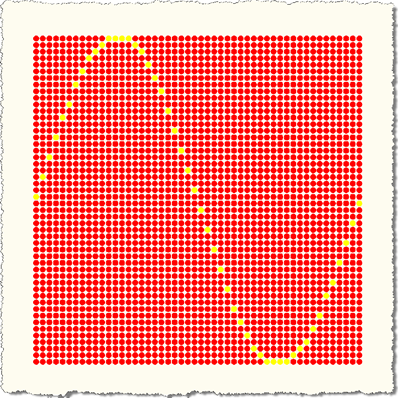
Well, I couldn't resist... as I mentioned in the last post - where we looked at creating a simple graph inside AutoCAD as an example of modifying objects inside nested transactions - the idea of graphing inside AutoCAD is a good fit for F#. This is for a number of reasons: F# is very mathematical in nature and excels at processing lists of data. I also spiced it up a bit by adding some code to parallelise some of the mathematical operations, but that didn't turn out to be especially compelling with my dual-core laptop. More on that later. Here's…
-

Firstly, I'd like to wish you all a very Happy New Year! I've just taken three consecutive weeks of vacation for the first time in years, and it's done me the world of good. In fact I'm also on holiday this week but am easing back into the rhythm of things, and have decided to get back into the blogging saddle, while I'm at it. Thanks for your patience during the interruption in service. 🙂 So to start 2009 with a bang (or a pop, at least) I'm going to run a programming contest. The basic idea is to generate…
-
This post continues on from Part 1 of this series. You'll find much of this content has been used before in these previous posts, although post does include content updated for F# 1.9.6.2 (the September 2008 CTP). The first thing we need to do is – as with any AutoCAD .NET project – add project references to AutoCAD's managed assemblies, acmgd.dll and acdbmgd.dll. With F#'s integration into Visual Studio 2008 you do this in exactly the same way as you would for a C# or VB.NET project, by selecting Project -> Add Reference... from the pull-down menu or right-clicking the…
-
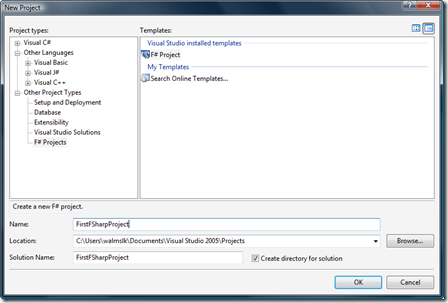
As mentioned in my previous post, I've been beavering away on the handout for a new class I'm delivering at this year's Autodesk University. Here is the first part of this handout. Introduction F# is a new programming language from Microsoft, due to become a first-class .NET citizen (joining its siblings C# and VB.NET) and fully integrated with Visual Studio 2010. In this class we'll introduce many of the concepts behind the F# language, and look at examples where we use it to create applications inside AutoCAD. At the time of writing, F# is available as a Community Technology Preview…
-
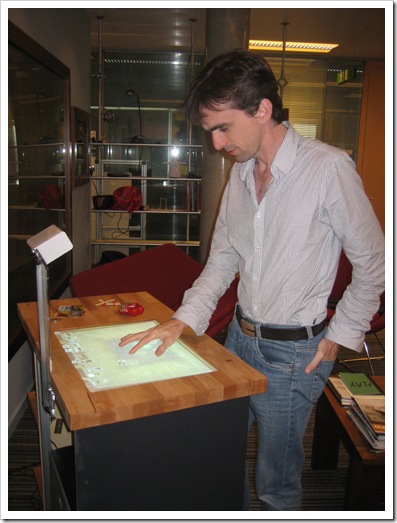
As mentioned in this previous post, I had the great pleasure of spending a day up at Microsoft Research in Cambridge last week. My host, Don Syme, took great care of me and was very generous with his time and knowledge. Some background on why I decided to request a meeting with Don: Don is the person behind F#, a new programming language that has, over the last year or so, transitioned from being a research project to a fully-fledged .NET language with full support in Microsoft's development tools. Expect to see the capability to create F# projects (just as…
-

Thanks to all who have provided feedback on my recent interview with John Walker. Here is a PDF of the complete series for those who would rather use that format for offline viewing (please think twice before printing all 27 pages, though). The interview proved to be a very interesting activity - even more so than I had anticipated - and so I've decided to try a few more. I'm in no danger of making a career of this (don't worry) but I'm finding it an interesting diversion to meet and talk with people who have important information to share…
-
This just may be the catalyst I needed to get around to installing Visual Studio 2008: the availability of the F# September 2008 Community Technology Preview. This takes F# an important step closer to being a full .NET citizen, with the first release delivered by Microsoft's Developer Division (the previous releases having been delivered by Microsoft Research). It's not required to use VS 2008 with this release of F#, but that's the version that's been targeted for the IDE integration, naturally enough. I've been holding off from installing VS 2008 for some time - mainly as ObjectARX applications still require…
-
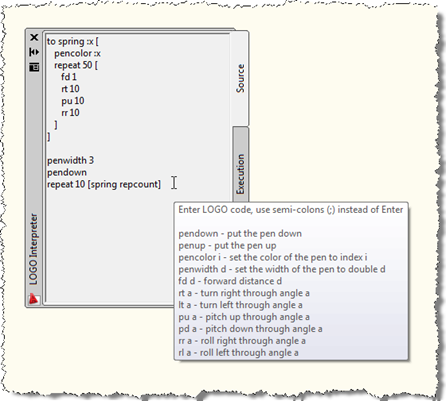
I've been threatening to implement this for a few posts, now, so I decided it was finally time for me to put my money where my mouth is. 🙂 This post extends the series I've been writing on turtle graphics (here's the most recent part, from which you'll find links to its predecessors). This series has been about developing a turtle graphics engine using C#, eventually extending it for 3D. The series so far has focused very much on the engine, but from very early on it was my intention to use this engine to implement a subset of the…
-
The class schedule for Autodesk University 2008 has been published on Joseph Wurcher's BLAUG. Here are this year's Developer Track sessions (although they may end up being categorized under "Customization & Programming", along with a host of other interesting classes from external presenters). You'll see a number of speakers listed, both from my team (DevTech) and our various Engineering teams (who I've highlighted in italics below). I'm personally presenting three classes: two will be more-or-less the same as last year (here are the handouts for There's More to DWG™ than AutoCAD®, Parts 1, 2 and 3 and Enrich Your DWF™,…
-
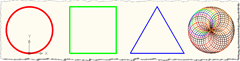
Like many thirty-something Brits (and possible non-Brits, for all I know) my earliest introduction to the world of graphics programming was via a language called Logo running on the BBC Microcomputer. This machine and its educational software were commonplace in UK schools in the 1980s, and I have clear memories of staying late at primary school (which I suppose means I was somewhere between 8 and 10) to fool around with BBC BASIC. With a friend I used to try to write text-based adventures ("you are in a cave, there are exits North, South, East and West" - you know…
