F#
-
I've submitted three sessions for this year's Autodesk University: Getting to know AutoCAD's Plugins of the Month (a 60-minute virtual class, session ID 1681) Synopsis: The Autodesk Developer Network (ADN) team has been publishing "Plugins of the Month" on Autodesk Labs for over a year. Each of these plugins extends an Autodesk products in a useful or interesting way, and is provided with full source code! Attend this session for an introduction to the various AutoCAD plugins that have been published (with a brief mention of those published for other products). We will take a detailed look at the source…
-
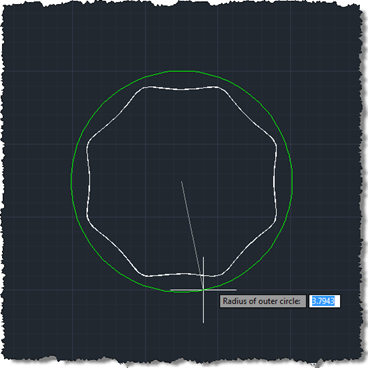
This one is a bit of an experiment: our first "fun" Plugin of the Month (fun in that it doesn't serve a serious work-related purpose that I can think of :-). I've post earlier versions of the code to this blog, but thought I'd post and share the latest & greatest. Scott has kindly announced the plugin's availability already over on It's Alive in the Lab. This is our first Plugin on the Month written in F#, which means an additional DLL needs to be copied with the plugin itself. Other than that the application should work just as if…
-
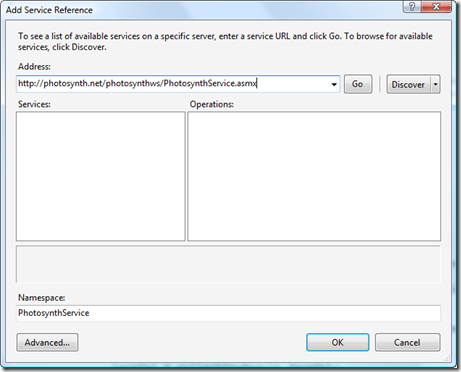
In the previous posts in this series we introduced a command that downloaded and imported point clouds from Photosynth.net, we introduced a WinForms user interface on top of it and then replaced that UI with one implemented using WPF. As threatened last time, we're now going to make some efficiency improvements in the original command implementation. In our previous implementation we were blindly asking for files, one after the other, and using failure to indicate when we'd reached the end. Which was fine, but it limited us in a few ways: we could not reliably parallelize this otherwise highly parallelizable…
-
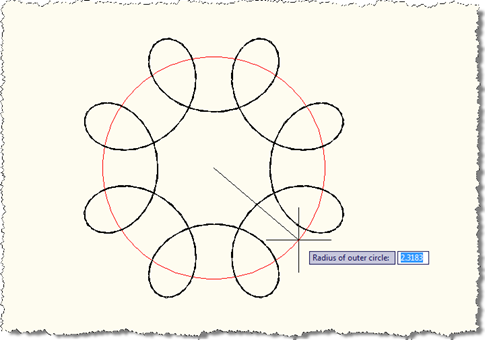
Last week we looked at a preliminary version of this application that made use of an EntityJig to display a Spirograph as we provided the values needed to define it. While that was a good start, I decided it would be better to show additional graphics during the jig process, to give a clearer idea of the meaning of the information being requested from the user. I wanted, for instance, to show temporary circles indicating the radii of the outer and inner circles, mainly to make it clearer how the various parameters affect the display of the resultant Spirograph pattern.…
-
This week I'm going to posting a few topics related to F#, as it feels as though I've been neglecting it, of late. And as this technology is going to hit the mainstream very soon – when Visual Studio 2010 ships – it seems all the more important to keep one's F# skills honed. We're going to start the week with an F# equivalent to the code shown in this previous post, where we go through and reflect on the commands exposed by an assembly in order to create corresponding demand-loading Registry keys automatically. We've shipped VB.NET and C# versions…
-
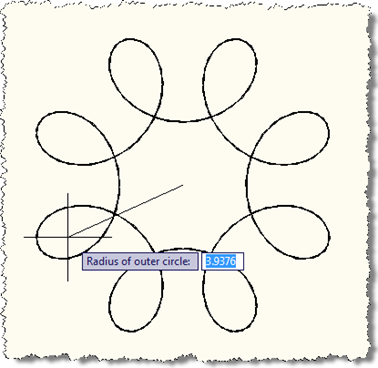
After my initial fooling around with turning AutoCAD into a Spirograph using F#, I decided to come back to this and bolt a jig on the front to make the act of making these objects more visual and discoverable. The process was quite interesting – I'd created jigs from Python and Ruby, but not from F#, so this was a first for me. It's also a multi-stage jig, which is fun: we acquire the outer radius of the pattern followed by the radius of the smaller circle and the distance of the pen from the smaller circle's center. At each…
-
I've arrived at the end of my AU+East Asia tour, having spent the last 2 weeks in Las Vegas, San Francisco, Tokyo, Seoul and now Beijing. My blog is blocked by the Great Firewall of China, so while I can post this content via Typepad I can't see the results (although I'm told I should be able to VPN into our Singapore office to bypass this restriction – I'll give that a try, later on). Later today (and today is currently Friday December 11th in China 🙂 you should be able to gain access to the sessions I delivered at…
-
I've now crossed the international date line (giving up a big portion of my weekend, but that's life) and landed in Tokyo. Tomorrow I head on to Seoul and then to Beijing for the end of the week. In many ways a change of pace from the week in Vegas, but in other ways it's more of the same (fun, that is :-). In this previous post we looked at some code to retrieve and process RSS information from various blogs using an agent-based message passing architecture. The code wasn't completely asynchronous or parallelised, though, as we fired off each…
-
For any Autodesk Developer Network members who have not already signed up for AUv, in the upcoming edition of our DevNews newsletter you'll find a discount code allowing you to received a free Premier Pass for AU Virtual (normally worth $99). If you don't know who in your organisation receives DevNews, please send us an email with your ADN number and we'll get you the information. And if you do manage to attend, please do join one of my F# sessions (here are some other AutoCAD-related AUv sessions, and I know Jeremy's also delivering one on Revit families).
-
If you're curious about the AU Virtual experience (perhaps you've signed up and are wondering what it's going to be like, perhaps you're thinking about signing up but would like to know what you're getting into, or perhaps you have no intention whatsoever of signing up but just want to know what 13,000+ other people are going to be doing next week 🙂 then check out this video: And if you end up attending AUv, I'm sure there are plenty of virtual seats left in my F# class! 🙂