As mentioned, last week, I've been working away to port my previous OpenNI/NITE AutoCAD-Kinect integration across to the official (although still in Beta) Microsoft Kinect SDK.
Today's post presents a very basic implementation – essentially equivalent to the code in this previous post – which makes use of the Microsoft Kinect SDK to bring a colourised point cloud into AutoCAD. As in the previous post, the txt2las tool is still currently needed to bring the generated point cloud into AutoCAD.
It's worth noting that the Microsoft SDK is a) much simpler to install/deploy and b) provides more reliable colourisation of the point cloud than I was able to get from OpenNI (at least at the time). The previous approach simply took pixels from each of the depth and RGB images and mapped the colour directly onto the 3D point. But as there are a few centimeters between the two cameras on the Kinect device, this was ultimately inadequate.
The Kinect SDK provides a function – NuiCamera.GetColorPixelCoordinatesFromDepthPixel() – which does a more reliable (although admittedly a bit slower) colour mapping.
It should also be noted that the Microsoft Kinect SDK provides more accurate mapping of depth data into 3D space (or "skeleton" space", in the parlance of this particular SDK). The points we get in AutoCAD are actually measured in metres (or fractions thereof). We'll see how accurate this is, later on.
The big chunk of work, for this particular example, was to implement the equivalent of the GeneratePointCloud() method that Boris Scheiman had kindly implemented for me in his nKinect library. This new version uses the aforementioned SDK methods to generate an accurate – and accurately-colourised – point cloud.
Here's the C# code showing a basic reimplementation of the previous KINECT command:
using Autodesk.AutoCAD.ApplicationServices;
using Autodesk.AutoCAD.DatabaseServices;
using Autodesk.AutoCAD.EditorInput;
using Autodesk.AutoCAD.Geometry;
using Autodesk.AutoCAD.Runtime;
using AcGi = Autodesk.AutoCAD.GraphicsInterface;
using System.Collections.Generic;
using System.Diagnostics;
using System.Reflection;
using System.IO;
using System;
using Microsoft.Research.Kinect.Nui;
namespace KinectIntegration
{
// Our own class duplicating the one implemented by nKinect
// to aid with porting
public class ColorVector3
{
public double X, Y, Z;
public int R, G, B;
}
public class KinectJig : DrawJig
{
// A transaction and database to add polylines
private Transaction _tr;
private Document _doc;
// We need our Kinect sensor
private Runtime _kinect = null;
// With the images collected by it
private ImageFrame _depth = null;
private ImageFrame _video = null;
// A list of points captured by the sensor
// (for eventual export)
private List<ColorVector3> _vecs;
// A list of points to be displayed
// (we use this for the jig)
private Point3dCollection _points;
// An offset value we use to move the mouse back
// and forth by one screen unit
private int _offset;
public KinectJig(Document doc, Transaction tr)
{
// Initialise the various members
_doc = doc;
_tr = tr;
_points = new Point3dCollection();
_offset = 1;
// Create our sensor object - the constructor takes
// three callbacks to receive various data:
// - skeleton movement
// - rgb data
// - depth data
_kinect = new Runtime();
_kinect.VideoFrameReady +=
new EventHandler<ImageFrameReadyEventArgs>(
OnVideoFrameReady
);
_kinect.DepthFrameReady +=
new EventHandler<ImageFrameReadyEventArgs>(
OnDepthFrameReady
);
}
void OnDepthFrameReady(
object sender, ImageFrameReadyEventArgs e
)
{
_depth = e.ImageFrame;
}
void OnVideoFrameReady(
object sender, ImageFrameReadyEventArgs e
)
{
_video = e.ImageFrame;
}
public void StartSensor()
{
if (_kinect != null)
{
// We still need to enable skeletal tracking
// in order to map to "real" space, even
// if we're not actually getting skeleton data
_kinect.Initialize(
RuntimeOptions.UseDepth |
RuntimeOptions.UseColor |
RuntimeOptions.UseSkeletalTracking
);
_kinect.VideoStream.Open(
ImageStreamType.Video, 2,
ImageResolution.Resolution640x480,
ImageType.Color
);
_kinect.DepthStream.Open(
ImageStreamType.Depth, 2,
ImageResolution.Resolution640x480,
ImageType.Depth
);
}
}
public void StopSensor()
{
if (_kinect != null)
{
_kinect.Uninitialize();
_kinect = null;
}
}
public void UpdatePointCloud()
{
_vecs = GeneratePointCloud(true);
}
private List<ColorVector3> GeneratePointCloud(
bool withColor = false
)
{
// We will return a list of our ColorVector3 objects
List<ColorVector3> res = new List<ColorVector3>();
// Let's start by determining the dimensions of the
// respective images
int depHeight = _depth.Image.Height;
int depWidth = _depth.Image.Width;
int vidHeight = _video.Image.Height;
int vidWidth = _video.Image.Width;
// For the sake of this initial implementation, we
// expect them to be the same size. But this should not
// actually need to be a requirement
if (vidHeight != depHeight || vidWidth != depWidth)
{
Application.DocumentManager.MdiActiveDocument.
Editor.WriteMessage(
"\nVideo and depth images are of different sizes."
);
return null;
}
// Depth and color data for each pixel
Byte[] depthData = _depth.Image.Bits;
Byte[] colorData = _video.Image.Bits;
// Loop through the depth information - we process two
// bytes at a time
for (int i = 0; i < depthData.Length; i += 2)
{
// The depth pixel is two bytes long - we shift the
// upper byte by 8 bits (a byte) and "or" it with the
// lower byte
int depthPixel = (depthData[i + 1] << 8) | depthData[i];
// The x and y positions can be calculated using modulus
// division from the array index
int x = (i / 2) % depWidth;
int y = (i / 2) / depWidth;
// The x and y we pass into DepthImageToSkeleton() need to
// be normalised (between 0 and 1), so we divide by the
// width and height of the depth image, respectively
// As we're using UseDepth (not UseDepthAndPlayerIndex) in
// the depth sensor settings, we also need to shift the
// depth pixel by 3 bits
Vector v =
_kinect.SkeletonEngine.DepthImageToSkeleton(
((float)x) / ((float)depWidth),
((float)y) / ((float)depHeight),
(short)(depthPixel << 3)
);
// A zero value for Z means there is no usable depth for
// that pixel
if (v.Z > 0)
{
// Create a ColorVector3 to store our XYZ and RGB info
// for a pixel
ColorVector3 cv = new ColorVector3();
cv.X = v.X;
cv.Y = v.Z;
cv.Z = v.Y;
// Only calculate the colour when it's needed (as it's
// now more expensive, albeit more accurate)
if (withColor)
{
// Get the colour indices for that particular depth
// pixel. We once again need to shift the depth pixel
// and also need to flip the x value (as UseDepth means
// it is mirrored on X) and do so on the basis of
// 320x240 resolution (so we divide by 2, assuming
// 640x480 is chosen earlier), as that's what this
// function expects. Phew!
int colorX, colorY;
_kinect.NuiCamera.
GetColorPixelCoordinatesFromDepthPixel(
_video.Resolution, _video.ViewArea,
320 - (x/2), (y/2), (short)(depthPixel << 3),
out colorX, out colorY
);
// Make sure both indices are within bounds
colorX = Math.Max(0, Math.Min(vidWidth - 1, colorX));
colorY = Math.Max(0, Math.Min(vidHeight - 1, colorY));
// Extract the RGB data from the appropriate place
// in the colour data
int colIndex = 4 * (colorX + (colorY * vidWidth));
cv.B = (byte)(colorData[colIndex + 0]);
cv.G = (byte)(colorData[colIndex + 1]);
cv.R = (byte)(colorData[colIndex + 2]);
}
else
{
// If we don't need colour information, just set each
// pixel to white
cv.B = 255;
cv.G = 255;
cv.R = 255;
}
// Add our pixel data to the list to return
res.Add(cv);
}
}
return res;
}
protected override SamplerStatus Sampler(JigPrompts prompts)
{
// We don't really need a point, but we do need some
// user input event to allow us to loop, processing
// for the Kinect input
PromptPointResult ppr =
prompts.AcquirePoint("\nClick to capture: ");
if (ppr.Status == PromptStatus.OK)
{
// Generate a point cloud
try
{
if (_depth != null && _video != null)
{
_vecs = GeneratePointCloud();
// Extract the points for display in the jig
// (note we only take 1 in 5)
_points.Clear();
for (int i = 0; i < _vecs.Count; i += 20)
{
ColorVector3 vec = _vecs[i];
_points.Add(
new Point3d(vec.X, vec.Y, vec.Z)
);
}
// Let's move the mouse slightly to avoid having
// to do it manually to keep the input coming
System.Drawing.Point pt =
System.Windows.Forms.Cursor.Position;
System.Windows.Forms.Cursor.Position =
new System.Drawing.Point(
pt.X, pt.Y + _offset
);
_offset = -_offset;
}
}
catch {}
return SamplerStatus.OK;
}
return SamplerStatus.Cancel;
}
protected override bool WorldDraw(AcGi.WorldDraw draw)
{
// This simply draws our points
draw.Geometry.Polypoint(_points, null, null);
return true;
}
public void ExportPointCloud(string filename)
{
if (_vecs.Count > 0)
{
using (StreamWriter sw = new StreamWriter(filename))
{
// For each pixel, write a line to the text file:
// X, Y, Z, R, G, B
foreach (ColorVector3 pt in _vecs)
{
sw.WriteLine(
"{0}, {1}, {2}, {3}, {4}, {5}",
pt.X, pt.Y, pt.Z, pt.R, pt.G, pt.B
);
}
}
}
}
}
public class Commands
{
[CommandMethod("ADNPLUGINS", "KINECT", CommandFlags.Modal)]
public void ImportFromKinect()
{
Document doc =
Autodesk.AutoCAD.ApplicationServices.
Application.DocumentManager.MdiActiveDocument;
Editor ed = doc.Editor;
Transaction tr =
doc.TransactionManager.StartTransaction();
KinectJig kj = new KinectJig(doc, tr);
try
{
kj.StartSensor();
}
catch (System.Exception ex)
{
ed.WriteMessage(
"\nUnable to start Kinect sensor: " + ex.Message
);
tr.Dispose();
return;
}
PromptResult pr = ed.Drag(kj);
if (pr.Status != PromptStatus.OK)
{
kj.StopSensor();
tr.Dispose();
return;
}
// Generate a final point cloud with color before stopping
// the sensor
kj.UpdatePointCloud();
kj.StopSensor();
tr.Commit();
// Manually dispose to avoid scoping issues with
// other variables
tr.Dispose();
// We'll store most local files in the temp folder.
// We get a temp filename, delete the file and
// use the name for our folder
string localPath = Path.GetTempFileName();
File.Delete(localPath);
Directory.CreateDirectory(localPath);
localPath += "\\";
// Paths for our temporary files
string txtPath = localPath + "points.txt";
string lasPath = localPath + "points.las";
// Our PCG file will be stored under My Documents
string outputPath =
Environment.GetFolderPath(
Environment.SpecialFolder.MyDocuments
) + "\\Kinect Point Clouds\\";
if (!Directory.Exists(outputPath))
Directory.CreateDirectory(outputPath);
// We'll use the title as a base filename for the PCG,
// but will use an incremented integer to get an unused
// filename
int cnt = 0;
string pcgPath;
do
{
pcgPath =
outputPath + "Kinect" +
(cnt == 0 ? "" : cnt.ToString()) + ".pcg";
cnt++;
}
while (File.Exists(pcgPath));
// The path to the txt2las tool will be the same as the
// executing assembly (our DLL)
string exePath =
Path.GetDirectoryName(
Assembly.GetExecutingAssembly().Location
) + "\\";
if (!File.Exists(exePath + "txt2las.exe"))
{
ed.WriteMessage(
"\nCould not find the txt2las tool: please make sure " +
"it is in the same folder as the application DLL."
);
return;
}
// Export our point cloud from the jig
ed.WriteMessage(
"\nSaving TXT file of the captured points.\n"
);
kj.ExportPointCloud(txtPath);
// Use the txt2las utility to create a .LAS
// file from our text file
ed.WriteMessage(
"\nCreating a LAS from the TXT file.\n"
);
ProcessStartInfo psi =
new ProcessStartInfo(
exePath + "txt2las",
"-i \"" + txtPath +
"\" -o \"" + lasPath +
"\" -parse xyzRGB"
);
psi.CreateNoWindow = false;
psi.WindowStyle = ProcessWindowStyle.Hidden;
// Wait up to 20 seconds for the process to exit
try
{
using (Process p = Process.Start(psi))
{
p.WaitForExit();
}
}
catch
{ }
// If there's a problem, we return
if (!File.Exists(lasPath))
{
ed.WriteMessage(
"\nError creating LAS file."
);
return;
}
File.Delete(txtPath);
ed.WriteMessage(
"Indexing the LAS and attaching the PCG.\n"
);
// Index the .LAS file, creating a .PCG
string lasLisp = lasPath.Replace('\\', '/'),
pcgLisp = pcgPath.Replace('\\', '/');
doc.SendStringToExecute(
"(command \"_.POINTCLOUDINDEX\" \"" +
lasLisp + "\" \"" +
pcgLisp + "\")(princ) ",
false, false, false
);
// Attach the .PCG file
doc.SendStringToExecute(
"_.WAITFORFILE \"" +
pcgLisp + "\" \"" +
lasLisp + "\" " +
"(command \"_.-POINTCLOUDATTACH\" \"" +
pcgLisp +
"\" \"0,0\" \"1\" \"0\")(princ) ",
false, false, false
);
doc.SendStringToExecute(
"_.-VISUALSTYLES _C _Conceptual ",
false, false, false
);
//Cleanup();
}
// Return whether a file is accessible
private bool IsFileAccessible(string filename)
{
// If the file can be opened for exclusive access it means
// the file is accesible
try
{
FileStream fs =
File.Open(
filename, FileMode.Open,
FileAccess.Read, FileShare.None
);
using (fs)
{
return true;
}
}
catch (IOException)
{
return false;
}
}
// A command which waits for a particular PCG file to exist
[CommandMethod(
"ADNPLUGINS", "WAITFORFILE", CommandFlags.NoHistory
)]
public void WaitForFileToExist()
{
Document doc =
Application.DocumentManager.MdiActiveDocument;
Editor ed = doc.Editor;
HostApplicationServices ha =
HostApplicationServices.Current;
PromptResult pr = ed.GetString("Enter path to PCG: ");
if (pr.Status != PromptStatus.OK)
return;
string pcgPath = pr.StringResult.Replace('/', '\\');
pr = ed.GetString("Enter path to LAS: ");
if (pr.Status != PromptStatus.OK)
return;
string lasPath = pr.StringResult.Replace('/', '\\');
ed.WriteMessage(
"\nWaiting for PCG creation to complete...\n"
);
// Check the write time for the PCG file...
// if it hasn't been written to for at least half a second,
// then we try to use a file lock to see whether the file
// is accessible or not
const int ticks = 50;
TimeSpan diff;
bool cancelled = false;
// First loop is to see when writing has stopped
// (better than always throwing exceptions)
while (true)
{
if (File.Exists(pcgPath))
{
DateTime dt = File.GetLastWriteTime(pcgPath);
diff = DateTime.Now - dt;
if (diff.Ticks > ticks)
break;
}
System.Windows.Forms.Application.DoEvents();
if (HostApplicationServices.Current.UserBreak())
{
cancelled = true;
break;
}
}
// Second loop will wait until file is finally accessible
// (by calling a function that requests an exclusive lock)
if (!cancelled)
{
int inacc = 0;
while (true)
{
if (IsFileAccessible(pcgPath))
break;
else
inacc++;
System.Windows.Forms.Application.DoEvents();
if (HostApplicationServices.Current.UserBreak())
{
cancelled = true;
break;
}
}
ed.WriteMessage("\nFile inaccessible {0} times.", inacc);
try
{
CleanupTmpFiles(lasPath);
}
catch
{ }
}
}
internal void CleanupTmpFiles(string txtPath)
{
if (File.Exists(txtPath))
File.Delete(txtPath);
Directory.Delete(
Path.GetDirectoryName(txtPath)
);
}
}
}
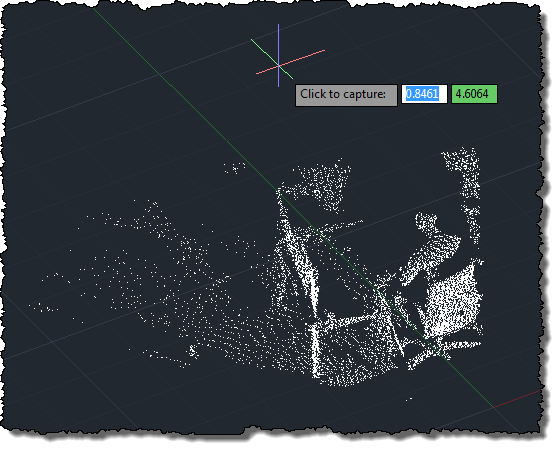
Here's the KINECT command in action, firstly during the jig:
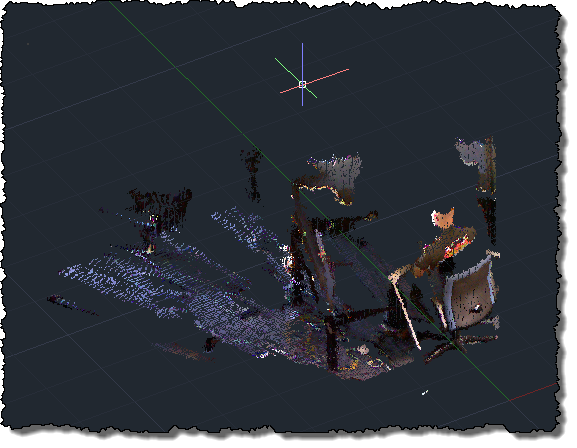
And once the point cloud has been successfully imported:
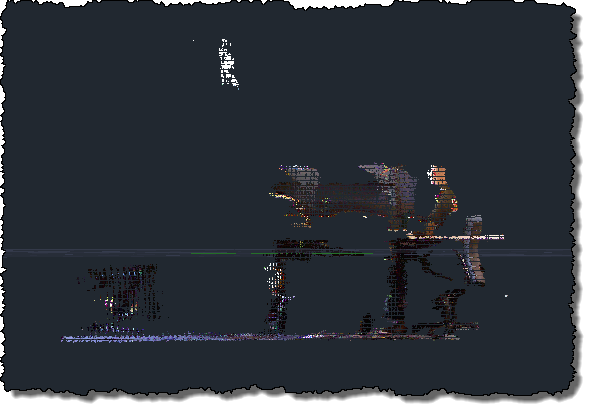
And after 3DORBITing to another angle:
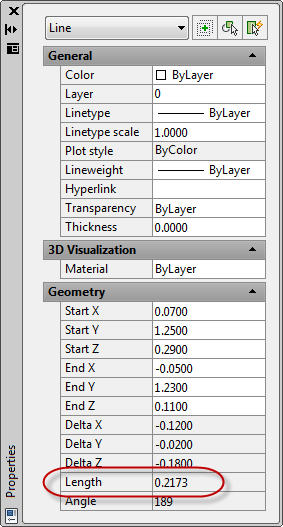
I mentioned earlier that the Microsoft Kinect SDK provides more accurate results, in terms of positioning in 3D space. To test this out, I tried again while holding my Kindle in my hand, which I then measured by drawing a line between its corners:
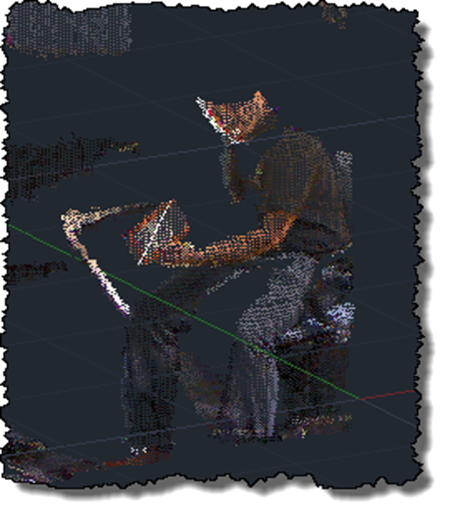
I measured the device physically as being 21.5cm, corner to corner (including its much-needed rubber case :-). And sure enough, AutoCAD more-or-less agrees with this:
The next step – as far as my Kinect work is concerned – is to hook up the skeleton tracking to enable gestures. More on that, soon.


Leave a Reply to gabriel munoz Cancel reply