Point clouds
-
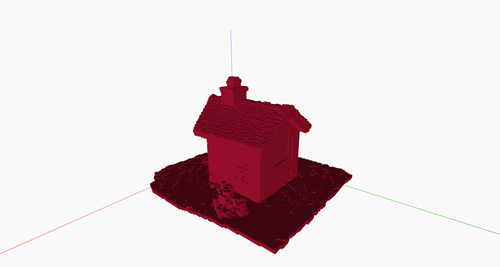
Last week we saw a Dynamo graph that imports a point cloud from an ASCII-based format to specify the initial locations for a fun flocking simulation. This week we're going to look at a graph that uses a similar import technique but rather creates a voxel model based on the point cloud: The main difference from the previous import code is that rather than returning a list of Point objects, we've tweaked the code to return 9 doubles for each point that are taken as triangle definitions. The little secret is that the triangle's vertices are coincident: we use the…
-
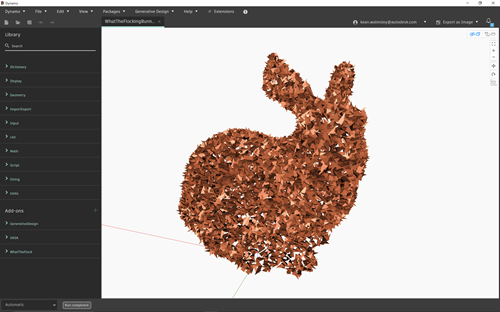
I was thrilled to see a post by Long Nguyen over the weekend announcing his publication of a Dynamo package called WhatTheFlock – with full source code – that implements a Boids-like flocking simulation. This work is significant not because ornithologists will use Dynamo to predict or simulate murmurations (although that in itself is a fun thought) but because Long has demonstrated a valuable technique that might be used to implement other arguably more useful types of multi-agent simulation inside Dynamo. Long is using a background process to perform calculations before rendering the results into the Dynamo window. A really…
-

This isn't exactly new news, but it was to me. Today I found out we've made a very useful component, the Autodesk Reality Solutions SDK, available to the public. This is a C++ library that allows you to read and write Autodesk's RCP and RCS formats, as well as to create custom plugins for new point cloud definition formats. ADN members can log in today and download the SDK and accompanying samples. Non-members can send an email and get access to it that way. There's a particular reason I find this to be important news: it will enable developers to…
-
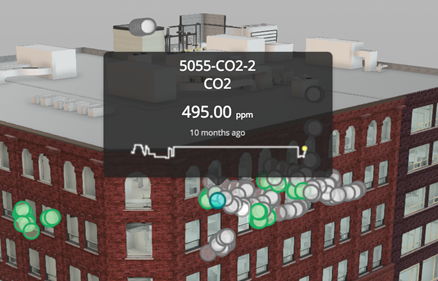
In the last post we talked about a recent optimization to Dasher 360, where we implemented a point cloud rather than individual SVG-based markers for our various sensors. As mentioned, last time, this was pretty straightforward to get working, but did add some complexity: rather than having seperate DOM-resident markers – which can easily have separate tooltips assigned – we now have a single object and need to be able to display tooltips when individual points in the cloud are hovered over. Here's the basic algorithm we used to determine when an individual sensor was being hovered over: Implement a…
-

Some serious updates to our reality computing tools have been released in the last few days… here's a quick round-up with links you can use to go and find out more. ReCap 2.2 Each member of the ReCap portfolio – ReCap, ReCap 360 and ReCap Ultimate – has significant new features in this release. Full details are available here. To summarize just a few, there are new features focused on noise clean-up of point clouds as well as optimizing them for editing performance and project size, and a number of improvements relating to creation of presentation assets such as walkthroughs,…
-
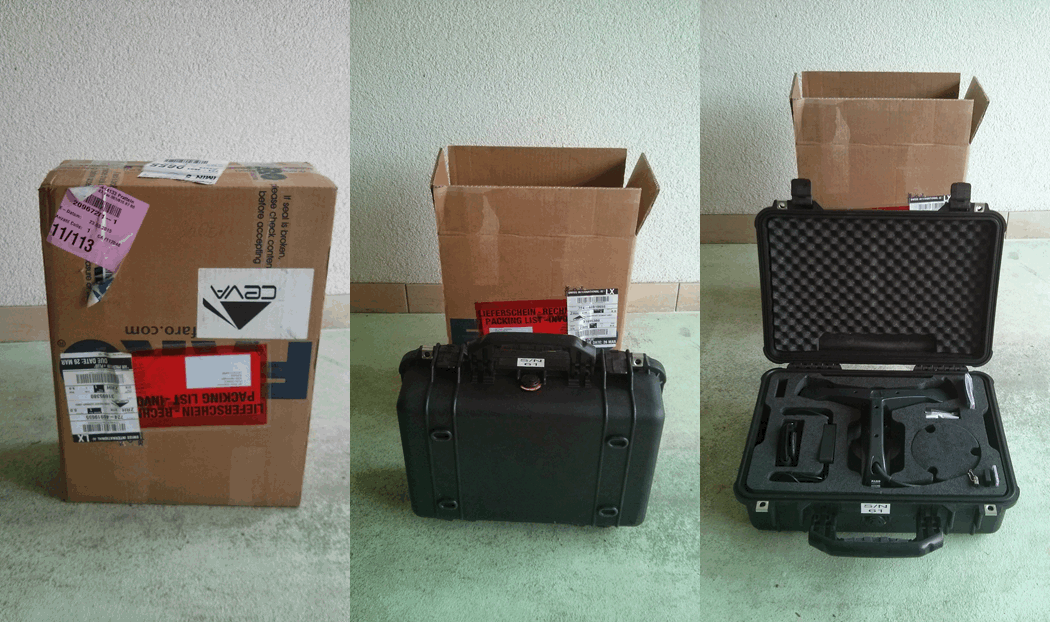
Back when FARO announced their new Freestyle3D handheld scanner, I contacted them to see whether they might have one for me to take a look at. They very kindly obliged, and a few weeks ago I received a loaner model in the post. I won't be writing an exhaustive review – at least not in this post – but I did want to share my first impressions, mainly to capture them for future discussion. Bear in mind that most of what I'm writing here is personal opinion and the rest is pure speculation :-). Hopefully someone at FARO will be…
-
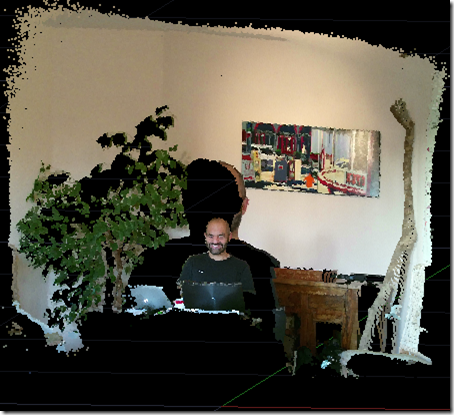
A little while ago you may remember an HTML progress meter I created while looking at "future API features". The API feature in question was of course for AutoCAD 2016, and related to the extraction of floorplans programmatically using .NET, a topic we're covering in today's post. We're going to see some fairly basic code that asks AutoCAD to analyse a point cloud – that we're going to attach from an RCS or RCP file – and generate polyline boundaries for its floorplan. Now I didn't actually have a great point cloud to test this, so I ended up using…
-
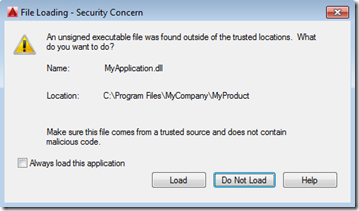
After our quick look at AutoCAD 2016 from a user perspective, let's now spend some time looking at the things important to developers in this latest release. Compatibility Off the bat it's worth stating that AutoCAD 2016 is a DWG compatible release: it's using the same file format as AutoCAD 2013, 2014 and 2015. It's also a binary application compatible release: ObjectARX apps written for AutoCAD 2015 should work in 2016 and it's likely that .NET apps built for AutoCAD 2014 will work, too. That said, some changes have been made to the security model for this release of AutoCAD,…
-

One of the announcements at the recent REAL 2015 conference – and if you missed the event, as I did, you can see a great summary here – was the fact that the much-appreciated mesh manipulation tool from our Reality Solutions division, Autodesk Memento, has now entered public beta. It has graduated from Autodesk Labs and is now available for download without you having to log into the beta portal. It also has a brand new web-site describing why you might want to use it. For those of you who have been tracking its progress, release on release, here are…
-

There's a really interesting conference in San Francisco, later this month (groan). It's being held in Fort Mason on February 25-27, and covers all aspects of reality computing, whether relating to capture, compute or create: Autodesk is the main organizer of the event, but there are lots of other companies and institutions involved, too. Check out the list of speakers: there are executives and specialists from Autodesk lined up as well as several eminent names from the industry. Here's a quick video giving a sense of what the conference is all about: And in case you're still interested in registering,…