Kinect
-
Some weeks ago I joined Evan Troxel for a couple of hours to chat about my journey and some of the projects I've worked on. I've enjoyed the TRXL podcast for some time, so it was a real honour to be invited on. Our discussion has just been published as episode 152. If you prefer video, here's the version from YouTube: Evan's a great interviewer: I enjoyed the session a great deal and I hope you do, too. Listening back to it I realize there's a lot more we could have talked about… hopefully Evan will…
-
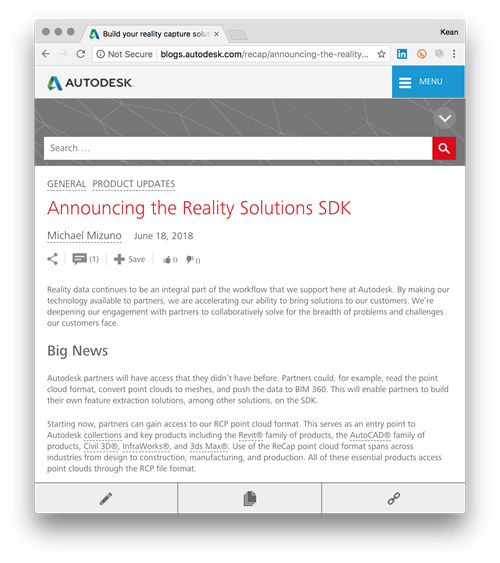
This isn't exactly new news, but it was to me. Today I found out we've made a very useful component, the Autodesk Reality Solutions SDK, available to the public. This is a C++ library that allows you to read and write Autodesk's RCP and RCS formats, as well as to create custom plugins for new point cloud definition formats. ADN members can log in today and download the SDK and accompanying samples. Non-members can send an email and get access to it that way. There's a particular reason I find this to be important news: it will enable developers to…
-
I've had the pleasure of having Cyrille Fauvel from the Forge team with me in Neuchatel, this week. I've worked with Cyrille for many years, and we continue to be interested in very similar technology areas (particularly AR/VR, IoT and robotics/UAVs). So we inevitably have lots to talk about. 🙂 So it's been a fun-packed few days: on Wednesday we spent the afternoon at Microcity at the Innovation World Cup Conference which was focused primarily on wearable computing and IoT. There were a number of presentations both from established platform providers such as STMicroelectronics and BSH (Bosch) and from Swiss-based…
-

There's a really interesting conference in San Francisco, later this month (groan). It's being held in Fort Mason on February 25-27, and covers all aspects of reality computing, whether relating to capture, compute or create: Autodesk is the main organizer of the event, but there are lots of other companies and institutions involved, too. Check out the list of speakers: there are executives and specialists from Autodesk lined up as well as several eminent names from the industry. Here's a quick video giving a sense of what the conference is all about: And in case you're still interested in registering,…
-
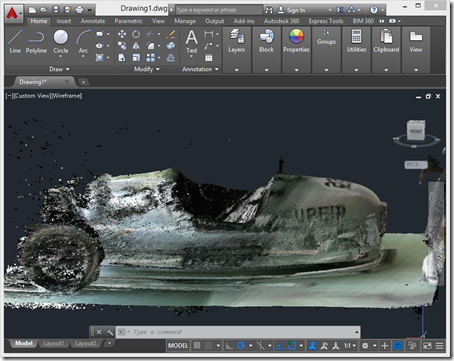
After introducing the series, taking a look at some basic samples and then looking at importing Kinect's high-definition face tracking data into AutoCAD, it's time for (in my opinion) the most interesting piece of functionality provided on the Kinect SDK, Kinect Fusion. Kinect Fusion is a straightforward way to capture 3D volumes – allowing you to move the Kinect sensor around to capture objects from different angles – and the KINFUS command in these integration samples let's you bring the captured data into AutoCAD. Which basically turns Kinect into a low-cost – and reasonably effective – 3D scanner for AutoCAD.…
-
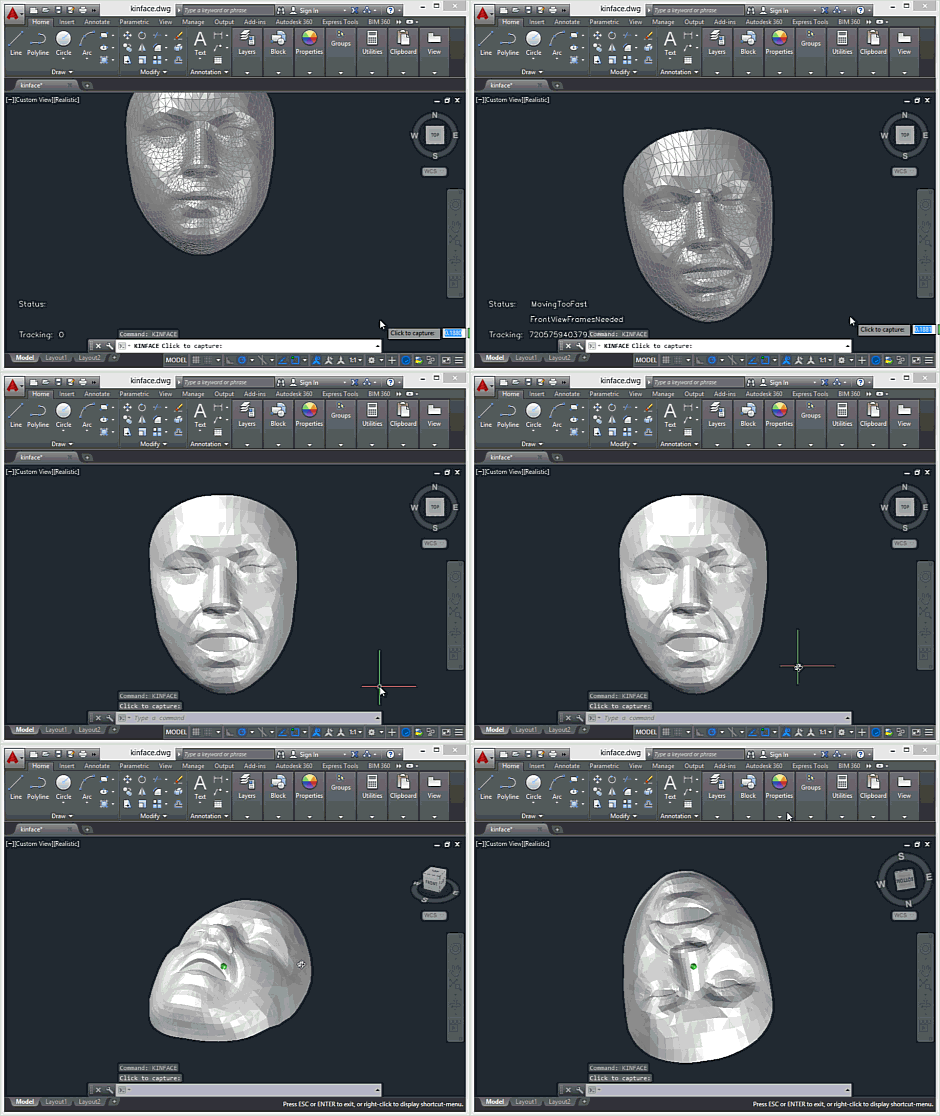
Today's post looks at face tracking and – to some degree, at least – Kinect Fusion, two more advanced Kinect SDK features that go some way above and beyond the standard samples we saw in the last post. In Kinect for Windows v1, these features belong to an additional "developer toolkit", although they appear to have been fully integrated into the core Kinect SDK for v2. At least that's the case in the preview SDK. There are some additional runtime components you'll need to copy across into AutoCAD's program files folder to make use of these features: you'll need Kinect20.Face.dll…
-

Following on from the introduction to this series – and to the Kinect for Windows v2 sensor – it's time to take a closer look at some of the AutoCAD integration samples. At the core of the Kinect sensor's capabilities are really two things: the ability to capture depth data and to detect people's bodies in the field of view. There are additional bells and whistles such as audio support, Kinect Fusion and face tracking, but the foundation is really about RGB-D input and the additional runtime analysis required to track humans. Let's take a look at both of these.…
-
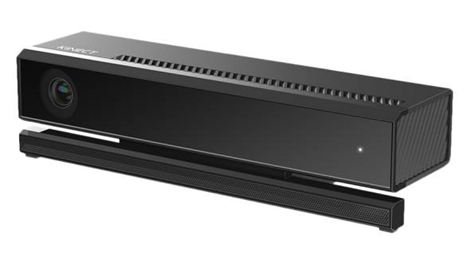
Last Friday Microsoft announced a preview SDK for Kinect for Windows 2. As the first public release of the SDK, it seems a good time to publish an initial set of samples for readers to play with. These are very much a work in progress – I tend to restart AutoCAD between Kinect Fusion captures, for instance, as otherwise I've been getting regular crashes – but they should give people a sense of what's possible. And while I haven't yet implemented certain capabilities we had before, I have gone ahead and snuck a few enhancements in (which you'll see in…
-

A few weeks ago I received the official retail version of Kinect for Windows 2 (having signed up for the pre-release program I had the right to two sensors: the initial developer version and the final retail version). After some initial integration work to get the AutoCAD-Kinect samples working with the pre-release Kinect SDK, I hadn't spent time looking at it in the meantime: the main reason being that I was waiting for Kinect Fusion to be part of the SDK. The good (actually, great) news is that it's now there and it's working really well. For those of you…
-
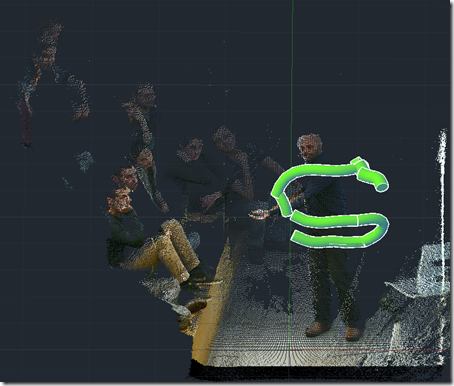
It's been a really interesting and productive few days here in Tel Aviv. In a sense it was too short a trip – I was penned in by commitments during the weekends either side of it – but despite that a lot was achieved. I didn't get to see very much of the city – apart from the hotel, a restaurant, some nice lunchtime eateries and a bar or two – but I'll definitely try to come for longer, next time around. After arriving on Tuesday and meeting with the people I'd be working most closely with during the course…