AutoCAD
-
It's quite common to want to call commands from one or other of AutoCAD's programming environments. While it's cleanest (from a purist's perspective) to use an API to perform the task you want, the quickest way - and the one which will appeal to the pragmatists (and the lazy) among us is often to call a sequence of commands. And there are, of course, a few places in AutoCAD where APIs have not been exposed, so scripting commands is the only way to achieve what you want. Let's take the simple example of adding a line. Here's what you'd do…
-
This recent entry on Jimmy Bergmark's JTB World Blog brought to my attention the fact that ObjectDCL is about to become an Open Source project. Chad Wanless, the father of ObjectDCL, was a very active ADN member for many years, but - according to this post on the ObjectARX discussion group - is now unable to spend time working on ObjectDCL due to a severe medical condition. In case Chad is reading this... Chad - all of us here at ADN wish you a speedy recovery and all the best for your future endeavours. Ignoring the background behind the decision…
-
While debugging it's sometimes very frustrating to find yourself repeatedly stepping into an irrelevant function. For instance, complex statements pretty commonly include object constructors etc. that you know function perfectly well, but the debugger routinely takes you into them. The Visual Studio IDE has an undocumented (and unsupported) mechanism to help with this. During the VC 6.0 timeframe it was implemented via our old friend the autoexp.dat file (see my previous post on this), in a special section called [ExecutionControl]. Since VC 7.0 this has been moved to the Registry. For VC 7.0 and 7.1, it was in the HKCU…
-

I've been using Visual C++ (and afterwards Visual Studio) since it was 16-bit, back in version 1.52. OK, maybe that's not so long ago, relatively (11 short years), but the point is that in spite of having followed the Visual Studio technology over this period, I've so far been completely unaware of the autoexp.dat file. This feature of the Visual Studio was brought to my attention by Ahsan Ali, a programmer in the Inventor Engineering team who was based over in Bangalore at the same time I was (we had both previously worked in the US - he had come…
-
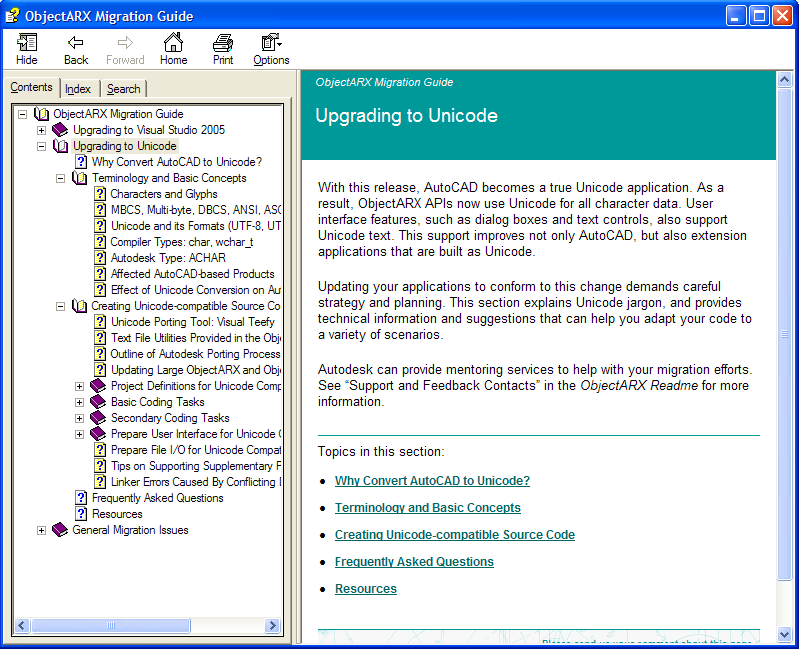
The work we did to migrate AutoCAD 2007 to use Unicode (rather than MBCS), has impacted many developers around the world. For those that are yet to go through the pain themselves, I thought I'd talk about the resources that are available to ObjectARX developers needing to port their applications to Unicode. Firstly, you should check out the Migration Guide that ships with the ObjectARX 2007 SDK (docs/acad_xmg.chm): There's a whole section called "Upgrading to Unicode", with lots of useful information. A good deal of the material in the guide was compiled during the development phase of AutoCAD 2007, as…
-
One of the really compelling features of .NET is its ability to call "legacy" unmanaged C++ APIs. I say "legacy", but we use this facility regularly to call APIs that are far from being considered defunct (the C++ version of ObjectARX is alive and kicking, believe me! :-). Autodesk understands that our development partners have invested many years in application development, and can't afford to throw that investment away to support the latest & greatest (and sometimes "flavor of the month") programming technology. For example, over the years we've made sure it was possible to create a VB or VBA…
-

Most of our desktop products support a "plug-in" model of development: you create a DLL (which may or may not be renamed with a number of extensions, such as DBX or ARX) which gets loaded into the calling executable's memory space. This allows the process to share memory with the loaded modules, improving performance over the more archaic IPC (inter-process communication)-based architectures. [Here begins retracted information...] While Visual C++ Express Edition supports debugging DLL projects using an external executable, Visual C# Express and Visual VB.NET Express Editions do not. When developing with our products it is extremely common to launch…
-
This topic was suggested by one of our ADN members - Paul Richardson, from CAD System Engineering - and answered by Cyrille Fauvel, from DevTech EMEA. So all I really had to do was copy/paste and some minor editing... now that's my kind of blogging. 🙂 The ObjectARX Wizard's installer targets the Microsoft Visual Studio 2005 platform rather than the Microsoft Visual C++/C#/VB.NET Express Editions. The main reasons for this are the limitations of the Express Editions' IDE - particularly due to its lack of support for AddIns. The ObjectARX Wizard is actually made up of a number of components:…
-
To get started with writing a .NET app for AutoCAD, download the ObjectARX SDK for AutoCAD 2007. Contained within the samples/dotNet folder of the SDK are a number of helpful samples showing how to use various features of the managed API to AutoCAD. Incidentally, the project files etc. are generally saved in the version of Visual Studio that is recommended to build ObjectARX (C++) apps for that version of AutoCAD. So the projects in the ObjectARX 2006 SDK will be for Visual Studio .NET 2002, and in ObjectARX 2007 they will be for Visual Studio 2005. These specific Visual Studio…
-
The AutoCAD Engineering first prototyped a "managed" (for "managed" read ".NET") API for AutoCAD 2004. It was pretty revolutionary stuff at the time - a mixed-mode DLL was created to expose the managed interface and marshall these calls through to "unmanaged" ObjectARX calls. There were a number of reasons .NET was - and remains - very interesting for developers... .NET provides the ease of development previously available only (or at least primarily) to Visual Basic clients through COM. You can make use of COM or .NET components in your project, but generate simple client code using more evolved programming languages…