AutoLISP / Visual LISP
-
The material for this year's online Autodesk DevDays is now live on YouTube. These sessions were held back in March, but now that the various products discussed have been released publicly, the information has been made available for everyone (i.e. not only covered by the Non-Disclosure Agreement signed by Autodesk Developer Network members, the famously palindromic ADN NDA). Here's the full playlist, if you want to watch it here: Here are links to the individual sessions: Autodesk DevDays 2021 keynotes Inventor, Vault and Fusion API update AutoCAD API update Revit API update Civil 3D update One interesting tidbit from the…
-
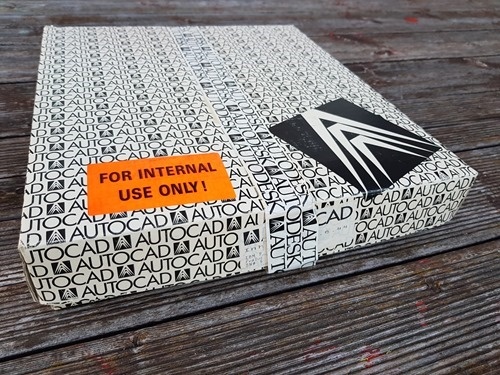
This is a slightly anomalous post in the "one man's trash" series, in that we've actually found something I can't bear to part with. This was nearly the case for The Autodesk File 3rd Edition, but I did bring myself to ship that one off to Oregon. Today's item, once again uncovered by Francesco Tonioni, is a boxed version of AutoCAD 2.6. It's probably too heavy and fragile to ship around the world, but if I'm honest that's only part of the reason. It's just too precious! It's the German edition, which for sure was localized from the English version…
-

Over the weekend I received an email from Jürgen Becker. It came with this image, which certainly brought back memories. The email referred to our recent trip down memory lane… I read your last post and remembered a poster. Do you remember that release, it was terrible? This is one of my favourite "chat over a beer" topics, and one that seems relevant to where we are today with Fabric, so I wrote Jürgen a quick note to say that I'd reply via my blog. Here is that reply. R13 was bad, but it had to happen I joined Autodesk…
-

The AutoCAD team is running their annual survey to better understand developers' needs relating to documentation. Access the survey here before the end of May. Lee Ambrosius provides more information over on his blog, including some interesting data-points from last year's survey as well as areas of the documentation that were influenced by it.
-
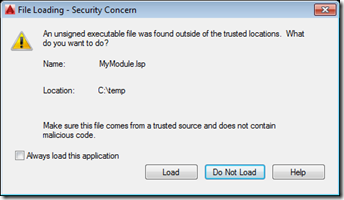
Yesterday we introduced the need to sign program modules for AutoCAD 2016. Today we're going to see how AutoCAD behaves when loading signed and unsigned modules, as well as what the innards of a signed LISP module look like. Here's a simple piece of AutoLISP code that I've placed in a file called c:/temp/MyModule.lsp: (defun c:test() (princ "\nThis is a test command.") (princ) ) Here's what AutoCAD displays when we try to load this module: We can use AcSignApply.exe to sign this module with our digital certificate, as we discussed yesterday: Here are the contents of the file…
-

This series of posts is one I've been meaning to write since AutoCAD 2016 started shipping. Thankfully a number of other people have filled the void, in the meantime, so I've created an appendix of related posts that you can find at the bottom of each post in this series. The series is about how we're working to improve security inside AutoCAD, and what this means for application developers. Dieter's posts on Lynn's blog help explain some of the background to this work, much as I've posted here in the past, too. Perhaps the biggest security change in AutoCAD 2016…
-

photo credit: Marcin Wichary via photopin cc As mentioned in the last post, fibers are now inactive in AutoCAD 2015 (the code paths are still there, largely for testing purposes, but should not need to be enabled for typical usage of the product). Fibers were a technology that Microsoft introduced way back when to help single document (and typically single-threaded) applications adapt more easily to the brave new world of MDI. At least that's my recollection and understanding. They were basically a mechanism by which applications such as AutoCAD could manage their per-document state, making the relevant data current depending…
-

Yesterday the first AutoCAD 2014 for Mac customers pealed the virtual shrinkwrap off their shiny digital copies. Here's some info on this release from my friend Micah, the AutoCAD for Mac Product Manager: There's been quite a lot of press on the 2014 release already, both from Autodesk and beyond (here are but a few examples of the coverage to date). The release schedule for our Mac version has now been synced with Apple's annual announcements, allowing us to take advantage of the latest & greatest OS X capabilities but also to be part of the launch event (however briefly: watch…
-

As reported by Tom Stoeckel over on Without a Net, AutoCAD 2013 Service Pack 1 is now available for download. I've been waiting for this release with some impatience… in my new role I've been increasingly involved in discussions around the security of AutoCAD and our customers' data, and this Service Pack makes significant progress in this area. As Tom notes, malware attacks in AutoCAD typically† take advantage of the fact that when a drawing is loaded, AutoCAD tries automatically to load various types of acad.* files (acad.dvb, acad.lsp, acad.fas, acad.vlx, …) from the drawing's folder. Which means that when…
-
Following on from our look at the Core Console, Dynamic .NET and .NET migration for AutoCAD 2013, today we're going to look briefly at the remaining API features in the AutoCAD 2013 release. Model Documentation The model documentation feature was introduced in AutoCAD 2012 – simplifying creation of 2D sections and details of 3D drawing content – and this initial API provides (primarily read-only) access to this information. It comprises the following classes SectionSymbol SectionViewstyle ViewBorder ViewRepBlockReference DetailViewStyle DetailSymbol The writeable aspects of the API are mostly related to the "style" objects – these can be created and edited programmatically,…