IoT
-
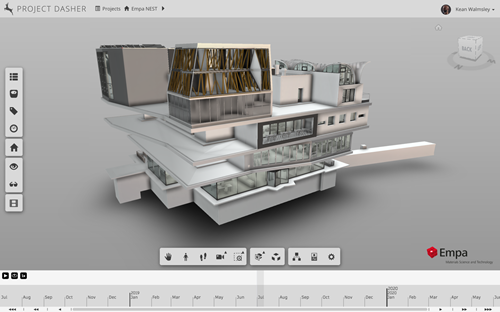
Last time we saw how it's possible to use Autodesk's HIG to add different visual themes to a Forge viewer application. When I first started down this path, I thought I'd probably just stop at implementing another dark theme inside Dasher: I suspected it would be a lot of work to implement a light theme. It turns out I was wrong: towards the end of last year I'd spent a few days rationalising our use of styles inside Dasher, by eradicating every use of "hardcoded" colours inside CSS styles and have them stored in SCSS variables. It felt like a…
-
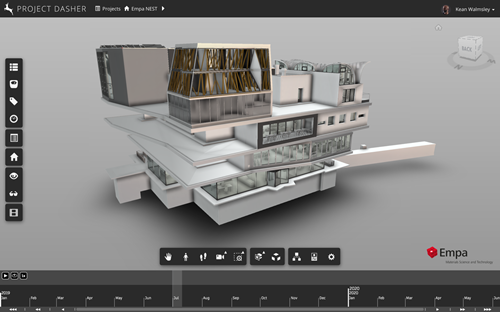
I mentioned in the last post that I've been working on integrating a new timeline component into Dasher. By default the component supports a different visual theme than the one we've been using in Dasher: in order to make the look & feel consistent, I had to include Autodesk's HIG toolkit in the Dasher project. HIG stands for Human Interface Guidelines, and it's Autodesk's effort to increase visual consistency across our products (especially those that are web-based). And the best thing is, it's open source and available for anyone to integrate in their projects via npm or yarn. And if…
-
We have a feature in Dasher called "kiosk mode". It basically takes control of the browser to run a sequence of operations that show people how Dasher works. I published a series of posts a couple of years ago that explain a bit about how we implemented it. One of the issues in kiosk mode is knowing when Forge viewer operations – such as view transitions or state restorations – are complete. Until recently the code just checked the viewer's progressbar property, to see whether its value was close to 100 or not. This wasn't ever a very good approach,…
-

In Dasher we have some interesting functionality to isolate parts of the building by level. This is increasingly something you can do via "out of the box" Forge viewer functionality, but we've found a couple of reasons to go beyond that basic capability: Not all elements or objects are assigned to the correct level. Some elements – such as those belonging to the building facade or perhaps internal pipes – transcend levels, and so don't behave well. It's of course possible to split elements/objects that belong to the second category, but we tend to take the approach of allowing certain…
-
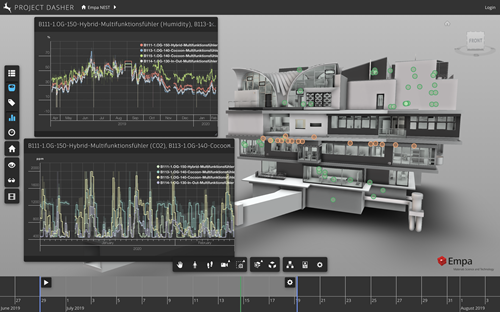
I've been heads-down this week on a couple of tasks related to Dasher: the first relates to working on the integration of a new timeline control. I'm hoping this will be ready for people to try in the coming weeks, but we're not quite there yet. The second relates to bringing more data into our time-series back-end from the NEST building: I noticed last week that we were missing data from October of last year onwards. It turns out we had a credentials problem – we have a "conduit" that regularly federates the NEST data into our back-end, but it…
-
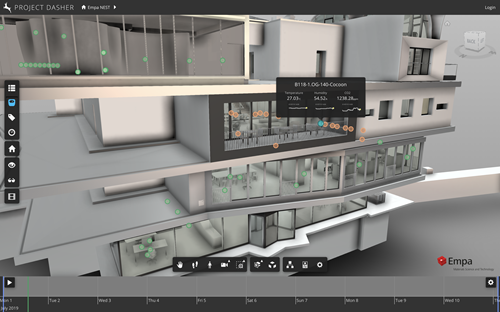
A few posts ago I mentioned some work was needed to migrate our Dasher 360 shaders to the latest version of the Forge viewer (or the one after it). This work is now complete, so I can share a few thoughts and comments on what was needed to make this happen. Before doing that, though, I need to thank Elias Cohenca for his invaluable help during this process: I can honestly say that without his help the migration would either not have happened or would remain a work in progress. Thanks, Elias! Firstly, it's important to note that even if…
-
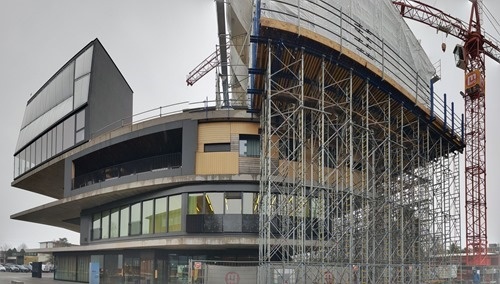
On Wednesday I was back at the NEST building on Empa's Dübendorf campus. I've posted about NEST lots of times over the last few years, but these are the main two tours in case you want to track its evolution. I was there to meet Brian Glancy – visiting from Kingspan in Ireland – and Reto Largo from NEST. NEST and Kingspan are two of the main ongoing pilots of Dasher, so it was great to get everyone in the same place to discuss possibilities. Reto started the tour in the media room in NEST, with it's 16-screen media wall.…
-
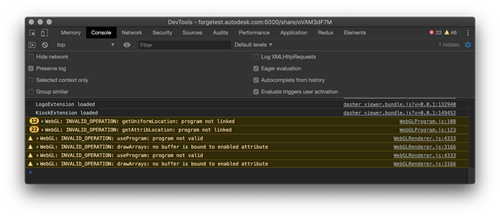
An interesting thing happened when I tried Dasher 360 with the latest production version of the Forge viewer: no sensor dots appeared. As Dasher without sensors is a glorified 3D viewer, this was a bit of a problem. Digging into things a little, I worked out that our custom WebGL shader wasn't working properly in this latest version. At this point I reached out to my friend Elias Cohenca in Tel Aviv for a quick sanity check: he confirmed that this latest version of the Forge viewer is now defaulting to WebGL 2.0. This was confirmed in the Forge viewer…
-
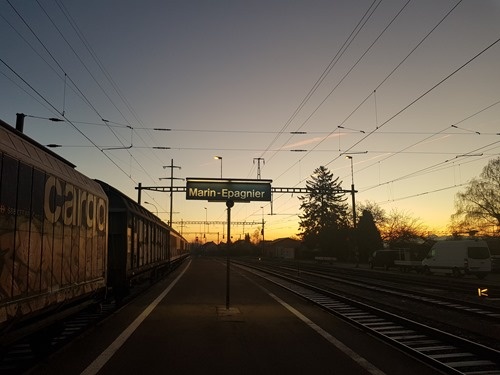
Bright and early, yesterday morning, I hopped on a train (well, a couple of trains) to get across to Basel for this year's Swissbau, the bienniel construction-related trade show held in Switzerland, and apparently one of the largest in Europe. I'd never been before, but thanks to social media I'd compiled a list of people to see there, and had even coordinated to meet up with my friend and fellow blogger, Jeremy Tammik. There was quite a bit going on at Swissbau, even outside the exhibition hall. At one point I saw some people performing while suspended from a building.…
-
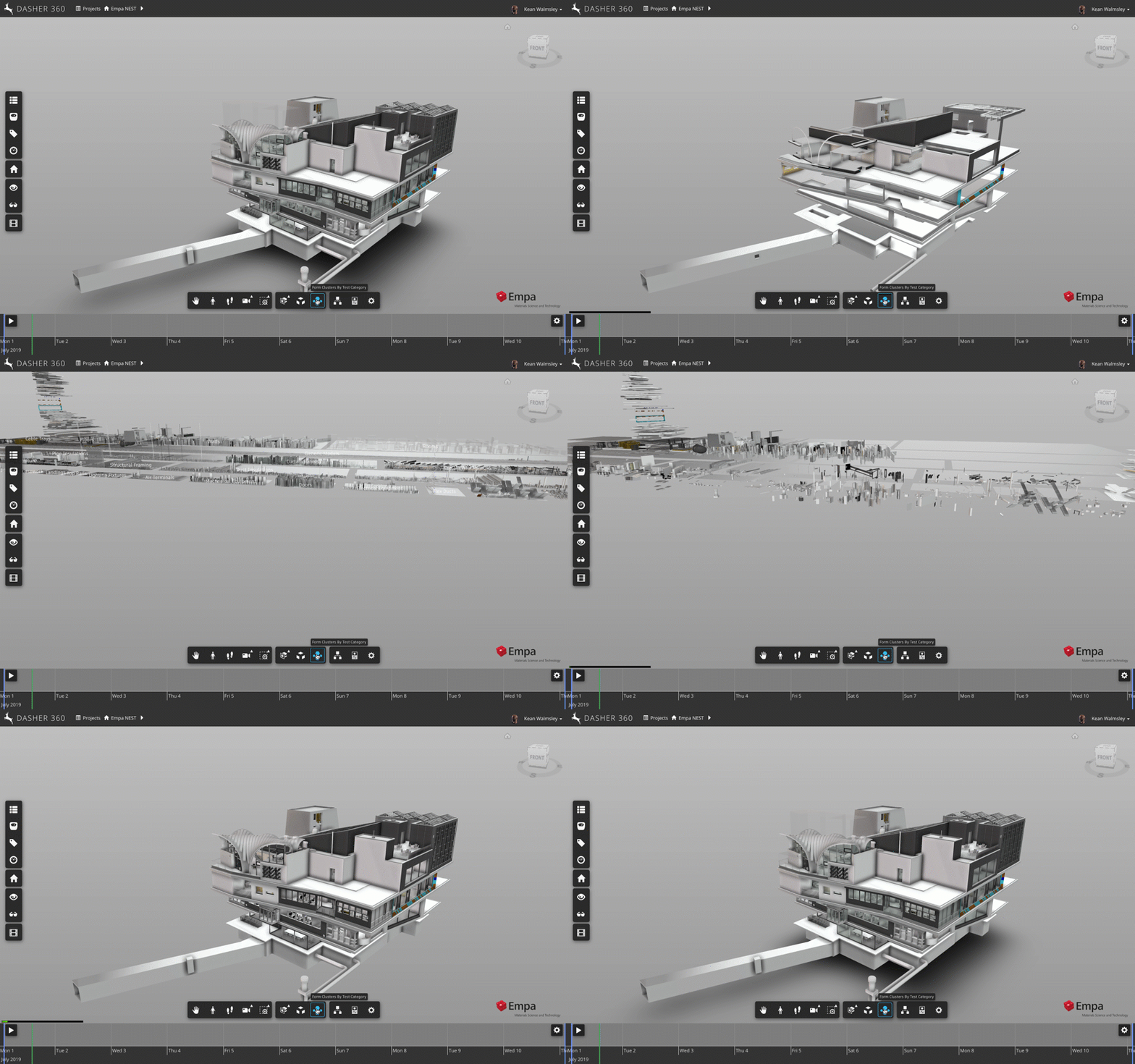
Some of you may already have seen Augusto's tweet showing the "Visual Clusters" Forge viewer extension that has been developed by the BIM 360 Design team. It really is super-cool: the extension takes the content of the model loaded in the Forge viewer and clusters it spatially based on the value of the various items' category property. The extension was first published in v7.6 of the Forge viewer, so it's been around a little while. If you don't have a Forge viewer application to test it out with, fear not! Petr Broz has added the capability to load extensions into…