Arduino
-
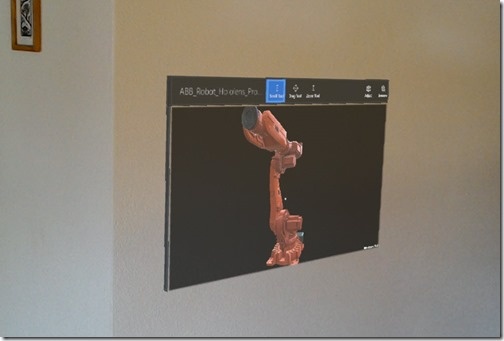
This post shows something really simple, but I decided to share it here as it took me some time to track down. On Saturday I received the 3D model of an ABB industrial robot – the IRB 6620 I mentioned last week – from Tom Eriksson. He's used a number of tools – including Fusion 360 – to create a gorgeous rendition of this particular robot in Unity. Tom very kindly agreed to share the model, and has spent quite a bit of time helping get it ready for HoloLens. The first version Tom sent unfortunately didn't work for my…
-

This is without a doubt the coolest office Autodesk has anywhere in the world. Pier 9, on San Francisco's waterfront, houses the Autodesk Consumer Group, including the Tinkercad and Instructables teams, as well as members of Autodesk Research and visiting artists-in-residence. And it has the most phenomenal workshops, kitted out with cutting-edge technology. I'd been hoping to visit for some time but this was really my first real opportunity since its official opening back in September. I wandered across from our 1 Market office (which is also pretty cool, but relatively lacking in toys 😉 with Gaurav Sachdeva, a colleague…
-

This one came as a (very nice) surprise: Autodesk has collaborated with Circuits.io to provide a new tool called 123D Circuits. Here's the announcement along with some media coverage. 123D Circuits is a handy, web-based tool that allows you to create, share and collaborate on circuit designs such as those you'd use with an Arduino microcontroller. And if you're using an Arduino in your circuit, you can even code inside the embedded IDE and simulate its behaviour directly inside your browser – with almost no risk of blowing it up! You can also embed these circuits into web-pages, which is…
-
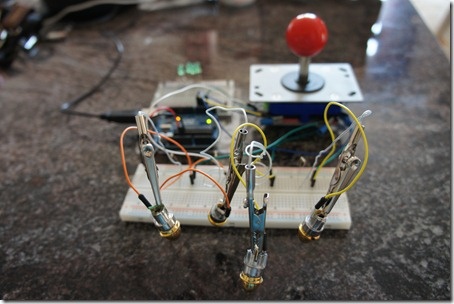
As mentioned in the last post, I had some fun ripping apart laser pointer key-rings and repurposing their laser diodes to (at last!) use my Arduino to blink something a bit more interesting than LEDs. This project is really just about blinking lasers using the switches inside a joystick – nothing very complicated. I'm not using servo or stepper motors to create a controllable laser turret or even my own 3D scanner (both of which sound like interesting future projects ;-). A quick note on the source of these lasers. I picked up a bunch of laser pointer key-ring that…
-
Over the long July 4th weekend (always a great time for me, being based in Europe, to catch up on projects free from interruption) I dusted off my Arduino and started playing around with it again. My goal was to hook up my Zippyy arcade joystick to find out how it might be used to control electronics circuits, in this post to control LEDs but later to drive some 1mW lasers I salvaged from some broken toy key-rings. The joystick was actually simpler than I expected to hook up, in that it's essentially a collection of 4 switches: one for…
-
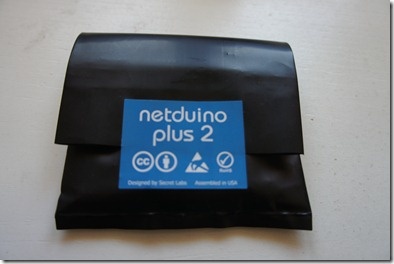
After blinking LEDs with an Arduino Uno R3 and its younger step-sibling the Digispark, I decided to give the same treatment to their beef-cake second cousin, the Netduino Plus 2. James Maeding had been telling me to take a look at the Netduino for ages, so when I ordered some parts for my (optimistically speaking) forthcoming Kinect for ZX Spectrum integration, I decided to throw in a Netduino Plus 2. Now the Netduino Plus 2 retails for $60 in the US (and 80CHF here in Switzerland, as the device is assembled in the US), which means it's at least twice…
-
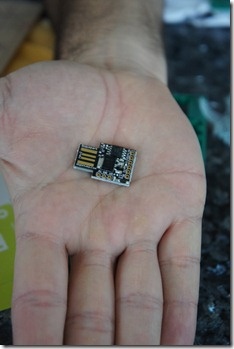
I talked about some of the fun I've been having with Arduino in this previous post. I eventually added a pushbutton and a potentiometer to that particular circuit, modifying the code to watch for a hardware interrupt – to blink the LEDs only when the button is pressed – but also to apply a variable delay to the blinking (speeding it up or slowing it down depending on the direction in which you turn the knob of the potentiometer). I've now ordered an edge connector that will fit my ZX Spectrum: my next stage for the Arduino-based work is to…
-
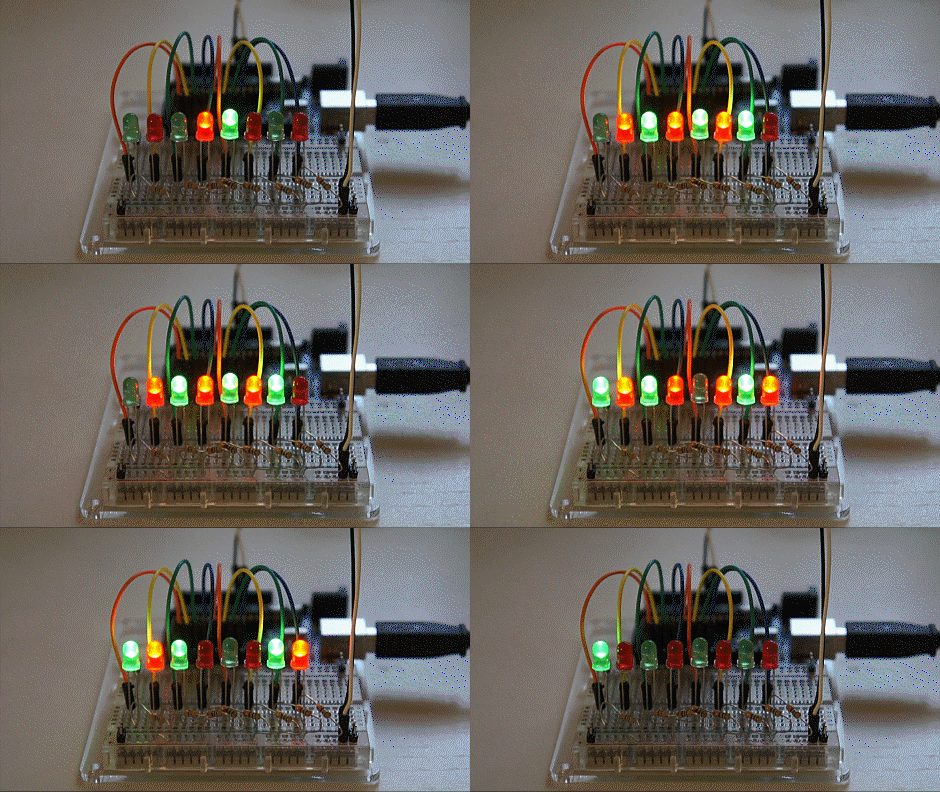
I've started to find time to start playing with the Arduino Experimentation Kit I bought myself for Christmas. So far, I've just embarked on the first two example circuits provided with the kit. The first one blinks an LED, the second blinks multiple LEDs in sequence. Hence the name of this post, which I've borrowed from the excellent Eels album. At my son's request, I modified the code from the second project very slightly to blink the LEDs from the middle outwards, but otherwise I followed the (very clear and straightforward) instructions to the letter. Nothing very exciting, I admit,…
-
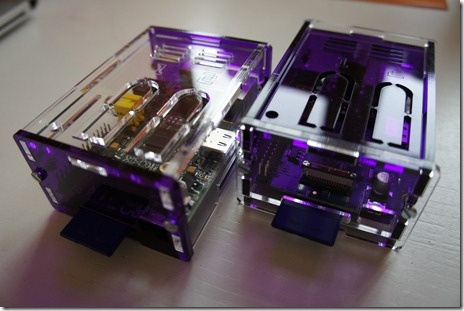
One of the ulterior motives (although you might really consider it a mere side benefit) for my recent trip back to the UK was to pick up the Christmas presents I'd bought for myself on behalf of my wife and kids. 🙂 The first – one of the new Raspberry Pi Model B's with 512 MB of memory – could have been ordered from Switzerland, but I was a bit frustrated at the mark-up added by the local reseller (the previous one I bought from the UK and had shipped directly here from China… that no longer seems possible now…