Raspberry Pi
-
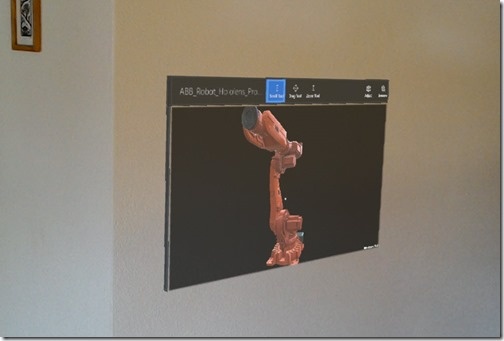
This post shows something really simple, but I decided to share it here as it took me some time to track down. On Saturday I received the 3D model of an ABB industrial robot – the IRB 6620 I mentioned last week – from Tom Eriksson. He's used a number of tools – including Fusion 360 – to create a gorgeous rendition of this particular robot in Unity. Tom very kindly agreed to share the model, and has spent quite a bit of time helping get it ready for HoloLens. The first version Tom sent unfortunately didn't work for my…
-

Happy New Year! I hope that those of you who celebrate at this time of year, were able to take a nice, relaxing break. I certainly did. 🙂 Anyway, it's now time for me to ease back into work. But rather than it being an abrupt transition, I've decided to take a look at a pet project that I thought would be pretty fun: controlling robots from inside AutoCAD. The thinking is to outline some possibilities for moving virtual robots inside a floorplan drawing and having their real-world, physical counterparts move as instructed. Perhaps along a specific path, perhaps by…
-
Most of this week I've been heads-down trying to finish a sample demonstrating the API that's coming for the new Autodesk 360 viewer (of which we saw a sneak peek in this recent post), so today I don't have much to talk about. The sample is pretty cool and involves my favourite car. But hopefully you'll be able to see it in action before too long, so there's really no need to say more about it, for now. 🙂 A good portion of this blog's readership is currently grilling meat and celebrating the 4th of July, so I won't beat…
-
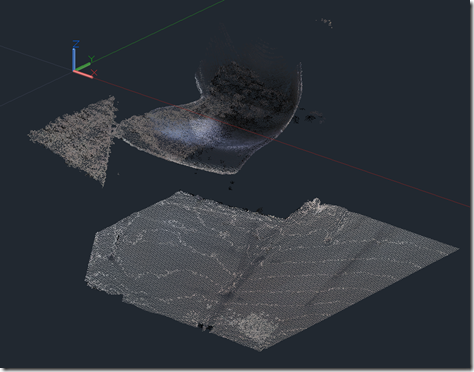
Yesterday I presented a condensed sneak peek of my upcoming AU sessions on Kinect Fusion and Leap Motion to colleagues in the Neuchâtel office (I'll do the same at our office in Gümligen next week). It was good to make sure my various demos are working well in time for AU, as well as creating some awareness around the possibilities presented by these two technologies. We attempted a live capture of a chair using Kinect Fusion, which actually came out surprisingly well (the Kinect's USB cable popped out as I was trying to scan the chair's back, but the command…
-
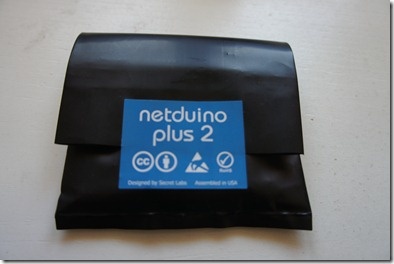
After blinking LEDs with an Arduino Uno R3 and its younger step-sibling the Digispark, I decided to give the same treatment to their beef-cake second cousin, the Netduino Plus 2. James Maeding had been telling me to take a look at the Netduino for ages, so when I ordered some parts for my (optimistically speaking) forthcoming Kinect for ZX Spectrum integration, I decided to throw in a Netduino Plus 2. Now the Netduino Plus 2 retails for $60 in the US (and 80CHF here in Switzerland, as the device is assembled in the US), which means it's at least twice…
-
I talked about some of the fun I've been having with Arduino in this previous post. I eventually added a pushbutton and a potentiometer to that particular circuit, modifying the code to watch for a hardware interrupt – to blink the LEDs only when the button is pressed – but also to apply a variable delay to the blinking (speeding it up or slowing it down depending on the direction in which you turn the knob of the potentiometer). I've now ordered an edge connector that will fit my ZX Spectrum: my next stage for the Arduino-based work is to…
-
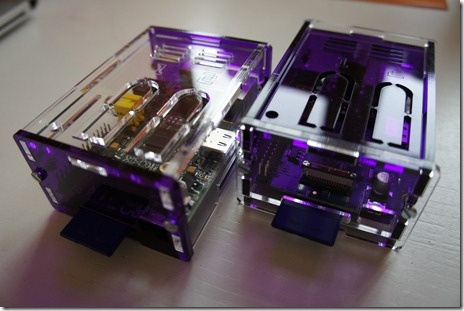
One of the ulterior motives (although you might really consider it a mere side benefit) for my recent trip back to the UK was to pick up the Christmas presents I'd bought for myself on behalf of my wife and kids. 🙂 The first – one of the new Raspberry Pi Model B's with 512 MB of memory – could have been ordered from Switzerland, but I was a bit frustrated at the mark-up added by the local reseller (the previous one I bought from the UK and had shipped directly here from China… that no longer seems possible now…
-
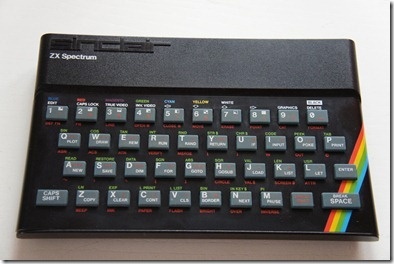
I had a fantastic surprise at the beginning of the week: a friend from work – to whom I'd shown my retro-foolings with the Raspberry Pi – brought a plastic bag to my desk containing an original Sinclair ZX Spectrum and power supply. He had talked about my project to a friend of his back home in Rome, who thought I'd like it (he was otherwise going to throw it away). The computer was in very good condition externally, at least: I was impressed by the condition of the keyboard, in particular, as these very quickly became dirty and damaged,…
-
Over the weekend, from Friday to Sunday, I spent far more hours than I'd have liked finishing off my AU Virtual class for this year, "Secure Your AutoCAD Environment" (I'm increasingly involved in security-related activities for the AutoCAD development organisation). Preparing material for AU Virtual is often pretty tough, whether it's being recorded in person (I've done a couple of those) or being in advance and needing extensively editing. This year's format was a bit different, in that it required multiple modules to be recorded separately as opposed to a single, monolithic recording. Better from a consumption perspective, apparently, and…
-

This is the final part of the series on creating a face-recognising security cam. We started by showing how to get motion detection working, and then followed with an initial overview and then posts on the separate Facebook-downloader tool and the onboard face detection component. In this post, we'll see how we managed to connect up a USB-powered LED message-board from DreamCheeky. I was originally inspired to use this device to present the results of the Facecam while having dinner at a friend's place. He's a fellow geek – even his welcome mat says so – so we Googled around…