Autodesk Research
-

Last week this blog sailed through the 10th anniversary of its first post. I can't believe how time has flown… posting 3 times a week for a decade has resulted in 1,448 posts, accumulating more than 6.2 million pageviews. I suppose when something's so much fun you don't really see time passing. Visually, the blog has changed a few times, over the years… (There's a 4th theme that is still in the works, but I've hit a bit of a wall with the content transfer… I've noticed that backslashes have been filtered from the various code samples. I need to…
-

Today has been a strange day, to say the least. Waking up to the results of the UK's EU referendum (also known as the "Brexit" vote) was a complete shock, and I'm yet to recover. The world has certainly changed but it's going to be some time before the full impact is felt. Last week in SF I felt a little bit of this, although in a much more positive direction: that we were at a moment in time where things were about to change. Not immediately, and not for everyone, but I definitely came away with the sense that…
-
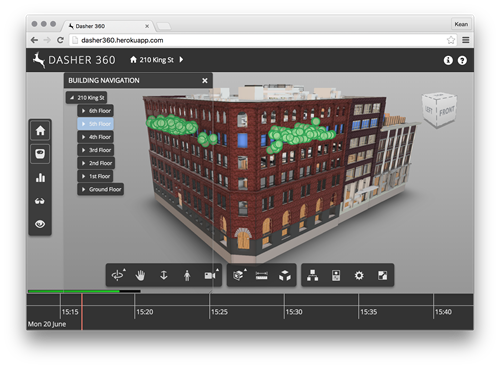
This question has come up more than a few times over the last year or so: I remember a number of Revit developers hitting it when creating Viewer applications at the accelerators in Munich and Prague, for instance. The problem appears to be that RVT files – when translated and loaded into the Viewer – do not have the concept of room objects: they're just spaces. Which presents a challenge for developers who want to work at the room level. Last week I showed a demo during our "Autodesk Research and IoT" session, which showed room-centric navigation built into the…
-

One of the projects I've been working on – alongside Simon Breslav, a colleague from Autodesk Research Toronto – is a prototype, web-based client for our IoT back-end. I'll be demoing it next week at the Forge DevCon. It uses Forge's viewer component to provide access to sensor readings from within a 3D model. Here are a few sequences of images to give you an idea of what it does. It's still early days, but we're steadily working towards feature parity with the desktop-based Project Dasher. The first sequence shows how you can view the sensors in a building model:…
-
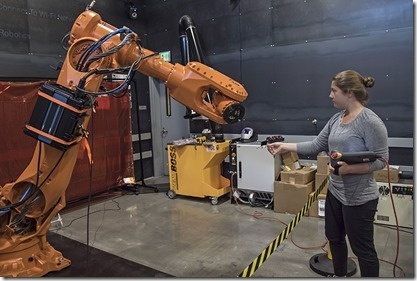
Following up from last week's post, which included a brief video showing where we're headed with generative design, today's post highlights a speech by my colleague in Autodesk's Office of the CTO (OCTO), Maurice Conti. I've mentioned Maurice before: he has an Applied Research team working on Pier 9 that is currently hiring a Machine Learning + Robotics researcher. Maurice gave a speech at TEDx Portland entitled "The Future of Human Augmentation". It looks at how we're being augmented, not only by computational systems (helping us think) but by robotic systems (helping us make) and by a digital nervous system…
-
I was just sent this short video that captures the essence of the Dreamcatcher project beautifully. Be sure to check it out if you're interested in what Autodesk Research is up to in the field of generative design. You won't regret it. Exciting stuff!
-
We have our annual, internal Technical Summit coming up in a couple of weeks. I'll be heading across to Montreal with 700+ other Autodesk employees to learn more about the cool stuff going on within the company. As I've done in previous years, I'll do my best to report information that I think will be interesting to this blog's readers (and that is ready to be discussed publicly, of course). One of the event's activities is being hosted by my team: the IoT Hackday. We'll have 30+ participants spread across 8 different teams. Each team will get provided some sensors,…
-

Last Thursday I received possibly the most interesting job description I've ever seen. A colleague in the Office of the CTO, Maurice Conti, has a team of robotics researchers working in the Applied Research Lab on Pier 9 in San Francisco and is looking to bring Machine Learning expertise into the team. I've talked about the Lab before, and you may also have seen this Guardian coverage of my friend David Thomasson, who works there. I think this might actually be my dream job. There are a few reasons I won't be applying: there's a skills gap (I only have…
-

A few days ago, Scott Sheppard wrote an interesting blog post entitled "Why does Autodesk have a Labs?". I tweeted it, as I found it did a good job of describing not only the rationale behind Autodesk Labs, but other important customer touch points such as the Beta program and Autodesk Research. With my completionist hat on I'd probably expand the touch points to include how we connect with Major Account customers – particular via Autodesk Consulting and our Enterprise Support teams – as this is also a way that product features and defined and delivered. In fact, I'd probably…
-

Regular readers of this blog will have heard mention of Project Dreamcatcher and how Autodesk Research is using it to explore the future of design. It's a generative design technology that goes beyond the current "state of the art" – which means combinations of tools such as Revit + Dynamo or Rhino + Grasshopper – as it works backwards from goals stated by the user, rather than expanding and evaluating options that have been programmed in. One great way for people with a programming background to "get their heads around this" is to relate it to the world of programming…