Database
-

I first heard about Project Escher a few months ago and found the idea really interesting: coordinating multiple print heads to introduce parallelism into additive manufacturing. Then, last week, there was a really interesting Q&A about the project in an Autodesk-internal newsletter. I'm reprinting it here, below, as I know it will be of interest to this blog's readers. When it came to looking for an image for this post, I decided to look for something by M. C. Escher that was in some way descriptive or representative. An obvious choice was his "Drawing Hands" lithograph, although it's probably better…
-

Many thanks to Holger Rasch who worked out how to fix the code in this previous post. It really doesn't matter that 3 years have passed, Holger – I have no doubt people will greatly appreciate the fact the code can now run without causing the annoying display issues it produced previously. Holger made a few adjustments to the implementation to make sure the persistent hatch loop gets added and removed in the right places. Here's the updated C# code: using Autodesk.AutoCAD.ApplicationServices; using Autodesk.AutoCAD.DatabaseServices; using Autodesk.AutoCAD.EditorInput; using Autodesk.AutoCAD.Geometry; using Autodesk.AutoCAD.Runtime; using Autodesk.AutoCAD.Colors; using System; namespace HatchJig { class…
-
Another Friday, another installment of Wayne Brill's AutoCAD .NET training DevTV series (to complement those from previous weeks). Today's session is focused on responding to database events and creating a palette-based user interface. This series of DevTV sessions is a companion for the new AutoCAD .NET training material available from the AutoCAD .NET Developer Center. Enjoy! 🙂
-
Another Friday, another installment of Wayne Brill's AutoCAD .NET training DevTV series (to complement those from previous weeks). Today's session is focused on the fundamentals of AutoCAD's drawing database. This series of DevTV sessions is a companion for the new AutoCAD .NET training material available from the AutoCAD .NET Developer Center. Enjoy! 🙂
-
A big thanks to Stephen Preston for passing on this very interesting information. Stephen is one of the "volcanically challenged" members of my team, so fingers crossed he'll be able to get a flight across to the UK in the coming days. Aside from Stephen's delayed trip back to the motherland, the recent travel disruptions have also impacted an Inventor API training class being held in Moscow (which will go ahead with a back-up trainer) and extended another team member's vacation in the Philippines. The lack of a native 64-bit driver for ODBC, ADO, OLE DB, etc. access to Microsoft…
-
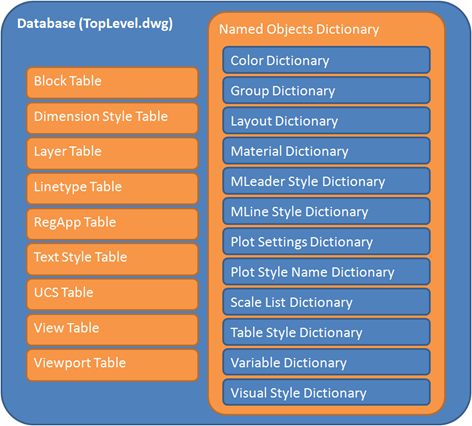
In the last post we looked at some code to define a block and insert it into the model-space of an AutoCAD drawing. Today we're going to look at creating a group. Before we dive into the code, it's worth taking a quick look at the difference between a block and a group, to understand the differences between these two container/aggregator objects. I know that much of this information is available elsewhere, but hey – I'm on a roll, so I request your forbearance. Let's start with looking at the top-level structure of an AutoCAD Database (which is equivalent to…
-
While not necessarily relevant when working with AutoCAD data, it's very common for people to want to make use of adjacent database systems when developing AutoCAD applications. For just this reason I've been meaning to post something on LINQ (and, in due course, PLINQ), but for now I recommend checking out this guest post from Joel Karr over on Jeremy Tammik's The Building Coder. Thanks for the tip, Jeremy! 🙂