AutoCAD .NET
-
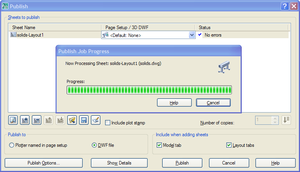
Introduction This session focuses on technologies that can be used to view and access DWF content downstream from Autodesk's design products. Yesterday's session focused on DWG – we're going to take the model containing 3D solids that we created during that session and publish it to DWF, adding custom metadata. We can then look at how to harness this data in lightweight applications, whether to access it non-graphically or to view it. Firstly, why are we using 3D solids in this example? The choice was somewhat arbitrary – the point is really to demonstrate the ability to access properties of…
-
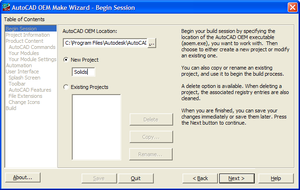
[This post continues from part 1 and part 2 of this series.] Building a full editing product using AutoCAD OEM Now we're going to take our AutoCAD .NET module from the beginning of the session and build a complete CAD package around it. AutoCAD OEM allows you to build a custom-branded version of AutoCAD, with the subset of AutoCAD's own features and additional functionality you choose to build in. A key feature of AutoCAD OEM is its security layer, which will stop any module being loaded that has not been built in by design. By limiting its extensibility – and…
-
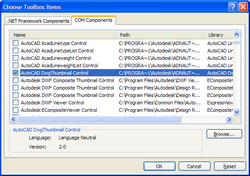
[This post continues from the last post, which I've been back and modified slightly since it was posted.] Using the DWG Thumbnail in a simple application Thumbnail images, when they exist inside a drawing, live in a predictable place at the beginning of the file. This makes it possible for a module – such as an ActiveX control – to extract the thumbnail information when pointed at a DWG file and generate an image from it. All done without the need for RealDWG (which also does this, but with a much heavier runtime component). A number of 3rd party tools…
-
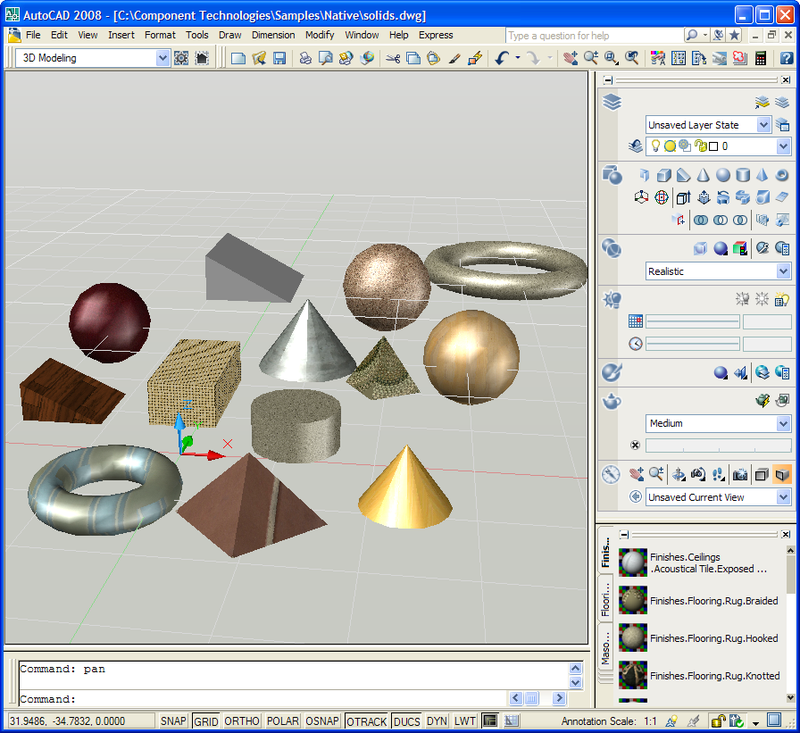
[As mentioned in the last post, I'll be publishing chunks of the handouts for my AU classes via this blog over the coming weeks] Introduction This session focuses on downstream technologies that can be used to access DWG content outside of AutoCAD-based products. We're going to start by creating a basic model inside AutoCAD comprised of 3D solid objects, and then look at a simple AutoCAD .NET application to access information about those solids. We will then take the same code and build a non-graphical (in terms of geometry - it does, after all, have a GUI) application around it…
-
On October 18th we're delivering a free AutoCAD development-oriented webcast entitled "AutoCAD: .NET for LISP Programmers". Check here for our overall API schedule, or go here to register directly. These sessions are typically held at the end of the working day in Europe (5pm CEST) which is the beginning of the day on the West Coast of the US (8am PDT). As usual, I'll post a link to the recording, once it's available.
-
This post extends this previous post that dealt with driving a single-sheet AutoCAD plot by adding some code to handle selection and transformation of a window to plot. First order of business was to allow the user to select the window to plot. For this I used the classic combination of Editor.GetPoint() for the first corner) and Editor.GetCorner() for the second. All well and good, but the points returned by these functions are in UCS (User Coordinate System) coordinates. Which meant that as it stood, the code would work just fine if (and only if) the view we were using…
-
A comment came in on this previous post regarding how best to know whether a media name is valid during your plot configuration. There are a few approaches, other than the one I chose of hardcoding the device and media names. The first is to implement a user interface of some kind which allows the user to select the device and media names. Another approach for setting the media name is to use PlotSettingsValidator.SetClosestMediaName() to choose the media name that most closely matches the paper size you desire. Today I'll focus on the first option, although I'm only going to…
-
This was a fun one to work on. The code in this post combines and extends upon techniques shown in two earlier posts: one showing how to plot multiple sheets and the other showing how to preview a single-sheet plot. One of the key differences when plotting or previewing is that while plotting can directly support multiple sheets (assuming the device does so), previewing does not. The good news is that AutoCAD provides you the user interface elements to allow cycling through plots: the user is provided with "Next" and "Previous" buttons - it's then up to you to implement…
-
This week's posts take the code I threw together last week for single-sheet and multi-sheet plotting, and introduces the concept of "plot preview". I'm learning as I go for much of this, so there are structural (although usually not functional) changes being made to the code as it develops. In this instance, for example, I've factored off common functionality needed by both previewing and plotting into a single helper function. This will no doubt evolve further (and change in structure) when I come to apply the principle to multi-sheet plotting later in the week. Here's the C# code: using Autodesk.AutoCAD.Runtime;…
-

Somewhat symmetrically I'm posting this from Chicago airport, once again, but thankfully I'm now on my way home. It was a busy week of meetings, but I did get the chance to put together some code that extended the last post into the realm of multi-sheet plot jobs. The following code took some work, but I finally managed to iron out the obvious wrinkles and put together an approach to plot multiple sheets into a single document. The standard DWF6 driver doesn't appear to support multiple sheet jobs (directly, at least), so I chose to use the DWFx driver that…