Kinect
-

As Labor Day passes and the summer draws to a close, it's time to start thinking about Autodesk University. The AU team clearly knows this (they themselves have been thinking about the event since before AU 2012, so this is more for the rest of us 😉 and so they've gone ahead and posted a preview of the class schedule for this year's event. Take a look at rows 2^8 and 2^8+1 (that's 256 and 257 for non-programmers 🙂 if you're interested in seeing information on the two classes I'm delivering, this year: one is on Leap Motion, the other…
-

Once again I'm a bit late announcing this one: I had friends visiting from the UK, last week, and so took the week off (although I ended finding a fair amount of time to study linear algebra, which was surprisingly fun). I'd queued up the week's blog posts in advance to reduce the chance of people noticing my absence. 😉 I first heard about Project Memento when I visited Singapore a few months ago (I predicted in that blog post that I'd be writing about this project the day it was live on Labs, but unfortunately that clearly didn't end…
-
I'm currently in Boston for an internal technical summit where I'll be presenting sessions on Kinect Fusion and Leap Motion (which will the sessions I've submitted - and will hopefully get accepted - for AU 2013). I arrived a day early and rented a bicycle from the hotel, taking the opportunity to cycle through the MIT and Harvard campuses (both of which are in Cambridge, where the summit is taking place) and then on to downtown Boston. It was really great being back in Boston after probably five years - it's still one of my favourite cities in the US.…
-
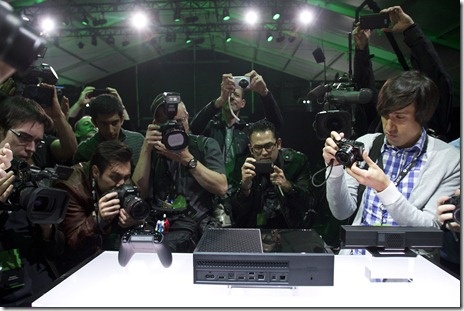
Another great week for tech. I'm in hog heaven reading all the information being shared regarding the newly-revealed Xbox One. I'm obviously most interested in the upgrade to the Kinect technology. Here's what I've gleaned, thus far: Full HD with 1080p resolution Use of something called "Active IR", a type of time-of-flight depth detection rather than relying on structured light, allowing accurate depth data even in the dark Enhanced skeleton tracking, with muscular stress and joint orientation down to the finger level Heart rate estimation, presumably using something akin to the Eulerian video magnification that made such a splash earlier…
-

I arrived back safely in Switzerland on Saturday night. It was a pretty good trip to the Bay Area, this time: most surprisingly this is the first time ever I've managed to sleep through until 6am (or thereabouts) on every single day of a trip to California. But then I – like many people – do find going west to be easier than going east, jetlag-wise. I certainly found that I couldn't get back to sleep when I woke up at home on Sunday morning at 3am, which made for a very long day (especially as we participated in the…
-
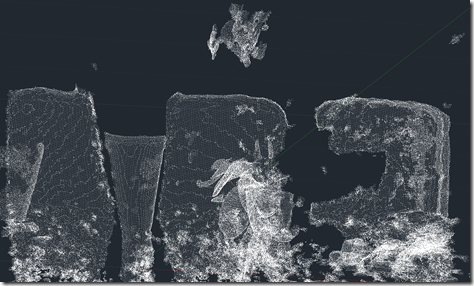
OK, here goes: my first (public) attempt at integrating the brand new Kinect Fusion functionality – made available this week in v1.7 of Microsoft's Kinect for Windows SDK – into AutoCAD. There are still a few quirks, so I dare say I'll be posting an update in due course. As mentioned in the last post, I've been working on this for some time but can now show it publicly, as the required SDK capabilities have now been published. As part of this effort, I've gone ahead and made sure the other Kinect samples I've written for AutoCAD work with this…
-
This is very exciting: v1.7 of the Kinect for Windows SDK is being released today and it includes the uber-cool Kinect Fusion component. For those of you who have not yet heard of Kinect Fusion, it allows you to use your Kinect for Windows sensor as an effective reality capture device: it aggregates input from depth frames provided by the Kinect sensor, mapping out a 3D volume. Or, for the layperson, it allows you to paint a 3D model of an existing real-world object or scene into your computer's memory. Here's a video from Engadget's Expand event, held over the…
-
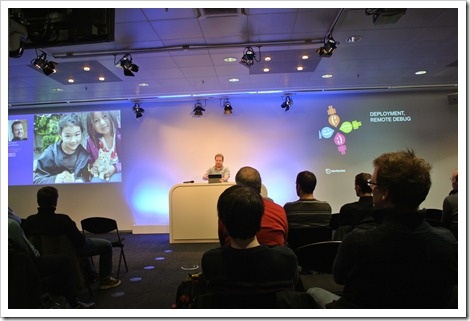
I headed cross to the Zurich area on Tuesday afternoon – which is quite a trek from where I live, around ~2.5 hours by train – to attend the first Zurich .NET Developer meet-up. The event was held in the Microsoft office in Wallisellen: they kindly provided beer and the meeting room, while the session itself was organised by members of the local .NET community. Considering the weather – a pretty serious snowstorm hit the country that day – the event was surprisingly well attended. The main topic of the session was MVVM Light, a lightweight framework developed by Laurent…
-
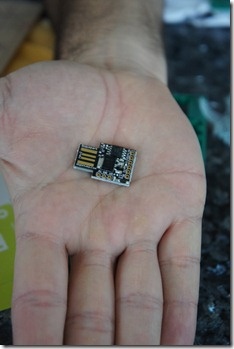
I talked about some of the fun I've been having with Arduino in this previous post. I eventually added a pushbutton and a potentiometer to that particular circuit, modifying the code to watch for a hardware interrupt – to blink the LEDs only when the button is pressed – but also to apply a variable delay to the blinking (speeding it up or slowing it down depending on the direction in which you turn the knob of the potentiometer). I've now ordered an edge connector that will fit my ZX Spectrum: my next stage for the Arduino-based work is to…
-
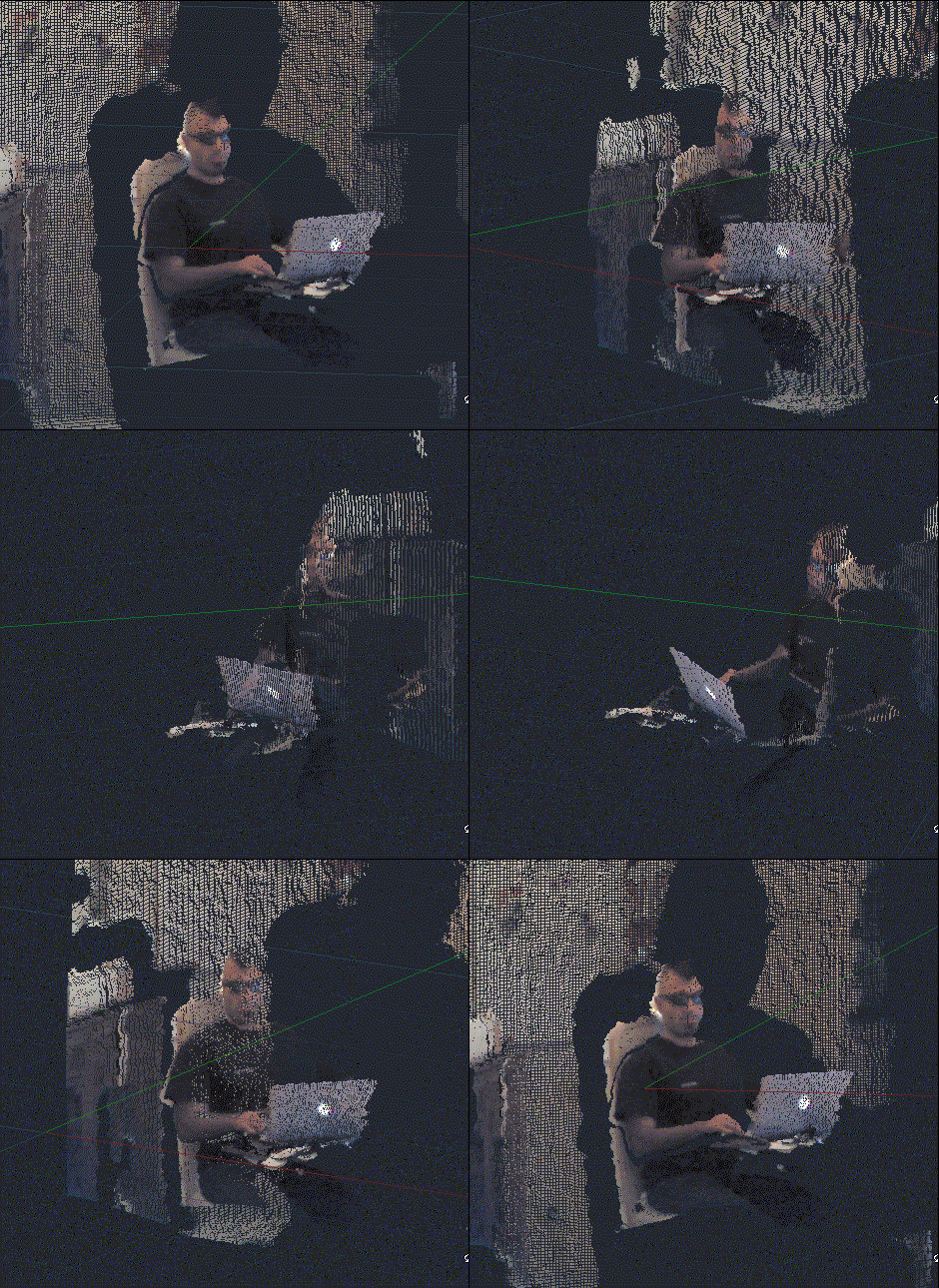
As part of my ongoing procrastination around my AU material development – despite which I'm managing to make some progress… my WinRT stuff is mostly done, now – I went ahead and updated my Kinect samples to use v1.6 of the SDK. The version which finally works from a Windows session inside a Parallels VM on my Mac. Yay! Here is the updated sample project, which includes the face-tracking capabilities shown in this previous post and therefore also requires the Kinect Developer Toolkit. It wasn't really much effort to port: a couple of methods that map depth and colour data…