3D printing
-
I stopped by the Fab Lab in Neuchâtel, last week, to say a quick hello and find out what's being worked on. Gaetan Bussy, the Lab manager, spent some time talking to me about some projects they have in the pipeline, one of which is to hack their Ultimaker to make it work with polar rather than (and eventually in addition to) Cartesian coordinates. Gaetan also showed me the latest addition to the Lab's equipment, a B9Creator they received after backing its Kickstarter project. The project was successfully funded (and then some) a year ago, so I was quite surprised this…
-
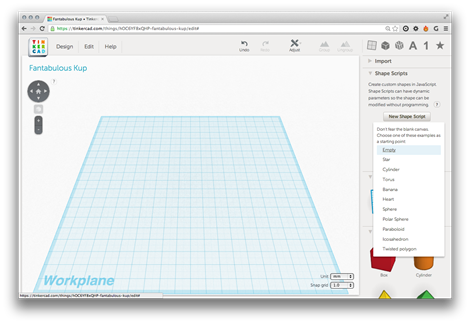
A little over a month ago, Autodesk acquired Tinkercad. Tinkercad is a 3D CAD tool that uses WebGL to display graphics directly in your browser. While this tool is primarily targeted at consumers – it's proving very popular among the 3D printing community – I thought I'd check it out to understand its customization capabilities. If you want to get to know the capabilities of the Tinkercad system, I suggest taking a look at these step-by-step lessons. I personally just dove right in – the system is very straightforward to learn – but I'm sure there are basics that I've…
-

I'm excited to announce some revolutionary new technology our "reality capture" team is working on at Autodesk. By now many people will be familiar with the Rip-Mod-Fab workflow (the 3D equivalent of Rip-Mix-Burn for music). The problem with this is that there's something fundamental missing from the equation: that most aromatic of dimensions, the world of odours. How many of you have used 123D Catch to copy a real-world object, printing it using with MakerBot, only to find something missing? That once you've got over the utter coolness of being able to print something in three dimensions, you're somehow left…
-
A few weeks ago, we looked at using PointCloud Browser to visualize simple spherical primitives brought down from a web-service, as well as creating a simple AR game to obliterate them. Visualizing (and popping) spheres is all well and good, but clearly it'd ultimately be much more interesting to visualize more complex objects in an AR scene. The good news is that PointCloud Browser supports loading models from .OBJ files, a format generated by a number of Autodesk products – particularly those used in the Media & Entertainment space. I'm not a big user of 3ds Max or Maya, and…
-
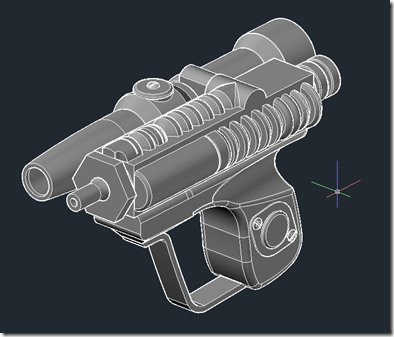
Being a bit of a Star Wars fan, I was delighted to come across this blog post by former MakerBot employee Todd Blatt (now working at Custom 3D Stuff), who modeled an Imperial Scout Trooper Blaster in AutoCAD for 3D printing. You can download the STL output and the original DWG file from here. Here's a view on the finished gun with the "shades of gray" visual style: And here's one that's "realistic" with a nice metallic material applied to it: 3D printing functional weapon parts is clearly a contentious subject – which, according to some, may sadly lead to the…
-

I clicked on through to the Chrome Web Lab from the Google home-page, yesterday. It contains some cool "experiments" that showcase the capabilities of modern web-browsers (and presumably Google Chrome, in particular). The one that especially caught my interest was number 3, the Sketchbots experiment: The experiment starts with an uploaded photo or – and this is what I did, in my case – a snapshot taken from your system's webcam. Some image processing and computer vision techniques then get applied to it – essentially to perform edge detection and convert those edges to vectors – and the resultant sketch…
-
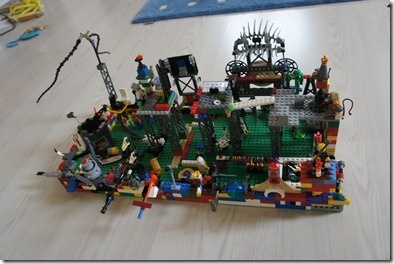
It's been a while since I've talked about our "reality capture" (or 3D reconstruction) technologies, but I still like to play around with them, when I get the chance. My previous projects have all been with the PC version of 123D Catch (previously known as the Photo Scene Editor for Project Photofly), but I've just spent a few hours messing around with the new web and iPad versions of this tool (Shaan has already spent some time talking about these new versions over on his blog, in case). Thinking about it, these two new versions have been made possible by…
-
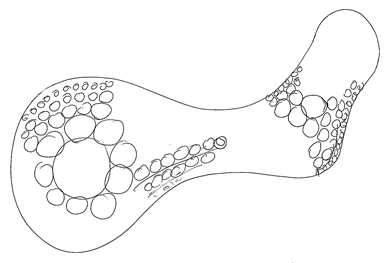
As we're nearing the end of this series, it seems a good time to do a quick recap of where we've been with the posts leading up to this point. Here goes… An interesting challenge: generating variable density fill patterns for 3D printing Generating hyperbolic geometry on a Poincaré disk in AutoCAD using .NET Generating hyperbolic tessellations inside AutoCAD using .NET Scripting the generation of hyperbolic tessellations inside AutoCAD Circle packing in AutoCAD: creating an Apollonian gasket using .NET Circle packing in AutoCAD: creating an Apollonian gasket using F# – Part 1 Circle packing in AutoCAD: creating an Apollonian gasket…
-
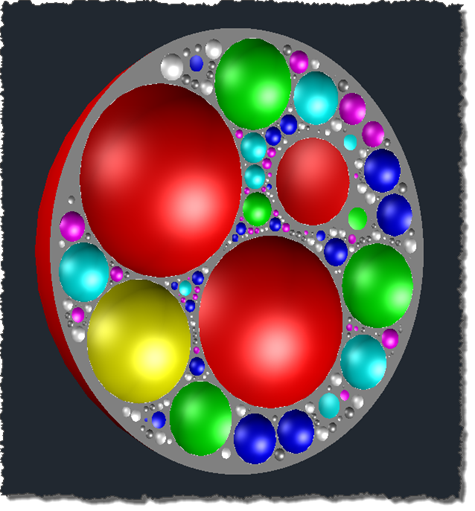
As suggested in the last post, today we're going to take the results of running the code from that post and use them to generate a hollowed-out sphere. A big thanks to Francesco Tonioni, from our Product Support team in Neuchatel, who spent some time throwing ideas around on a lazy (but very cold) Sunday afternoon, contributing significantly to this post. A few minor changes to the code were needed: rather than creating the spheres at exactly the size at which they were generated by the F# code, I adjusted the C# code to multiply the radius by 0.98 and…
-
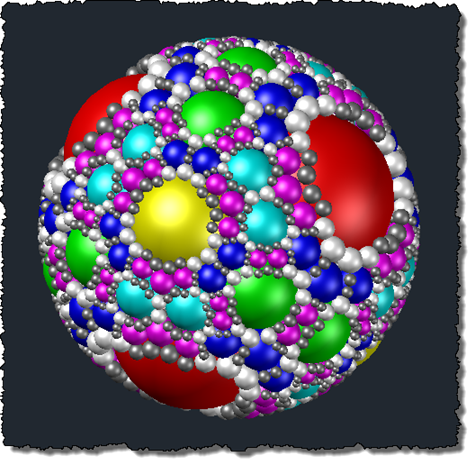
This post continues the series on fill algorithms for 3D printing by looking specifically at an Apollonian sphere packing. In the last post we got most of the way there, but today we're going to introduce a more elegant algorithm for solving the problem (with pretty impressive results :-). Many thanks to Professor Ronald Peikert from ETH Zurich for kindly providing the C++ code used to generate the F# code in today's post. The original algorithm was outlined in this paper co-authored by Professor Peikert, under the section The "Inversion Algorithm" and – as you might divine from the name…