AU
-
What a great week! The highlight – and that's from a lot of great moments – was probably the AutoCAD + Kinect session: the demos were clearly fun to do, but there was a high degree of audience participation and we all laughed a lot. For those who weren't able to attend in person, I'm going to try to find some time to record the demos and upload them to YouTube. Watch this space. I'm now about to head home to Switzerland. For lots of very good reasons, I'm currently carrying the following electronic devices: MacBook Pro This is currently…
-
So, here we are on Wednesday, day two of AU proper (although my team was busy with ADN-only sessions on Sunday and Monday). Yesterday was really fun: I was part of the "Meet the AutoCAD API Experts" panel (along with Stephen Preston, Albert Szilvasy, Mike Dickason, Bill Adkison, Davis Augustine and Fenton Webb), which is always a good session (and a privilege to spend some time alongside some of the brightest minds in CAD programming). I then had the honour of co-speaking a session on AutoCAD scripting with dave espinosa-aguilar, probably the all-time highest-rated AU speaker. It was really something…
-
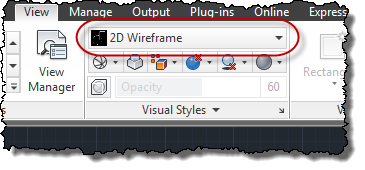
A quick one to end the week, as I really need to start packing for AU. 🙂 Thanks to Augusto Gonçalves, from DevTech Americas, for pointing out this DevNote on the ADN site in a recent email to an ADN member. The below code shows the steps to set the current visual style to "realistic" in AutoCAD. As with many AutoCAD features, you can also set the current visual style by sending commands to the command-line, but then why do something in 3 lines of code when you can do it in 40? 😉 Seriously, there are some advantages to…
-

You're probably thinking I've been talking about little else other than making Kinect work with your PC, of late (and not only because I've had a class to prepare for AU, I also think this technology has the potential to be very significant), but I did feel it was worth pointing out this important announcement from Microsoft: early next year (which presumably now means weeks away) we'll see a version of Kinect that's specifically intended to work with Windows systems (rather than the current version of the device that's really intended to be a controller for the Xbox 360). What's…
-
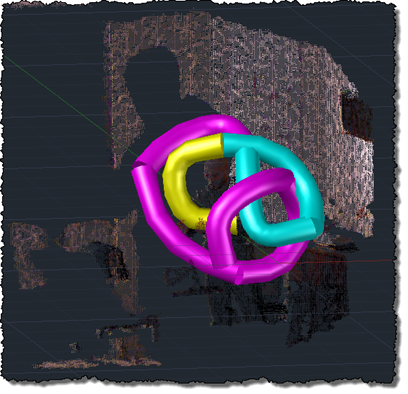
Oh, what fun. Kinect's audio capabilities were an area that I hadn't spent any time on, but an email conversation with a developer (thanks, Glenn! 😉 spurred me to take a closer look. The Beta 2 version of the Microsoft Kinect SDK, there's a new sample showing how to process audio and add speech recognition via the Microsoft Speech SDK. The Kinect SDK sample is pretty interesting: it displays a graphical indicator of where the sound is located, relative to the device (its array of four microphones allows Kinect to quite accurately position where sound is coming from, presumably to…
-
Yesterday evening, I had a nice chat by phone with a local development partner, here in Switzerland. I'm meeting with a member of his development team, next week, and we were establishing a way of us identifying one another at the train station. Rather than offering to wear a pink carnation, I suggested the visitor check the photo on my blog before coming. The developer – who had seen me in person, before – suggested it might be helpful if he mentioned to his colleague that I was "short and bald"… I'm apparently shorter than he'd initially expected – clearly…
-
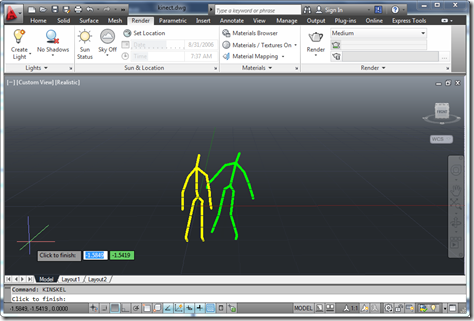
As promised, here's my handout for CP3840, the main class I'm teaching at this year's AU. Introducing Kinect Since Kinect for Xbox 360® was launched on November 4th, 2010, the device has taken the world by storm: it became the quickest selling consumer electronics device ever (according to the Guinness Book of World Records), selling 8 million units in the first 60 days. This record has since been surpassed, but still. Kinect was originally intended to be a controller for the Xbox 360 gaming system – allowing you to play games without a controller, or, as Microsoft like to say,…
-
After an initial attempt at adjusting the view in AutoCAD based on input from Kinect, this post takes it further by implementing a more effective orbit/zoom capability. The proportions/rates of each are currently still hard-coded – and so will vary in effectiveness depending on the scale of the model being navigated – but it's certainly a step in the right direction (and much closer to being demoable than my previous attempt). All in all it works quite well: when I get the chance, I'll try to put together another screencast to show it in action. The good news is that…
-
The looming AU material deadline has finally forced me to work out how to use Kinect gestures to navigate within an AutoCAD model. It's far from perfect, but the fundamentals are all there: we have a loop – outside of a jig, this time, as we don't need to display a point cloud or generate geometry in-place – that takes skeleton data provided by the Kinect and uses it to adjust the current view. Like most people, my head gets a bit twisted when dealing with DCS and WCS, cameras, targets, views, etc., but thankfully I stumbled across an old…
-
Given the fact AU 2011 is quickly approaching, I decided it was time to dust off my Kinect-related code and getting it working with the Beta SDK from Microsoft Research. Part of the reason I haven't been able to do this sooner is that my primary work machine is currently a MacBook Pro running Windows 7 via Parallels, and the Microsoft Kinect driver currently does not support working inside a Virtual Machine. I did start to try to get my previous implementation using OpenNI + NITE to work on this system, but as it uses the nKinect component that is…