AU
-
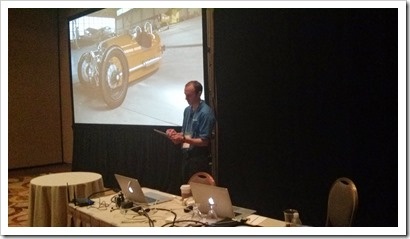
Autodesk University 2014 ended really well on Thursday. Despite me nearly showing up late for my final speaking engagement (I somehow had it in my head that it started at 1:30pm rather than 1:00pm – thankfully I chose to show up 32 minutes early!), the session itself went very well. It was the only one of my sessions that ended up being recorded (it wasn't about AutoCAD, at all – it was all about the Geneva Motor Show project which was implemented using Autodesk VRED), and it was a fun one. The final keynote was, once again, very inspiring. Amar…
-
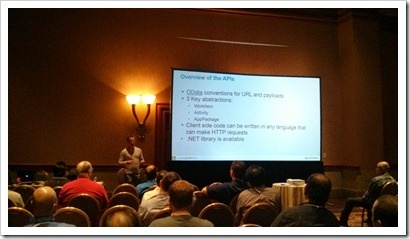
It's suddenly Thursday morning. I feel like I've been in one of those hyperlapse videos since my last blog post. Here's a quick update on what I've been up to. When I wrote my last post I was actually sitting in on Albert Szilvasy's AutoCAD I/O session. This very interesting class was recorded so be sure to watch it when it comes online. From there I headed to the Exhibit Hall. This year the Exhibit Hall at AU is just incredible. I don't know what's changed, exactly, but I just love the way it's been laid out. And I've really…
-
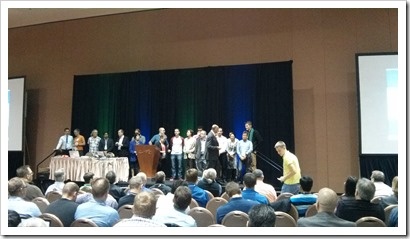
It's Tuesday afternoon and we're just one day into the main AU 2014 event. Yesterday's pre-conference event was the ADN DevDay. It was nice to see my old team (although there were quite a few new faces since I was part of it) take to the stage in a room that was pretty much packed to capacity: During his keynote our SVP of Industry Strategy and Marketing, Andrew Anagnost, talked about the upcoming business model transformation from perpetual to term-based licensing. Then followed a number of technical presentations about Autodesk's PaaS layer – especially the View & Data API –…
-

Even if you weren't able to make it across to Las Vegas for AU, this week, then you can still attend the opening keynote, innovation forums, closing session and a number of key classes via live streaming video. Apparently an additional 200+ classes will be recorded for AU Online, but I don't know which – if any – of mine will be. Here are links to the events/sessions in which I'm participating in some way, should you want to check out the posted handouts, samples and presentations. I've put them in chronological order, so people lucky enough to be here…
-
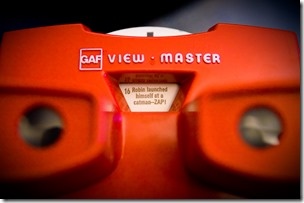
I've long been fascinated by stereoscopy, as I suspect is the case for most people lucky enough to have two functioning eyes. There's something magical about a device that immerses us in a three dimensional scene by hijacking that fundamental input mechanism of ours, binocular vision. I almost always get that "oh wow" feeling: it just never gets old. I also happen to like collecting cool bits of vintage technology, although in an admittedly haphazard and opportunistic way: I have printing blocks, a typewriter, a TI-57 programmable calculator, an Apple Newton, a Palm Pilot and an iPAQ, to name a…
-
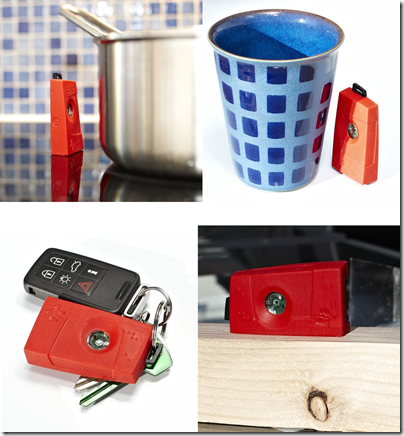
[This handout is for "SD5013 - Using SensorTag as a Low-Cost Sensor Array for AutoCAD", a 60-minute class I'll be presenting at AU 2014. Here's the sample project that accompanies this handout.] Introducing SensorTag SensorTag is a $25 device containing a number of sensors – an accelerometer, a gyroscope, a magnetometer, a thermometer, a hygrometer and a barometer – that communicates to a monitoring system (whether an iOS or Android mobile device or a Windows or Linux PC) via Bluetooth 4.0 (also known as Bluetooth Smart or Bluetooth Low Energy – BLE). Texas Instruments have packaged their CC2541 sensor…
-
In yesterday's post we saw a simple implementation of two commands to translate between geographical locations (latitude-longitude values) and drawing points inside AutoCAD. In this post we're extending that to access the current coordinate system, as returned by the GeoLocation object attached to the current drawing. Which in some ways should be simple, but then the CoordinateSystem property actually returns XML data, not just the simple coordinate system name you probably passed in when choosing it (see the IGR command, below, to see what I mean): <?xml version="1.0" encoding="utf-16" standalone="no" ?> <Dictionary version="1.0" xmlns="http://www.osgeo.org/mapguide/coordinatesystem"> <ProjectedCoordinateSystem id="SWISS"> …
-

Now that registration is open for Autodesk University 2014, people are busy signing up for classes. For those of you who are curious about the classes I'm delivering/hosting/attending at this year's event, here they are. I'll break things down day-by-day, in case you're interested in finding an opportunity to meet up but can't attend one of my sessions. Monday (Dec 1st) I'll be attending the ADN DevDay, all day. Always lots of great information to absorb there, of course (jetlag permitting ;-). Tuesday (Dec 2nd) I'll be hanging out at the ADN DevHack for most of the afternoon, although I…
-

A few weeks ago I received the official retail version of Kinect for Windows 2 (having signed up for the pre-release program I had the right to two sensors: the initial developer version and the final retail version). After some initial integration work to get the AutoCAD-Kinect samples working with the pre-release Kinect SDK, I hadn't spent time looking at it in the meantime: the main reason being that I was waiting for Kinect Fusion to be part of the SDK. The good (actually, great) news is that it's now there and it's working really well. For those of you…
-

Some of you are probably aware of this activity from Shaan's and Scott's blogs, but I thought it was overdue a mention here, too. Autodesk is sponsoring the mother of all road trips: over the course of 8 months, TJ McCue is travelling the length and breadth of the United States in a brightly decorated recreational vehicle (RV), spreading the word about 3D technology. TJ is talking to people around the country about reality computing – capture, processing and fabrication processes such as 3D printing – as well as the availability of low-cost design tools. TJ is documenting his travels…