AutoCAD
-
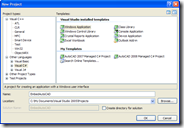
This post takes a look at another topic outlined in this overview of the new API features in AutoCAD 2009. AutoCAD 2009 introduces the ability to embed the application in a standalone dialog or form via an ActiveX control. This capability has been around for a number of releases of AutoCAD OEM, but this feature has now been made available in the main AutoCAD product. The way the control works is to launch an instance of AutoCAD in the background (it should go without saying that AutoCAD needs to be installed on the system, but I've said it, anyway 🙂…
-
Back from a nice long weekend, although I spent most of it sick with a cold. I find this increasingly the way with me: I fend off illness for months at a time (probably through stress, truth be told) but then I get a few days off and wham. A shame, as we had a huge dump of snow over the weekend... we get white Christmases here every five years or so, but it's really uncommon to get a white Easter. I had a very interesting question come in by email from 冷血儿, who wanted to get the technique shown…
-
A big thanks to Scott McFarlane, from Geotropix, Inc., for sharing the code in this post. Here's an email I received from Scott: I was reading this blog entry on "Through the Interface" and some folks were asking about how to implement .NET combo box versions of the color and linetype ActiveX controls that are available. I just wanted to share a simple .NET implementation of a color combo box. The color combo is quite easy, really. The linetype one would be more difficult. Attached is the source code. This is just a generic color combo, that loads up with…
-
I had a question come in by email about how to find out the full path of a drawing open inside AutoCAD. Here's some C# code that does just this: using Autodesk.AutoCAD.Runtime; using Autodesk.AutoCAD.ApplicationServices; using Autodesk.AutoCAD.DatabaseServices; namespace PathTest { public class Commands { [CommandMethod("PTH")] public void DrawingPath() { Document doc = Application.DocumentManager.MdiActiveDocument; HostApplicationServices hs = HostApplicationServices.Current; string path = hs.FindFile( doc.Name, doc.Database, FindFileHint.Default …
-
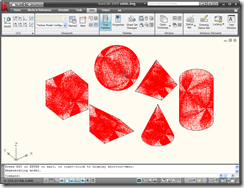
To start off my series of more in-depth looks at the new APIs provided in AutoCAD 2009, I decided to extend some recently posted F# code to generate and draw transient point clouds to be slightly less transient: we'll see how to use the new transient graphics API in AutoCAD to display a cache of transient graphics, even after the view has been changed. Some of you may be wondering about the amount of code I'm posting in F#. I find the technology extremely interesting and am also increasingly productive with it, so I've found myself gravitating towards using it…
-
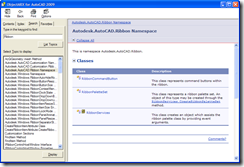
I've been taking some time this week to dive into some of the new APIs available in AutoCAD 2009. I'm going to post a very quick overview of the APIs available in this post, following up with a more in-depth look at some of the individual APIs in posts over the coming weeks. I've used material presented at our most recent ADN Developer Days tour as a source of information (a big thanks to Fenton Webb, from DevTech Americas, who was largely responsible for developing this content). Before talking about the new APIs, the first thing to note is that…
-
At the beginning of the week, we looked at some iterative F# code to generate random point clouds inside AutoCAD. We then took the time to use Reflector to dig under the hood and understand why the previous recursive implementation was causing stack problems. For completeness (and - I admit it - being driven slightly by laziness, as this is a quick post to crank out 🙂 here's the recursive version of the random point cloud generation code in F#: // Use lightweight F# syntax #light // Declare a specific namespace and module name module MyNamespaceRecursive.MyApplication // Import managed assemblies…
-
I've talked about Lutz Roeder's Reflector tool a couple of times and it's proven to be very useful to me, once again. I mentioned in my last post about some problems I was having with tail recursion, and my choice to replace certain recursive functions with iterative versions. Today we're going to use Reflector to take a look under the hood of some compiled assemblies, to determine which recursive functions have been optimised correctly and which have not. Let's start by taking a look at the two recursive functions I mentioned last time, starting with the most simple: // A…
-
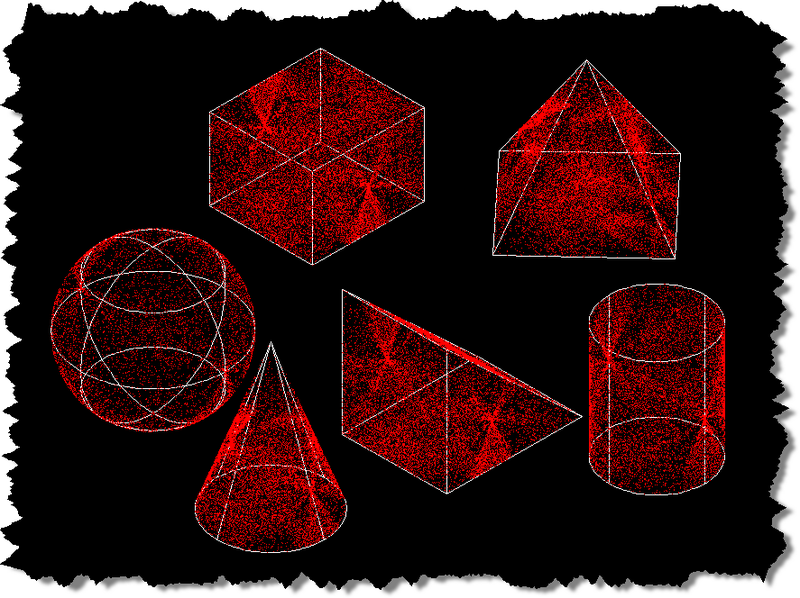
On my way back from the US last week, I started thinking more about uses for random numbers inside AutoCAD: especially ones that allow me to try out some possible application areas for F#. There's something deliciously perverse about using random numbers in Engineering systems, where it's really important for outcomes to be deterministic (i.e. predictable) & precise. And that perversity appeals to me quite strongly, for some reason. Feel free to drop me a mail if you have an idea why that might be, any amateur psychologists out there... 😉 So, I got to thinking... an interesting domain area…
-
In the last post we saw some code combining F# with C# to create a random "hatch" - a polyline path that bounces around within a boundary. This post extends the code to make use of Asynchronous Workflows in F# to parallelize the testing of points along a segment. In the initial design of the application I decided to test 10 points along each segment, to see whether it remained entirely within our boundary: the idea being that this granularity makes it very likely the segment will fail the test, should it happen to leave the boundary at any point.…