Reality capture
-
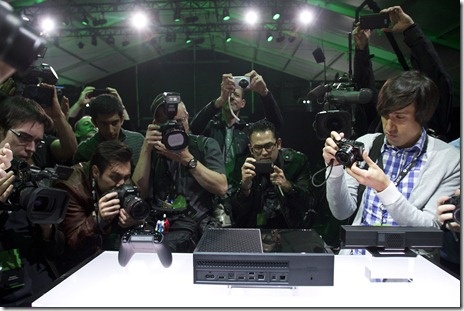
Another great week for tech. I'm in hog heaven reading all the information being shared regarding the newly-revealed Xbox One. I'm obviously most interested in the upgrade to the Kinect technology. Here's what I've gleaned, thus far: Full HD with 1080p resolution Use of something called "Active IR", a type of time-of-flight depth detection rather than relying on structured light, allowing accurate depth data even in the dark Enhanced skeleton tracking, with muscular stress and joint orientation down to the finger level Heart rate estimation, presumably using something akin to the Eulerian video magnification that made such a splash earlier…
-

I arrived yesterday morning in Singapore, coming in on a Singapore Airlines A380 from Zurich. It was a great flight, as far as long-hauls in economy go: comfortable seats with a great choice of films to watch (my favourite on this leg being "The Cloud Atlas", an excellent adaptation of a brilliant novel lent to me by Jeremy Tammik a couple of years ago). I even managed to catch an hour or two of sleep, which is surprising for a daytime flight, even if it landed at 6am local time in Singapore. I rested for a few hours at the…
-

I'm excited to announce some revolutionary new technology our "reality capture" team is working on at Autodesk. By now many people will be familiar with the Rip-Mod-Fab workflow (the 3D equivalent of Rip-Mix-Burn for music). The problem with this is that there's something fundamental missing from the equation: that most aromatic of dimensions, the world of odours. How many of you have used 123D Catch to copy a real-world object, printing it using with MakerBot, only to find something missing? That once you've got over the utter coolness of being able to print something in three dimensions, you're somehow left…
-
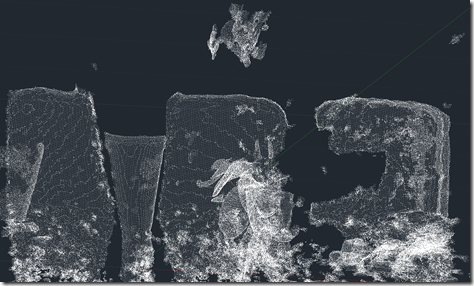
OK, here goes: my first (public) attempt at integrating the brand new Kinect Fusion functionality – made available this week in v1.7 of Microsoft's Kinect for Windows SDK – into AutoCAD. There are still a few quirks, so I dare say I'll be posting an update in due course. As mentioned in the last post, I've been working on this for some time but can now show it publicly, as the required SDK capabilities have now been published. As part of this effort, I've gone ahead and made sure the other Kinect samples I've written for AutoCAD work with this…
-
This is very exciting: v1.7 of the Kinect for Windows SDK is being released today and it includes the uber-cool Kinect Fusion component. For those of you who have not yet heard of Kinect Fusion, it allows you to use your Kinect for Windows sensor as an effective reality capture device: it aggregates input from depth frames provided by the Kinect sensor, mapping out a 3D volume. Or, for the layperson, it allows you to paint a 3D model of an existing real-world object or scene into your computer's memory. Here's a video from Engadget's Expand event, held over the…
-

I clicked on through to the Chrome Web Lab from the Google home-page, yesterday. It contains some cool "experiments" that showcase the capabilities of modern web-browsers (and presumably Google Chrome, in particular). The one that especially caught my interest was number 3, the Sketchbots experiment: The experiment starts with an uploaded photo or – and this is what I did, in my case – a snapshot taken from your system's webcam. Some image processing and computer vision techniques then get applied to it – essentially to perform edge detection and convert those edges to vectors – and the resultant sketch…
-
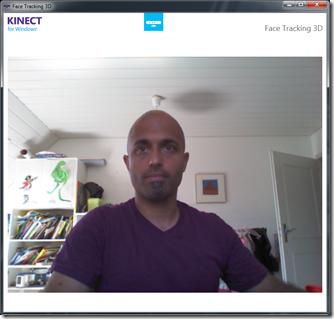
After discovering, earlier in the week, that version 1.5 of the Kinect SDK provides the capability to get a 3D mesh of a tracked face, I couldn't resist seeing how to bring that into AutoCAD (both inside a jig and as database-resident geometry). I started by checking out the pretty-cool FaceTracking3D sample, which gives you a feel for how Kinect tracks faces, super-imposing an exaggerated, textured mesh on top of your usual face in a WPF dialog: I decided to go for a more minimalist (which also happens to mean it's simpler and with less scary results 🙂 approach for…
-
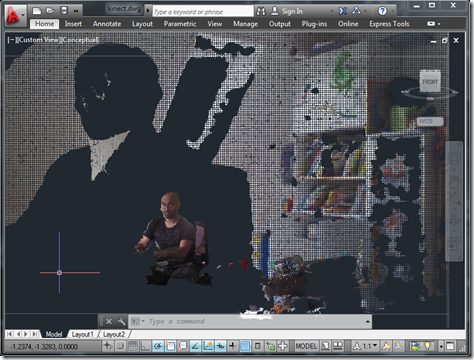
As promised in the last post, today we're going to see the adjusted point cloud import workflow applied to the previously posted Kinect integration samples. This was also an opportunity to look at the improvements in version 1.5 of the Kinect for Windows SDK. When the SDK was announced, my initial reaction was "OK, but what we really need is finger-tracking", especially as it was right around the time Leap Motion made their big announcement. But there have nonetheless been some really interesting capabilities added to the Kinect SDK with version 1.5: Seated mode skeletal tracking You can choose to…
-
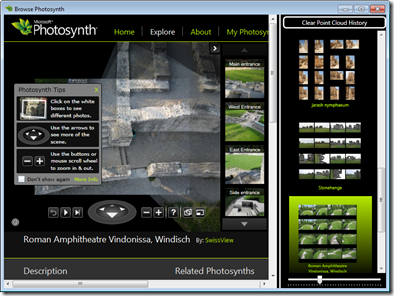
Thanks to RS for raising this issue via a blog comment and to my esteemed colleague, Christer Janson, for suggesting the solution during England's epic Euro 2012 victory over Sweden on Friday evening (sorry, Christer – I couldn't help but rub it in just a little ;-). On a slightly more serious note, I find it very painful to watch England play, at the best of times, and while I was happy "we" won, I was sad to see Sweden left with no chance of continuing past the group stage. So it goes. Those of you who have played around…
-
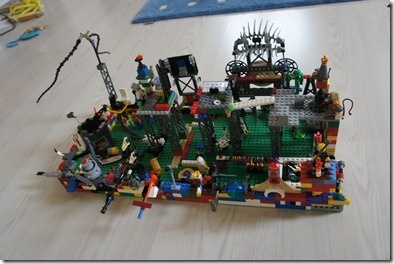
It's been a while since I've talked about our "reality capture" (or 3D reconstruction) technologies, but I still like to play around with them, when I get the chance. My previous projects have all been with the PC version of 123D Catch (previously known as the Photo Scene Editor for Project Photofly), but I've just spent a few hours messing around with the new web and iPad versions of this tool (Shaan has already spent some time talking about these new versions over on his blog, in case). Thinking about it, these two new versions have been made possible by…