Point clouds
-
There's a lot happening in the Reality Computing team. Firstly, there's a new Reality Computing blog in town. Be sure to bookmark it or subscribe to it to keep up-to-date on the goings-on in this fast-moving field. Secondly, [thanks to the blog we know] there's a series of webinars – starting today, apologies for the short notice – on Reality Computing topics. They are being held on May 13th, 20th and 27th and the series kicks off today at 9am PST with a session on "The basics of terrestrial 3D laser scanning with ReCap". If you happen to read this in…
-
It's Good Friday, so much of the world will be offline today, but I thought I'd post quickly on some (good) news that may be of interest to people. The ReCap team has officially launched a new partner program. This provides access to a number of mechanisms for integrating with or harnessing Autodesk ReCap products and services. The Capture Codec Kit is primarily for importing custom point cloud formats – something important for hardware manufacturers, particularly – into Autodesk ReCap on the desktop. Embedded ReCap OEM allows generated or post-processed point cloud data to be brought into Autodesk's design products…
-
I thought I was done with my posts for the week, but this was too good not to share. The below video shows a scene being captured using a GoPro Hero 3 Black edition on a 5-second timelapse setting mounted on a DJI Phantom drone and processed with Photo on ReCap 360 before being used as a basis for a conceptual model created in Revit 2014. Phew. This is very much a proof-of-concept rather than a genuine project – no architect was involved, for instance – but it does a good job of showing the possibilities of this kind of…
-
Aside from being St. Valentine's Day, Friday is notable as it marks the beginning of the first ever ETHx class, "AMRx – Autonomous Mobile Robots". ETHx is the moniker being used by the prestigious technical institution ETH Zurich for the MOOC courses they're delivering as part of edX. This is exciting: despite the fact I live close enough theoretically to attend classes at ETH Zurich in person, I'm very happy to be able to do so from the comfort of my home. The topic is itself very interesting… the "environment perception" piece alone looks as though it should cover algorithms…
-
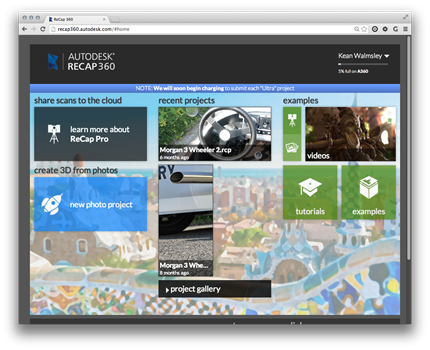
I've pulled together a few miscellaneous updates that relate to Autodesk's Reality Computing efforts, which – as I mentioned earlier – is a term that's intended to include "Reality Capture" at the beginning, followed by "Reality Modeling and Analysis" and then "Reality Delivery". Firstly, looking at the capture side of things… Photo on ReCap 360 (the new name for ReCap Photo) now has free and paid versions available. Although at the time of writing it's still possible to make use of the soon-to-be-paid benefits for free, but do hurry! Preview mode – with up to 50 source images of 12…
-
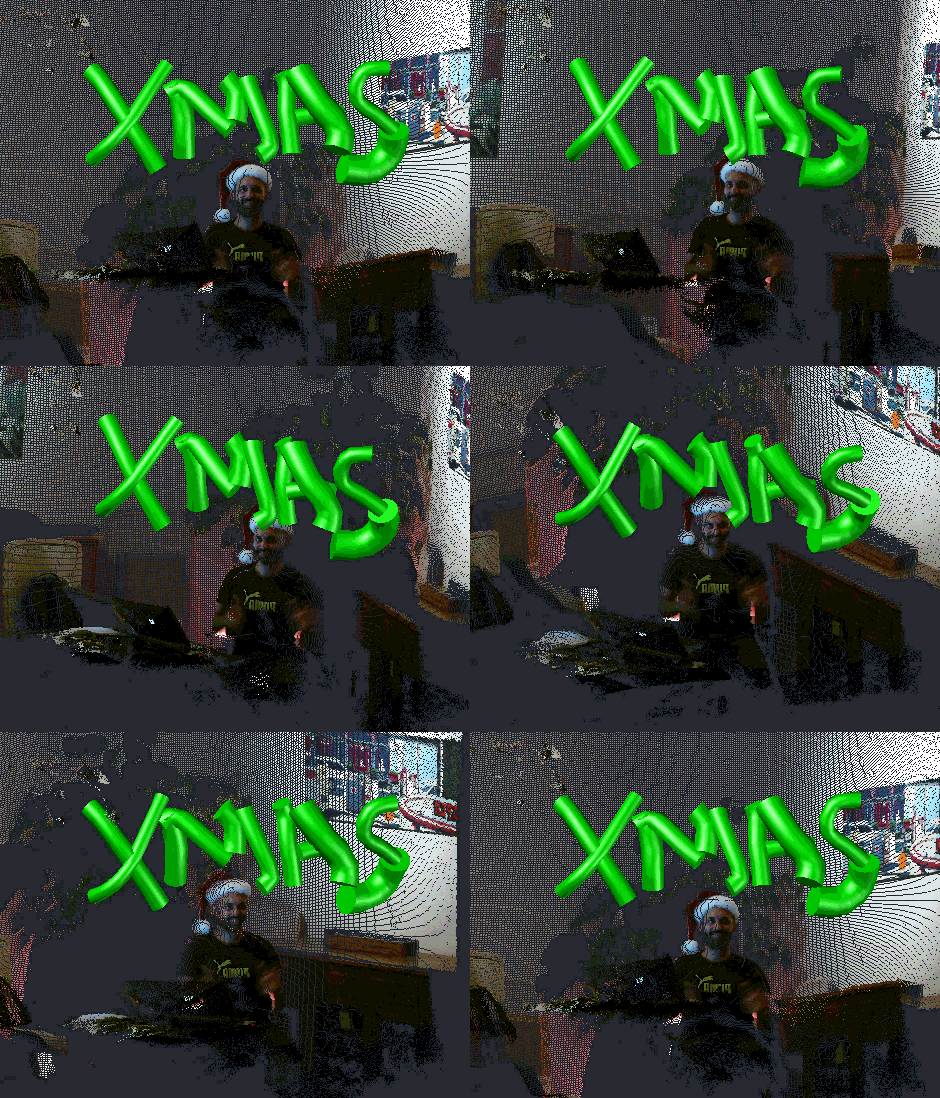
During the general wind-down before Autodesk's annual "week of rest", I've been spending some time this week getting more of my AutoCAD-Kinect integration samples working with the pre-release Kinect for Windows 2.0 device and SDK. Things are actually working pretty well: all samples – barring those that rely on capabilities that aren't yet part of the SDK – are functional and some have even been enhanced based on new capabilities of the 2.0 device. For instance, I've reworked the "piping" sample (the one that extrudes a circular profile through 3D space) to make use of the distance between the palm…
-
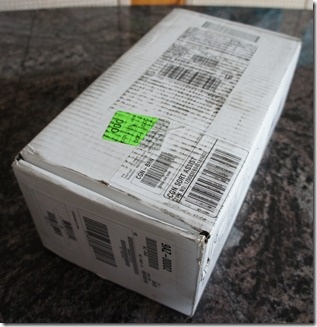
I was hoping to get the Kinect for Windows 2.0 pre-release developer kit in time for AU – so I can talk about it intelligently, even if I don't end up demoing it – so when the UPS delivery man showed up, yesterday, I was very happy. As always, it started with a simple box: Which, once opened, revealed some nice monochrome graphics: And the device itself, of course (tripod is model's own ;-). The addition of the tripod screw-hole on the bottom is very welcome: I ended up buying…
-
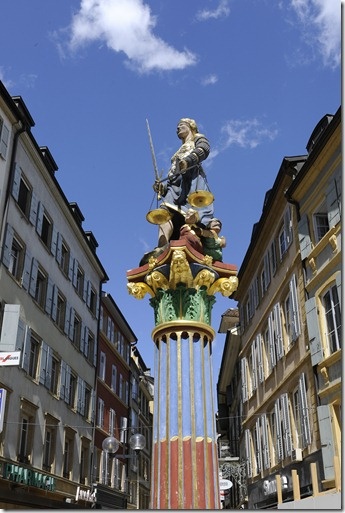
As mentioned in yesterday's post, on Monday I spent a few hours in the early morning at the local archeological museum, the Laténium. While this is nowhere near the scale of the Smithsonian, it is the largest archeological museum in Switzerland and is well known by people in the field, especially those interested in La Tène culture. I love the Laténium – our kids often seem to go there for birthday parties, which certainly beat the ones held at the local McDonalds – and so I was delighted to get to go "behind closed doors" (the museum is closed on…
-
Last week was an exciting one for the organisation at Autodesk that works on "Reality Computing" (a broader term I've seen recently that includes "Reality Capture" at the beginning, followed by "Reality Modeling and Analysis" and then "Reality Delivery"). Their big announcement was a partnership with the Smithsonian – the venerable Washington DC-based institution that is the world's largest museum and research complex – to bring digital scans of many important exhibits online and accessible to all via the Smithsonian x3D Explorer. Shaan talks about the announcement in depth on his blog. I won't repeat what he's said over there,…
-
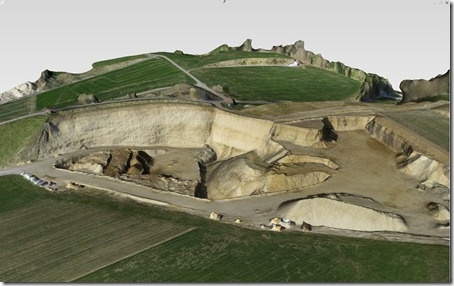
Earlier this year I came to know about a "local" company called senseFly. (When I say local, I mean they're also in the French-speaking area of Switzerland, which is a relatively small region of a small country… I suppose that would be considered local by some standards. 🙂 senseFly started as a spin-off of the prestigious Ecole Polytechnique Fédérale de Lausanne (EPFL). (EPFL is one of the two top technical universities in Switzerland, the other being Eidgenössische Technische Hochschule Zürich (ETH Zürich)). They specialise in making unmanned aerial vehicles (UAVs) – drones – and now belong to the Parrot group…