AutoCAD
-
Here's a question I received recently from Dustin Vest, who works as a PDMS administrator at Fluor: I am having a problem with Intergraph's SmartSketch dwg files it exports... I found some code on your site that got me into the blocks, but I can't seem to change the draworder of entities within the block. SmartPlant 3D exports all the symbols as blocks but with wipeouts on top of the rest of the block. Dustin provided some code that was very nearly working – it really didn't need much work to get it in shape – and has kindly allowed…
-

I'm a few days late to the party (largely because I got a little distracted), but felt it was still worth posting on this topic: we've just launched AutoCAD 360, the successor to AutoCAD WS. It's more than a straight re-branding, though: while the mobile apps for iOS and Android are updates to the existing WS-branded technology, there's a brand new web app that's currently in Beta. We've also taken the opportunity to roll out a true freemium offering, whereby the basic, free capabilities are complemented by "Pro" and "Pro Plus" mobile plans. Here's a comparison of the offerings, in…
-
The ADN team has recently announced their annual API wishlist surveys for both AutoCAD and AutoCAD Civil 3D. Our Engineering teams take the results of these surveys very seriously, and greatly appreciate the time you take to provide us with feedback on both our APIs and their related resources. The Civil 3D survey closes on June 15th, while the one for AutoCAD closes on June 21st. Thanks in advance for your feedback!
-

Do you make regular use of AutoCAD Architecture (ACA), AutoCAD MEP (AME) or AutoCAD Mechanical (ACM)? If so, I'd be interested in hearing from you. First, some background. Something I haven't yet talked about on this blog is an additional role I've picked in recent months: I'm now the (software) architect assigned to the three, above-mentioned, AutoCAD-based verticals. These products have a long history – and make quite varied use of AutoCAD's APIs – so I was excited by the opportunity. Incidentally, this doesn't mean the focus of this blog is changing, at all – my role for these products…
-
Here's something else that may be of interest to people. As I was working towards the solution shown in the last post – before Albert told me about the ucsToWorld() function (thanks, Albert 🙂 – I ended up extending the .NET code we saw in the previous post to include a TransformToWcs() method (marshaled by a transToWcs() function on the JavaScript side of things). What's interesting about this function – and has caused me to show it here, despite its existence being rendered redundant by ucsToWorld() – is that it returns a value to the caller by serializing point data…
-
I've learned a few things since the last post, where we complemented AutoCAD's new JavaScript API with some additional .NET functionality to work around an issue that existed in the code we'd developed in the previous two posts. Firstly, I found out there's a better way for your jig to display transient graphics than via "manual" calls to addTransient(), updateTransient() and eraseTransient(). Acad.Jig exposes an update() function you can call, passing in the xml fragment representing your geometry. The jig will manage the display of the transient and clear it at the end. (Thanks to Sherry Tan for pointing me…
-
After having some fun writing our first jig inside AutoCAD, last week, and calling it either from an HTML page or an AutoCAD command defined in a .js file, in today's post we're going to see how we can use AutoCAD's .NET API to extend its new JavaScript layer. We're going to take a concrete problem we had in last week's implementation: it turns out that when you draw a transient circle beneath the cursor using JavaScript – as we do during our jig – it absorbs mouse clicks. This is something we've logged as an issue, but it seems…
-
Just to complement yesterday's post showing how to define a simple jig using JavaScript, here's the same code from a separate .js file: var doc = Acad.Application.activedocument; var center = new Acad.Point3d(0, 0, 0); var radius = 0; var trId; function pointToString(pt) { var ret = pt.x.toString() + "," + pt.y.toString() + "," + pt.z.toString(); return ret; } function createCircle(cen, rad, first) { // Build an XML string containing data to create // an AcGiTransient that represents the circle var cursor = ''; var drawable =…
-
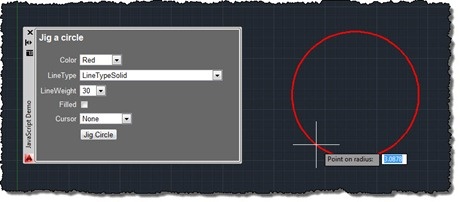
After talking about the architecture of our JavaScript API in this recent post – and mentioning the approach we expect developers to take when creating geometry in one of the comments – I thought it would be worth spending the time to write my first JavaScript jig in AutoCAD. For those of you who haven't come across jigs in either ObjectARX or AutoCAD .NET, jigs are the primary way applications request users to dynamically specify geometric parameters while providing them with graphical feedback. As users select points or specify distances, the object or objects they're creating are updated in real-time…
-

I arrived back safely in Switzerland on Saturday night. It was a pretty good trip to the Bay Area, this time: most surprisingly this is the first time ever I've managed to sleep through until 6am (or thereabouts) on every single day of a trip to California. But then I – like many people – do find going west to be easier than going east, jetlag-wise. I certainly found that I couldn't get back to sleep when I woke up at home on Sunday morning at 3am, which made for a very long day (especially as we participated in the…