AutoCAD
-
This post contains the second part of the handout for my Windows 8-related session at AU 2012 (here's the first part). Here's the accompanying source project for the MetroCAD application, which has now been upgraded to work on the shipping version of Windows 8. What can be done with AutoCAD? Something that's being promoted by Microsoft to developers of "heavyweight" desktop apps is the idea of a companion app. These are essentially Windows Store apps that complement desktop apps such as AutoCAD. We're going to see one such companion app in this session: an app called MetroCAD that is basically…
-
I finally managed to wrap-up my AU material over the weekend. Here's the first part of the handout for my Windows 8-related session (if you log in with your AU account, you'll be able to access the accompanying presentation and sample project). This is an "intermediate" class (rather than "advanced"), so at times it may seem fairly high-level. That said, if anyone sees issues with the material – especially important topics that have been glossed over – please do let me know: I'd be happy to make corrections (especially in advance of the class being delivered :-). Introduction Windows 8…
-
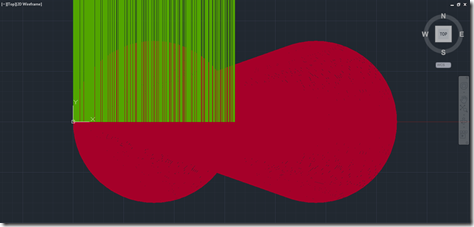
After introducing the work down by Carlos Paris on using AutoCAD to hunt prime numbers, we then looked at some DesignScript code that essentially recreates the core geometry Carlos used to visualize prime numbers. In this post, we'll create some .NET code that iterates through the visualization, gathering primes and tagging them with rays to make them easily locatable. Now use AutoCAD as a graphical hash-table in this way is not the way you're going to discover a billion-digit prime number, but the approach is interesting because it adds useful information to the primes visualization and also shows some potentially…
-
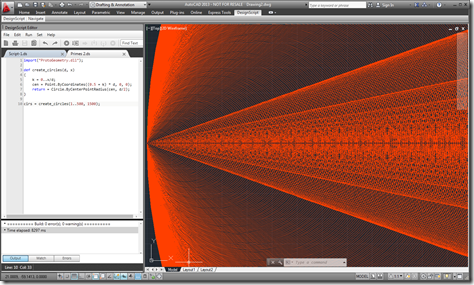
In the last post we looked at some amazing visualizations of prime numbers created by Carlos Paris. I also mentioned I'd try my hand at replicating the basic visualization using DesignScript: it's a good fit for solving this kind of problem (we want to create lots of repeated geometry based on the results of mathematical expressions). Incidentally, some readers of this blog have expressed an interest in learning more about DesignScript. I've roped in Robert Aish and Luke Church to share some of their insights into the design of – and uses for – the language, and so they'll be…
-
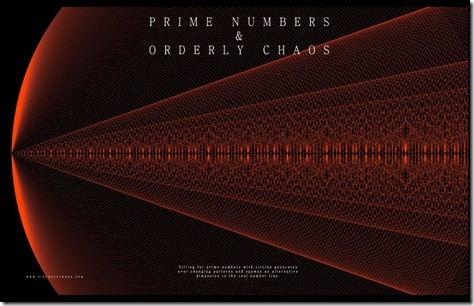
As Shaan reported over on his blog, AutoCAD gets used in some very surprising ways. This "Hack A Day" article highlights the achievements of Carlos Paris, an HVAC engineer and AutoCAD user who found a novel way to visualize and understand prime numbers. Carlos originally believed he'd found an elusive proof for the twin prime conjecture, and while it turned out not to be the case he certainly found a novel way of representing a Sieve of Eratosthenes graphically. I really enjoyed watching Carlos's videos on YouTube, and thought I'd check in with him by email to see how he'd…
-

There was a follow-up comment on this previous post, requesting that it also create a rectangular boundary around selected geometry. This is a much simpler problem to solve that dealing with a minimum enclosing circle, so I was happy enough to oblige. 🙂 Rather than duplicate code from the previous implement, I went ahead and generalised it to contain a core set of functions that get called from different commands: MEC in the existing case where circular boundaries are required and MER for the new case of a rectangular polyline boundary. I've also adjusted the prompts and code to be…
-
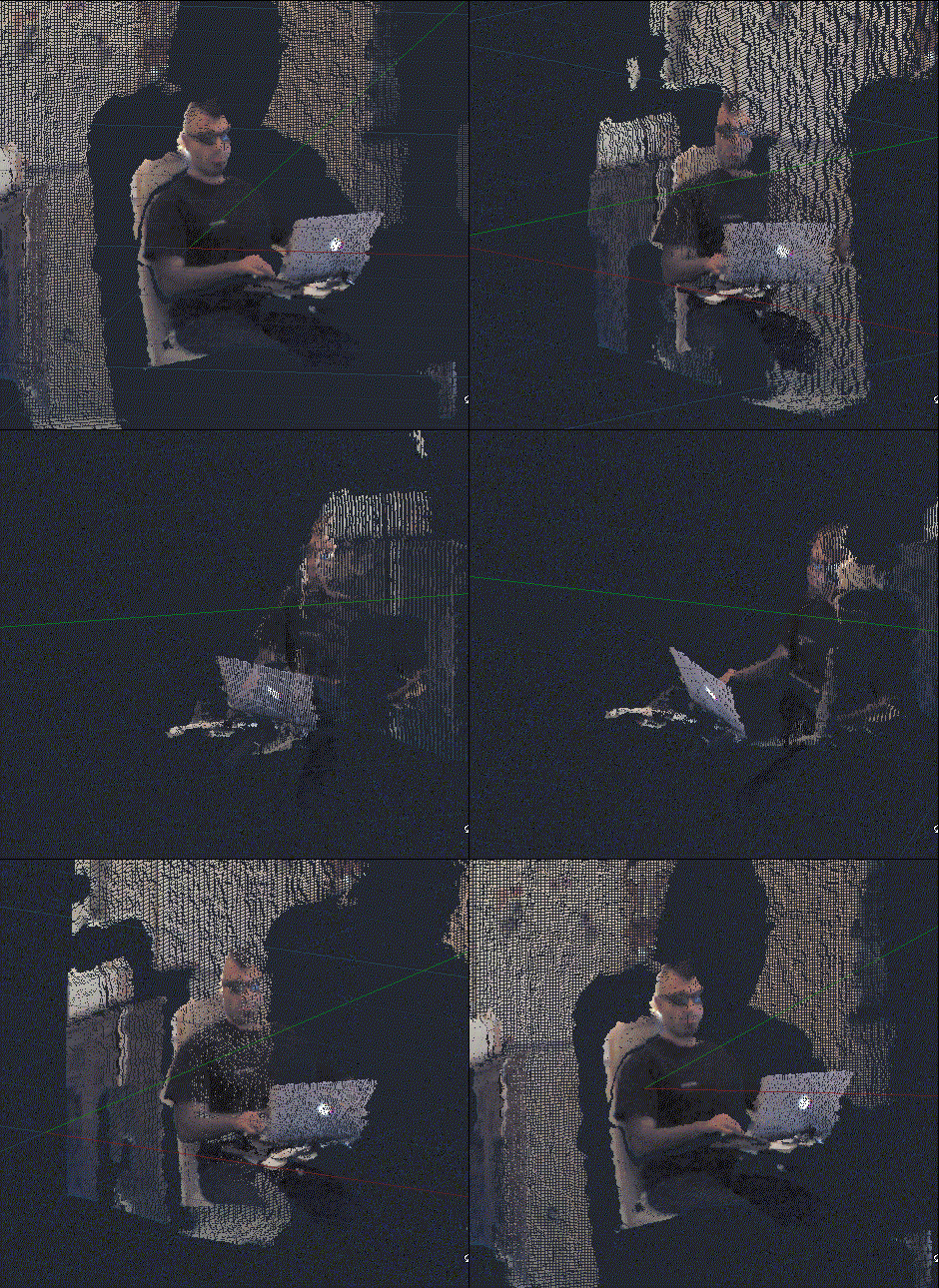
As part of my ongoing procrastination around my AU material development – despite which I'm managing to make some progress… my WinRT stuff is mostly done, now – I went ahead and updated my Kinect samples to use v1.6 of the SDK. The version which finally works from a Windows session inside a Parallels VM on my Mac. Yay! Here is the updated sample project, which includes the face-tracking capabilities shown in this previous post and therefore also requires the Kinect Developer Toolkit. It wasn't really much effort to port: a couple of methods that map depth and colour data…
-
Since mentioning my earlier involvement with DesignScript, I've been meaning to follow up with a quick post on why this programming language is different to the others people are currently using with AutoCAD. Hence the title of the post, which stands for "Yet Another Scripting Language?", inspired by two acronyms, Yacc and YAG (this is a subject-line often used by long-time Autodeskers leaving the company and stands for "Yet Another Gone"… I'm not sure if this term is used in the outside world – a quick Google would indicate not, but then you never know). Anyway, back to the question:…
-
It's been a hectic week and I haven't been able to find much time to work on a final post for today, so I had a quick delve in my "interesting" folder and found this little gem. Not long ago, someone asked me by email about the reason for making the various co-ordinate properties (X/Y/Z) of Autodesk.AutoCAD.Geometry.Point2d and Point3d read-only, essentially making these classes immutable. Being a big fan of functional programming, I can think of lots of good reasons for immutability, most of which (and more) have also been given to justify the logic behind making System.String an immutable…
-
Over the weekend, from Friday to Sunday, I spent far more hours than I'd have liked finishing off my AU Virtual class for this year, "Secure Your AutoCAD Environment" (I'm increasingly involved in security-related activities for the AutoCAD development organisation). Preparing material for AU Virtual is often pretty tough, whether it's being recorded in person (I've done a couple of those) or being in advance and needing extensively editing. This year's format was a bit different, in that it required multiple modules to be recorded separately as opposed to a single, monolithic recording. Better from a consumption perspective, apparently, and…