2015
-

This series of posts is one I've been meaning to write since AutoCAD 2016 started shipping. Thankfully a number of other people have filled the void, in the meantime, so I've created an appendix of related posts that you can find at the bottom of each post in this series. The series is about how we're working to improve security inside AutoCAD, and what this means for application developers. Dieter's posts on Lynn's blog help explain some of the background to this work, much as I've posted here in the past, too. Perhaps the biggest security change in AutoCAD 2016…
-

The 2nd VR Hackathon, which took place in San Francisco over the weekend, was an absolute blast. It was held at Galvanize, a co-working space about a 15-minute walk from our 1 Market Street office. The venue was great: it had plenty of space but also with a fair amount of natural light (very important for those of us getting over our jetlag). There were fewer people at this second event – inevitably, as it happened over the Memorial Day weekend – but there was nonetheless a great energy in the room. At the core of our team – which…
-
This is very cool. As Stephen Preston has reported, over on the Cloud & Mobile DevBlog, the A360 team has delivered a widget that can be embedded in web-pages and views design files – including DWG files saved from AutoCAD, of course – that are dragged & dropped onto it. Basically allowing you to view them as you would in A360, but inside any web-page. Instructions are available at 360.autodesk.com/viewer/widget, although – as Stephen notes – be sure to call adskViewerWidget.Init() with a capital "I". There are two ways to render the widget. You can either render just the drop…
-

Yesterday I went along with two fellow Autodeskers, Lars and Oleg, to the Silicon Valley Virtual Reality conference at the San Jose Convention Center. As we were only attending the second day – we all flew in on Monday – we just took passes for the exhibition hall rather than the full conference. People were lining up to get into the exhibition hall as it opened at 11am (it was only open for 4 hours, in total, closing at 3pm). We chose not to join the queue ourselves – we'd bumped into Damon Hernandez and were having too much fun…
-

I'm on the train to Zurich airport, where I'll hop on the direct flight to San Francisco. This evening I'm staying in San Jose, as tomorrow I'll be visiting the SVVR 2015 expo hall to do some research on the latest virtual reality technologies in advance of the coming weekend's VR Hackathon (following on from the one in October). This Hackathon is set to be really fun: while last time I ended up mostly talking with people about Autodesk and the View & Data API, demoing the Google Cardboard prototype I put together – which was also fun, especially when…
-
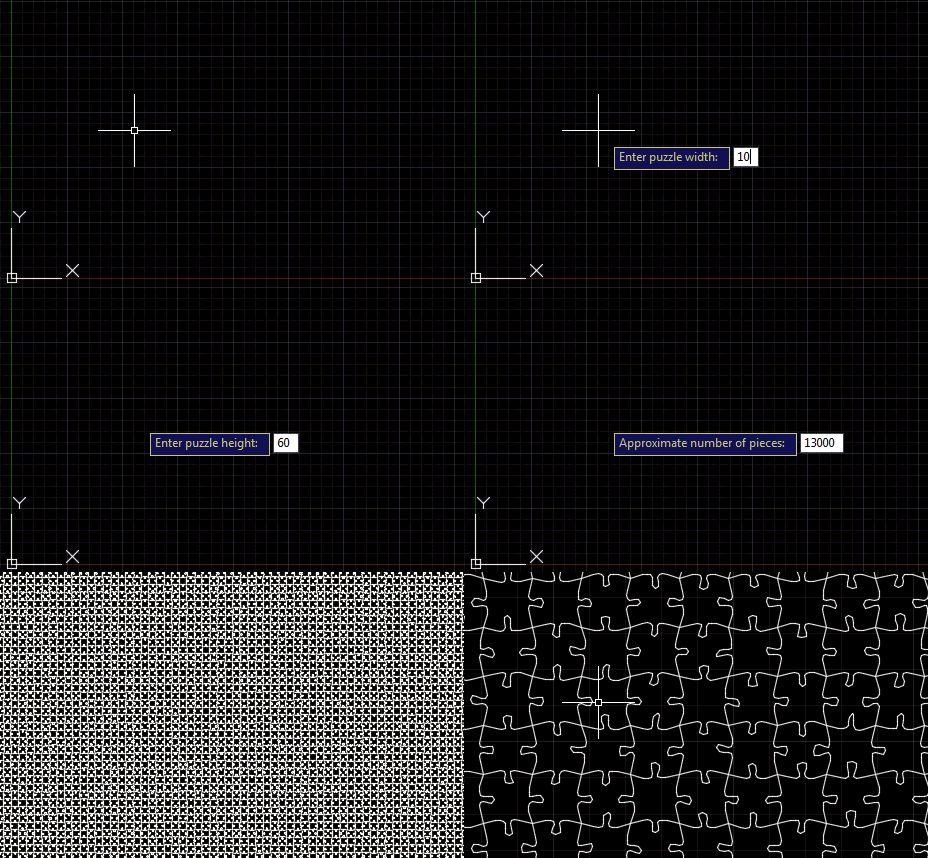
Following on from the last post, where we saw an outline for this series of posts on AutoCAD I/O, today's post adds a command to our jigsaw application that creates the geometry for a jigsaw puzzle of a specified size and with a specified number of pieces. As jigsaw puzzle pieces are largely quite square, it actually took me some time to get my head around the mathematics needed to calculate the number of pieces we need in each of the X and Y directions to make a puzzle of a certain size. And it's (with hindsight) obviously not possible…
-

The title of this post is probably a bit misleading: I'm not actually going to show how this works, today, but I do intend to plot a path for addressing this topic over the coming weeks. I was spurred on by a tweet I received a couple of hours ago: @keanw Dear kean, I've been looking into AutoCAD I/O and it looks like it may only execute "scripts"; so no .NET API calls or LISP? — Cyborg (@CyborgEvilHam) May 13, 2015 The short answer to this is "yes, it's absolutely possible!". But readers of this blog are clearly interested in…
-

A reminder that proposals are open for AU2015 until May 26th. I've just submitted two, myself. Of the three topics I had in mind – relating to VR, AutoCAD I/O and TypeScript – I decided to submit proposals on the first two: I'll do my best to use TypeScript for one or both of the other two (assuming they get accepted) which will at least give people some exposure to how the technology works. And give some good fodder for blog posts, of course. Here are the abstracts I submitted: Virtual Reality viewing of 3D models using Autodesk's View and…
-
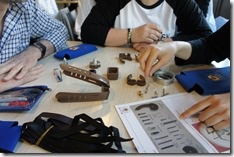
In the past I've mentioned the Autodesk Foundation and to some extent the focus Autodesk has on benefiting local communities. Today I was very happy to participate in a charitable teambuilding activity in the office: a group of volunteers spent a couple of hours building prosthetic hands for people in developing countries – very often children who have lost their hands due to landmines. The instructions were straightforward to follow: there were a few tricky parts, but we managed to work through them as a team. The resulting hands will be shipped back to Odyssey Teams in the US, from…
-
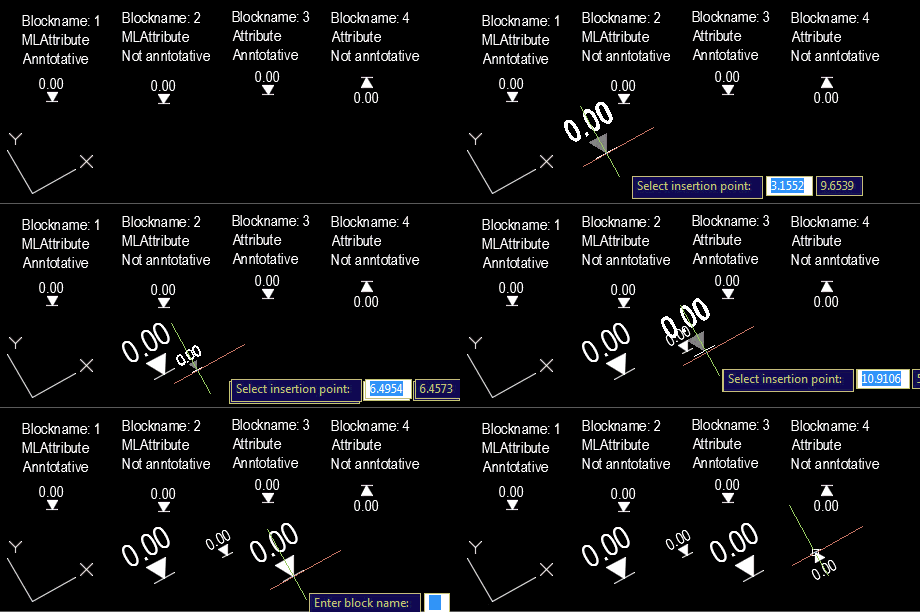
Our old friend Roland Feletic emailed me last week. He'd been having some trouble with this previous post when jigging blocks with multiline attributes. Roland had also identified some code in this post on another blog which worked properly for him. I spent some time looking into what was wrong with the original post. It certainly didn't deal with the appropriate placement of multiline text, and didn't take proper care of annotation scaling and UCS. Time for a do-over. 🙂 The following C# code is a combination of the code from the previous post and the approach spiderinnet1 took in…