Android
-
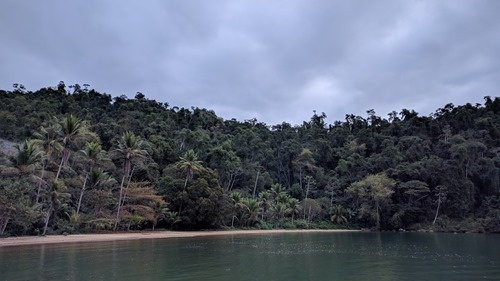
The weather wasn't great during our first few days in Paraty, but at least we were dry after the thorough soaking we received in Sao Paolo. We used the time to do a few "non-beach" tourist activities, such as renting a boat to take us around the coast, walking in the jungle and visiting a cachaça distillery. The old town of Paraty is really nice, too: The place we were staying in – the Resort Croce del Sud – was really special. It had been built by an Italian named Luca, who had previously built a boat he was living…
-
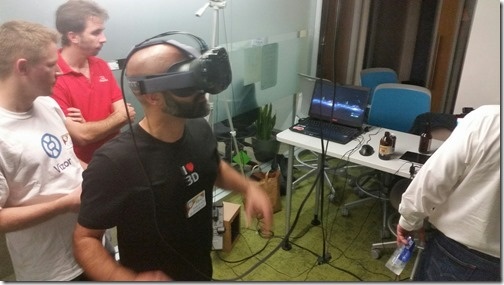
Last night, I left the (very fun) party at the X Summit a little early: partly because I knew I was presenting this morning and needed a clear head, but mainly to attend a WebVR meet-up being held at Mozilla. I'm rarely in the Bay Area and it seemed a shame to miss the opportunity to attend the event, especially as it was a chance to hang out with Jim Quanci and Goran Borjesson, a colleague visiting from Gothenberg. I'll describe my experiences of the evening's proceedings, but you can also watch the online recording. It was really an interesting…
-

I'm excited to announce the newest member of the Autodesk product portfolio, Autodesk SoCap. The term "SoCap" stands for "Software Capture", in much the same way as ReCap stands for "Reality Capture". SoCap is a tool that helps you capture existing software behaviour as code, just as ReCap helps you capture a 3D scene as a point cloud. For SoCap to do its thing, you point it at the piece of software whose behaviour you want to capture – whether desktop software on Windows/Linux/OS X, mobile software targeting iOS/Android* or the URL of a cloud-based app – and SoCap will…
-
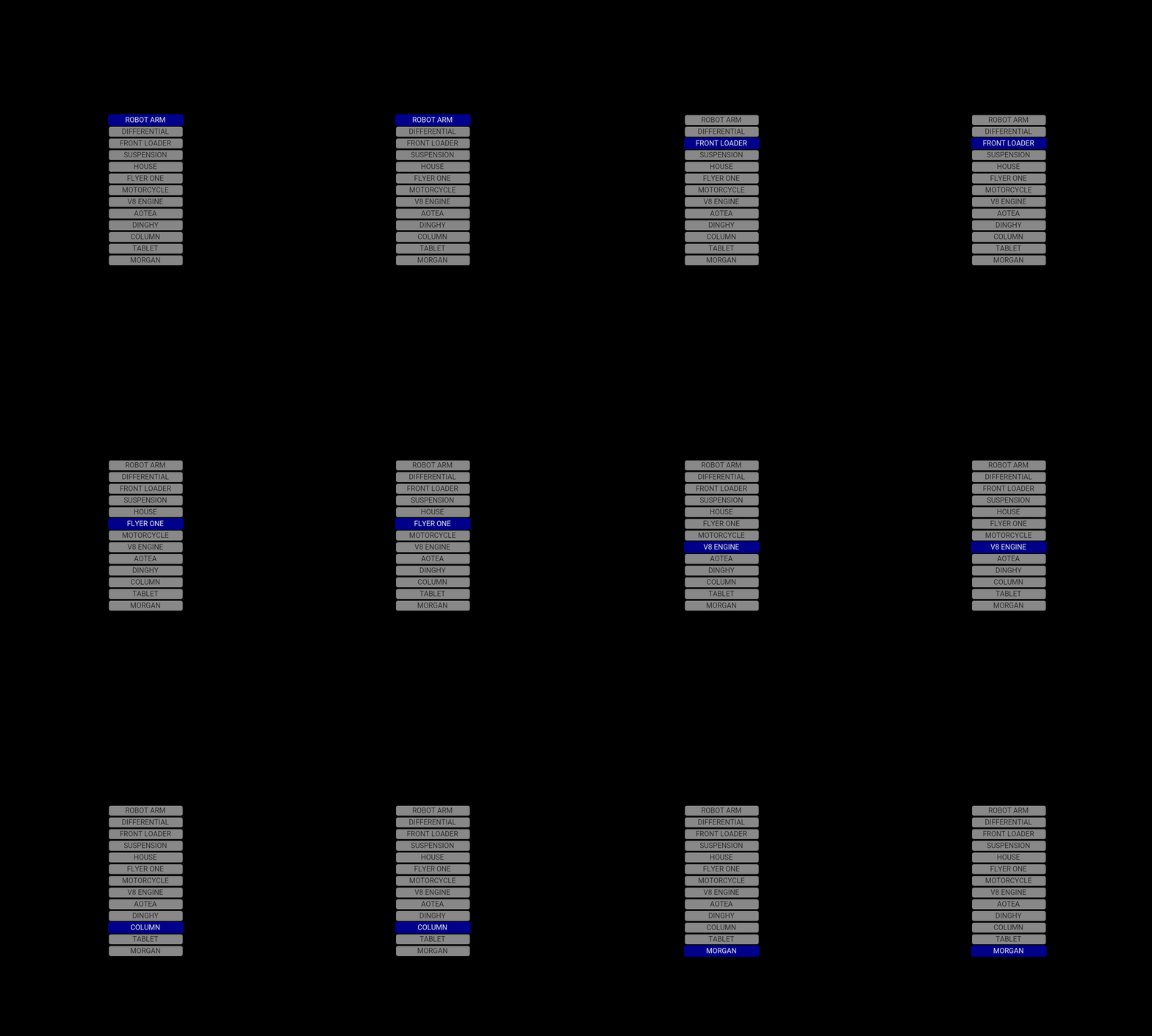
After building native Android apps for both Gear VR and Google Cardboard that embed our web-based VR samples using Autodesk's View & Data API, I really wanted to revisit the UI issue. After seeing the 3D UI capabilities of Gear VR – courtesy of the Oculus Mobile SDK – my own UI that I implemented in HTML felt, well, flat. The main problem seemed to be that it moved with your head, staying stuck to your view. It also suffered from the issue of visual degradation when the selection was away from the middle of the list. All in all…
-
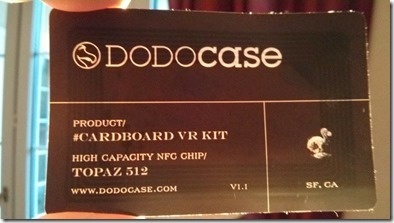
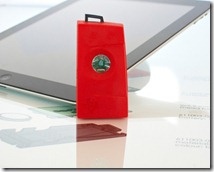
When I first got my Google Cardboard toolkit – in my case the DODOcase VR Toolkit V1 – I was fascinated by the NFC tag that came with it. I hadn't really played with NFC, prior to that, and only had a very vague idea of what it was about. It turns out that NFC is this important new(ish) technology that's enabling all kinds of local (hence "near-field") communications. Especially, it seems, in the area of mobile payments with technologies such as Apple Pay. Anyway, my first exposure to NFC was via this business card-sized sticker that came in the…
-
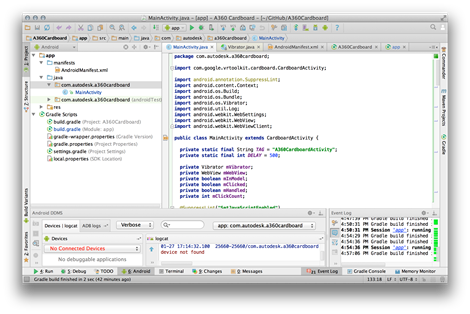
I mentioned this in last Friday's post: after building an Android app to bring our web-based VR samples to Gear VR, it made sense to do the same for Google Cardboard. It made sense for 3 reasons: Most importantly, I wanted to see what the additional capabilities of the Android SDK would bring to the web-based VR samples, particularly around the magnetic trigger button. Until the Note 4 gets its Lollipop update in "early 2015" – and WebViews support WebGL – there isn't much more to do with Gear VR. I've completed the plumbing but am waiting for the toilet…
-
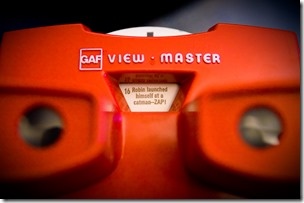
I've long been fascinated by stereoscopy, as I suspect is the case for most people lucky enough to have two functioning eyes. There's something magical about a device that immerses us in a three dimensional scene by hijacking that fundamental input mechanism of ours, binocular vision. I almost always get that "oh wow" feeling: it just never gets old. I also happen to like collecting cool bits of vintage technology, although in an admittedly haphazard and opportunistic way: I have printing blocks, a typewriter, a TI-57 programmable calculator, an Apple Newton, a Palm Pilot and an iPAQ, to name a…
-
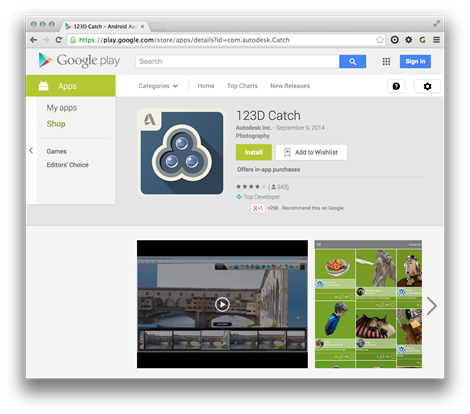
I was very happy to read the news on Shaan's blog: 123D Catch is now available on Android. I blogged about its availability via the web and on iOS, a couple of years ago, but there's now an Android version and it's pretty slick. Some quick background info: I do my best to stay OS agnostic, as a rule. My primary desktop OS is Windows (7 or 8.1, depending) but I also use OS X Mavericks and play with a few different Linux distributions when I get time. I have an old iPad 2 that has a cracked – but…
-
Over the last few days, I've been playing around with Texas Instruments' SensorTag device, working out how to connect it to AutoCAD and make use of the data coming in from it to manipulate the current view. As mentioned in this previous post, the SensorTag is a $25 device containing a number of sensors – an accelerometer, a gyroscope, a magnetometer, a thermometer, a hygrometer and a barometer – that communicates to a monitoring system (whether an iOS or Android mobile device or a Windows or Linux PC) via Bluetooth 4.0. So what is it I expected to do with…
-
This week has so far had an AU theme to it, just as last week we talked exclusively about Leap Motion and AutoCAD. Perhaps I'm sub-consciously shifting this blog to a weekly-themed format? Hmm. Like many of you, I'm sure, I received an email over the weekend to let me know that the recorded sessions from Autodesk University 2012 are now available online (for anyone with a valid AU online account). I wasn't sure which of my sessions had made it up there from this last year's event (thank goodness I rarely have to write cheques anymore), and so was…