Augmented Reality
-

I'm heading back across to the Bay Area on Wednesday for 10 days. There seems to be a pattern forming to my trips across: I'll spend the first few days in San Francisco – in this case attending internal strategy meetings in our 1 Market office – and then head up after the weekend to San Rafael to work with the members of the AutoCAD engineering team based up there. I'll still probably head back into SF for the odd day, the following week, but that's fine: I really like commuting by ferry from Larkspur to the Embarcadero. The weekend…
-
I've been sick in bed since returning from AU2013 – the fever I experienced on Thursday morning, before travelling home in the evening, was apparently due to bacterial bronchitis, and I've been coughing really badly over the last few days. At least the fever has passed, but I did have to cancel my plans to travel to the Munich DevDay. It would have just been too much for me to be on a series of trains for a total of 7 hours each way. Next year. Anyway, here's a quick post I've had sitting around that I've just augmented with…
-
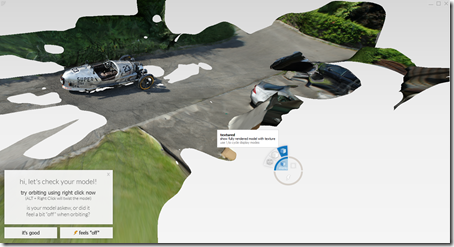
This morning I went back to look at Project Memento, with a view to using it to trim down a model I captured using ReCap Photo. I started with the model of the Morgan 3 Wheeler shown in this previous post. The first thing you'll notice when launching Project Memento is the modern, chrome-free user interface making copious use of marking menus. Navigation is fairly simple using a 3-button mouse. It was straightforward to select sections of the mesh and delete them: I repeated this – along with various zoom/pan/rotate operations to make different sections of the model visible for…
-
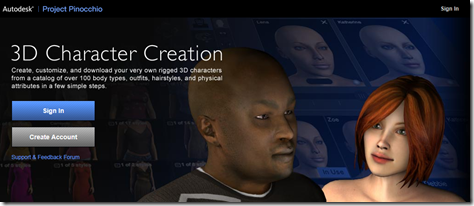
In this previous post, we looked at using PointCloud Browser to visualize an AR scene containing a mesh generated by 123D Creature, a new iPad app from Autodesk. In this post, we head on over to Autodesk Labs to take Project Pinocchio for a spin. Project Pinocchio is an online character generator that helps you "create, customize, and download your very own rigged 3D characters from a catalog of over 100 body types, outfits, hairstyles, and physical attributes in a few simple steps." Once you've signed in, it's a simple process to create a character. You start by choosing your…
-
A few weeks ago, we looked at using PointCloud Browser to visualize simple spherical primitives brought down from a web-service, as well as creating a simple AR game to obliterate them. Visualizing (and popping) spheres is all well and good, but clearly it'd ultimately be much more interesting to visualize more complex objects in an AR scene. The good news is that PointCloud Browser supports loading models from .OBJ files, a format generated by a number of Autodesk products – particularly those used in the Media & Entertainment space. I'm not a big user of 3ds Max or Maya, and…
-
Gamification is happening all over the place. In case you've missed what it's all about, this short video should help. To get even more background, here's another from the same source on augmented reality games, which is a follow-on from this video on alternate reality games. After having managed to get Apollonian Packings brought into the very cool PointCloud Browser, I thought it'd be fun to integrate some of the code from another of the PointCloud Browser sample apps, creating a little augmented reality game. Here's the basic idea: each level consists of a packing brought into PointCloud Browser from…
-
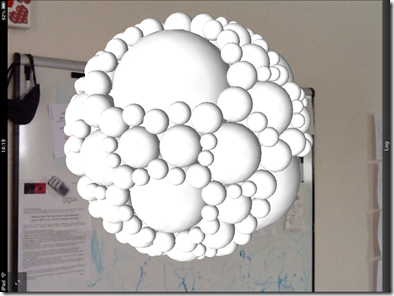
After my initial (only partially successful) attempt, earlier in the week, to get 3D geometry from the Apollonian web-service into a PointCloud Browser session, I finally managed to get it working properly. Given the currently fairly light documentation available – especially for the Viper JavaScript namespace which gives access to the 3D rendering capabilities in the browser – I ended up posting a question to the PointCloud forum. The answer was very instructive – I was able not only to get spheres of different radii displayed using the same mesh… … but also to apply different colours to the same…
-
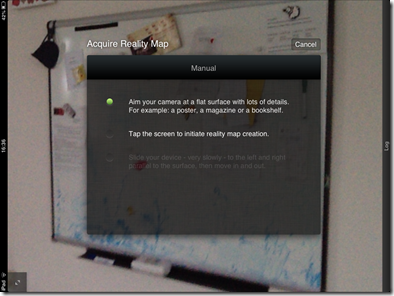
I first became aware of the work being done by 13th Lab a couple of years ago, but just last week someone pinged me about it again and re-triggered my interest (thanks, Jim :-). 13th Lab is a small Swedish company that has created some really interesting Augmented Reality technology. Many AR systems make use of fiduciary markers (which often look like sections of QR codes) to make it easier to determine where the 3D content should be positioned and visualized in the 2D image of the scene being fed from your device's camera. Ideally, though, you want a markerless…
-
As we reach the end of this long series of posts on moving code to the cloud – and a look at ways to use the functionality from a wide variety of applications, many of them on mobile devices – I felt it was worth putting together a quick summary post to reinforce the overall message (which may have been a bit lost in the sheer volume of information). Firstly, here are the posts in this series, including those looking at the original creation of the "desktop" application functionality: Creating the core desktop functionality Circle packing in AutoCAD: creating an…